

Check out our latest golf collection!
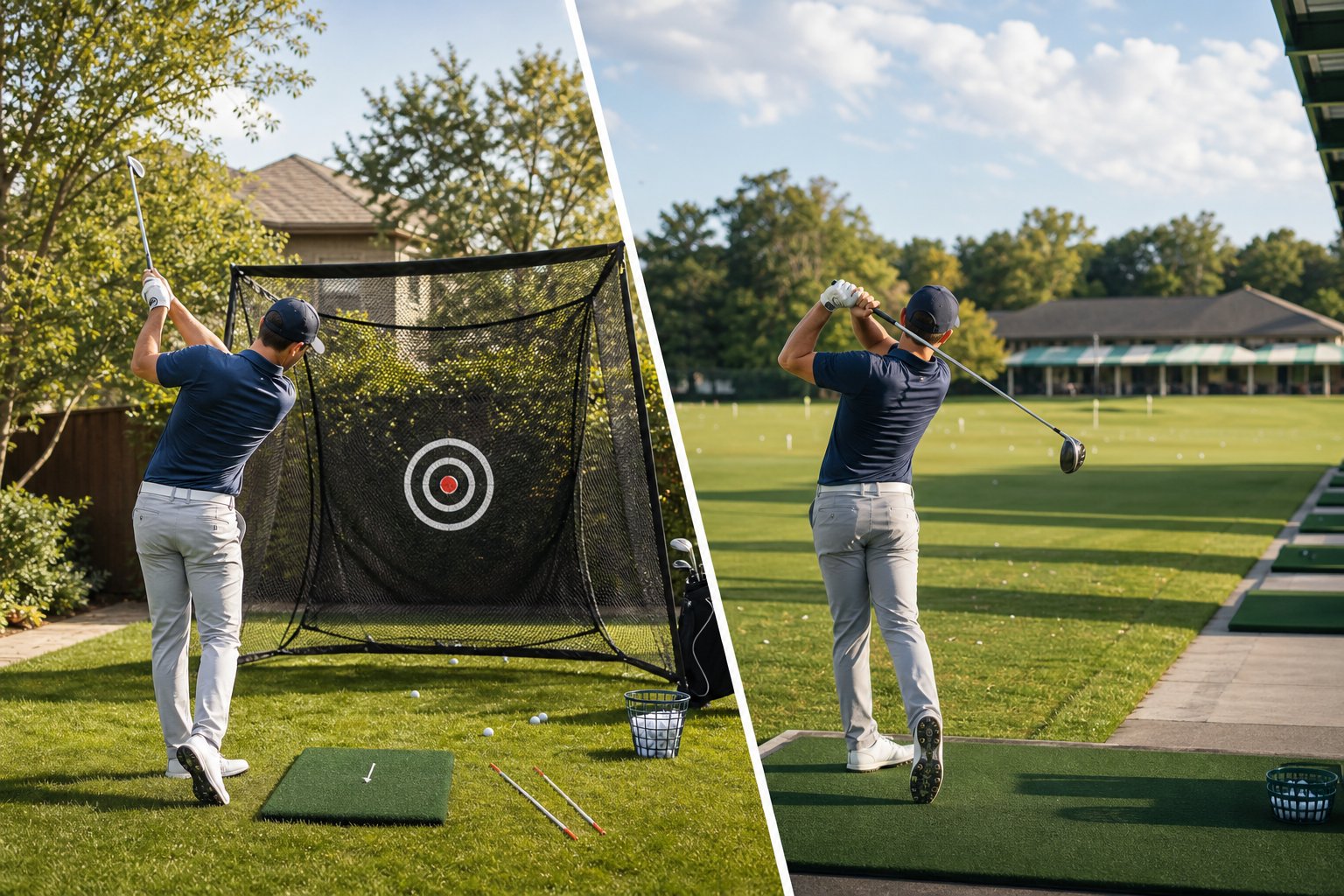
A golf practice net can make more sense than the driving range when you want convenient, low-pressure practice at home. The range, however, remains valuable when you need to see full ball flight or practise in a more open environment. Both can play a useful role in a well-rounded golf practice routine. The right choice depends on what you are trying to improve during each session.
If you are working on swing mechanics, focusing on tempo, or simply want to practise more often without travelling to a range, a net at home removes many of the barriers that can limit practice time. The range is useful when you need to see shot shape, estimate distances, or evaluate how a swing change affects ball flight. Using both environments can provide complementary forms of practice and feedback.
Below, we break down when at-home practice makes sense, what kind of feedback you can get from a golf practice net versus a driving range, and how to create a safer, more durable practice space. We will also cover useful net features to compare before you buy, so your setup suits your swing, available space, and practice goals.
Key Takeaways
- Match your practice environment to the specific skill you want to improve rather than relying on only one type of practice.
- A golf practice net is useful for repetition, contact, tempo, and swing mechanics, while additional feedback tools can help compensate for the lack of visible ball flight.
- A safe setup, clear practice goals, and a consistent routine can make at-home golf practice more productive.
The Quick Choice: Match the Practice Space to Your Goal
Golf practice nets are particularly useful for repetition, while driving ranges provide visible ball-flight feedback. Instead of treating them as competing options, consider choosing the environment that best supports the goal of each practice session.
Choose a Net for Frequent Swing Work
If you are trying to make a swing change, a golf practice net at home can be a practical option. Because you are not watching the full flight of every shot, you can place more attention on setup, tempo, balance, and specific swing movements.
Short, focused sessions can also make it easier to practise consistently. Repeating a movement regularly may help reinforce the swing pattern you are working on, particularly when the practice is deliberate and technically sound.
A home net also offers scheduling flexibility. There is no drive to the range, no need to purchase a bucket of balls, and fewer restrictions related to operating hours.
Choose the Range for Visible Shot Results
A net provides useful feedback on feel and contact, but it does not show the complete ball flight. Once a swing change begins to feel more consistent, the driving range can help you see how that change affects direction, trajectory, curvature, and distance.
Visible ball flight is especially useful when evaluating shot patterns or working on distance control. A compatible launch monitor can provide additional data, but the availability and accuracy of individual metrics vary by device and setup.
Consider using range sessions as checkpoints. After working on a movement at home, use the range to see whether it produces the intended result when the ball has room to travel.
Use Both to Build Skills That Transfer to the Course
The goal is not necessarily to choose one practice environment permanently. A balanced routine can use each environment for a different purpose.
- Net sessions for repetition, tempo, contact, and swing adjustments
- Range sessions for ball-flight checks, target practice, and distance work
- Skills games for practising decision-making, accuracy, and scoring-focused situations
Home practice can help develop a repeatable movement. The range can show how that movement affects ball flight, while skills-based practice can help connect technical work to the demands of playing golf.
What You Learn From Each Practice Environment
A golf practice net provides a controlled environment for repetition and contact work, while the driving range shows how the ball behaves after impact. Both can provide useful information, but they answer different practice questions.
Net Practice Builds Repetition and Ball Contact
A golf practice net makes it easy to hit multiple shots without collecting each ball between swings. That convenience is useful when you want to repeat a drill or focus on one mechanical change.
You can also learn a great deal from the quality of contact. The sound and feel of impact may help you identify centered strikes as well as thin, heavy, or off-center contact. Impact tape, clubface marking spray, or video can provide additional feedback when appropriate.
The limitation is that a net stops the ball before you can observe its complete flight. Contact may feel solid even when the resulting shot would not have travelled in the intended direction.
Range Sessions Reveal Distance and Shot Shape
The driving range allows you to observe trajectory, starting direction, and curvature. Patterns such as a recurring fade, draw, hook, or slice become much easier to identify when the ball has enough room to travel.
Range sessions can also help with distance control. Comparing how different clubs perform under similar conditions can give you a better understanding of your typical carry distances, although range-ball performance should not always be treated as identical to on-course performance.
This environment also helps connect swing changes with visible results. If a mechanical adjustment consistently produces a more desirable ball flight, you have stronger feedback than feel alone can provide.
Real Turf and Range Balls Change the Feedback
When a range offers natural grass, turf interaction can provide useful feedback about where the club contacts the ground relative to the ball. This can be particularly helpful when working on iron and wedge strikes.
Range balls can vary in construction, age, condition, and performance. Their flight and distance may differ from the golf balls you normally use on the course, so range distances are best treated as useful reference points rather than exact on-course yardages.
Even with those limitations, outdoor range practice provides environmental and ball-flight feedback that is difficult to reproduce with a basic net alone.
How to Get Useful Feedback When Hitting Into a Net
A golf practice net stops the ball quickly, so additional tools can help you understand what happened at impact. Depending on your goals, you can use technology, visual markers, or simple practice aids to evaluate strike quality and starting direction.
Add a Launch Monitor for Measurable Results
A launch monitor can add measurable feedback to a golf net setup. Depending on the model, it may provide information such as ball speed, club speed, launch angle, carry estimates, or spin-related data.
Some launch monitors also connect to software that displays a simulated ball flight. This can make net practice more informative by giving you additional context for each shot.
Before buying one, confirm that the device is designed for your available hitting distance and indoor or outdoor environment. Features and space requirements vary considerably between models.
Use Impact Feedback and Video Analysis
You do not need a launch monitor to make net practice more informative. Impact tape or a removable marking product designed for clubface feedback can help show where the ball is contacting the face.
A consistent cluster near the center of the clubface generally indicates more consistent contact. A scattered strike pattern can give you a clear area to investigate during practice.
Video can provide another useful perspective. Position a phone securely where it will not be struck by the club or ball, then record appropriate face-on or down-the-line angles. Reviewing posture, alignment, balance, and swing movement can reveal patterns that are difficult to detect by feel alone.
If you work with a golf instructor, video can also make it easier to share swings for professional feedback.
Set Targets to Check Start Direction
Because the ball reaches the net quickly, adding a visible target can help you practise aim and initial direction. A securely attached target area gives you a consistent reference point for each shot.
Alignment sticks or other floor markers can also help establish your target line and foot position. Make sure any practice aid is placed where it cannot interfere with your swing or create a tripping hazard.
This approach cannot replace watching the complete ball flight, but it can create a repeatable reference for alignment and starting direction.
Choosing a Safe and Durable At-Home Setup
Before taking full swings at home, make sure the available space, net, frame, hitting surface, and surrounding area are suitable for golf practice. The amount of clearance required depends on the golfer, club length, swing, and equipment being used.
Measure Space for Every Club and Follow-Through
Measure the practice area before choosing a golf net. A full driver swing generally requires more clearance than a short iron or wedge swing, and both overhead and side clearance are important.
Check the following before practising:
- Overhead clearance: enough unobstructed room for your tallest swing and longest club
- Side clearance: sufficient space to complete the swing without contacting walls, furniture, vehicles, or other objects
- Hitting distance: enough space between the golfer and net to meet the net manufacturer's setup instructions
- Surrounding buffer: additional protection for potential mishits or rebounds
- Flooring: a stable, non-slip hitting surface that remains secure throughout the swing
Garages, basements, and backyards may all work, but every location should be checked carefully for ceilings, fixtures, windows, shelves, vehicles, people, pets, and other hazards. Follow the clearance and setup instructions supplied with your specific practice equipment.
Select Durable Netting and a Stable Frame
A golf practice net should be specifically designed to handle golf-ball impacts at the type of swing speed you intend to use. Check the manufacturer's guidance rather than assuming that any general-purpose net is suitable for full swings.
The frame should remain stable during repeated impacts, and all connections should be assembled according to the manufacturer's instructions.
Before each session, check that:
- the frame and joints are securely assembled
- outdoor anchors or weights are installed when required
- the netting and seams show no significant wear, holes, or damage
- the net is positioned with the recommended clearance from walls and other objects
- the setup is approved for the type of ball and swing you plan to use
Regular inspections are important because repeated impacts and outdoor exposure can gradually affect netting and frame components.
Decide Between Real Golf Balls and Safer Practice Balls
Real golf balls are not appropriate for every home practice space. In tighter or less protected areas, foam or perforated plastic practice balls can reduce impact force while still allowing you to work on tempo and basic swing movements.
If you use real golf balls, make sure the net and surrounding protection are specifically designed for them. Real balls can provide more useful impact data when paired with compatible measurement equipment, but they also require a more robust safety setup.
A ball-return feature can also make repeated practice more convenient by reducing the need to collect balls between shots.
Golf Practice Net Features Worth Comparing
Golf practice nets vary in size, design, portability, stability, and ball-return features. Comparing these details can help you choose a setup that fits your available space and the way you plan to practise.
Size, Side Protection, and Target Design
Choose net dimensions based on your hitting distance, typical miss pattern, available space, and the clubs you intend to use. A larger capture area can provide additional protection, particularly when practising full swings.
Side protection can also be valuable because mishits do not always travel directly toward the center of the net. Some setups include side panels, while others allow additional protective netting to be added.
Target designs vary as well. Some nets include built-in target zones, while others use removable or hanging target sheets. Look for a design that remains secure during repeated impacts and does not create excessive rebound.
Portability Versus a Permanent Practice Area
If you need to store your equipment after each session, consider how easily the net can be assembled, folded, moved, and stored. A compact carrying case and straightforward setup can make a portable net easier to use regularly.
Frame construction can affect both weight and stability. Lightweight systems may be easier to move, while heavier setups may be better suited to a dedicated practice area. Always follow the manufacturer's instructions for anchoring and outdoor use, particularly in windy conditions.
If you have a permanent practice space, convenience may matter less than durability, stability, and the amount of protective coverage around the hitting area.
Ball Return Features That Keep Sessions Moving
A well-designed ball-return system can make longer practice sessions more efficient. Some nets use a sloped base or collection area that guides balls toward the golfer after impact.
More elaborate setups may use trays or other collection systems. These features can be convenient for frequent practice, although they may require additional space and setup.
For many golfers, a simple net that directs balls into an easy-to-reach collection area provides enough convenience without adding unnecessary complexity.
Build a Routine That Carries Over to the Course
A golf practice net and driving range can each contribute to better practice when they are used intentionally. Treating them as complementary environments can help you move from technical work to visible ball-flight feedback and, eventually, on-course performance.
Use Short Home Sessions for Technical Changes
Home net sessions are well suited to focused mechanical practice. Keeping sessions relatively short can help you maintain concentration and reduce the likelihood of continuing once fatigue begins to affect your movement.
Use these sessions for slow-motion swings, setup checks, grip work, tempo drills, or one clearly defined swing adjustment. Focusing on a limited objective makes it easier to evaluate whether the practice is productive.
Once the movement becomes more repeatable, test it in an environment where you can observe ball flight.
Make Range Practice More Game-Like
The driving range gives you access to visible targets, changing clubs, and full ball flight. Instead of repeatedly hitting the same club without a clear objective, structure the session so that it resembles decisions you make on the course.
For example:
- Switch clubs between shots rather than hitting the same club continuously
- Select a specific target before each shot
- Practise different trajectories or shot shapes when appropriate for your skill level
- Use range targets to represent fairways, greens, or approach shots
- Create accuracy games that reward successful shots rather than total balls hit
This approach can make range practice more purposeful and encourage you to reset your routine before each swing.
Confirm Your Progress During Real Rounds
The golf course ultimately provides the most complete test of whether a practice change is useful. On-course shots introduce changing lies, targets, weather, club selection, and scoring consequences that are difficult to reproduce in a practice environment.
During a round, pay attention to whether the movement or skill you practised remains reliable under different conditions. If it does not, use that information to guide your next home or range session rather than making several new changes at once.
Frequently Asked Questions
Is a golf practice net worth it for beginners and high-handicap golfers?
It can be. A golf practice net gives beginners a convenient way to work on setup, contact, tempo, and repetition at home. Because it does not show complete ball flight, pairing net practice with range sessions or instruction can provide more complete feedback.
How much space do I need to set up a golf practice net safely at home?
There is no universal minimum because the required space depends on your height, swing, club length, net design, and hitting position. Make a slow practice swing with your longest club, check clearance in every direction, and follow the net manufacturer's recommended distances and safety instructions before hitting balls.
Can practicing into a net improve my swing without seeing the ball flight?
Yes. Net practice can help with tempo, contact, setup, and specific swing movements. However, because you cannot see full ball flight, range sessions, video, coaching, or compatible measurement tools can provide additional feedback.
What are the ongoing costs of using a driving range compared with an at-home golf net?
Driving-range practice generally involves recurring fees for balls or access, along with possible travel costs. A home net requires a larger upfront equipment purchase and may eventually need maintenance or replacement parts. The better value depends on how often you practise and the type of setup you choose.
Should I use a launch monitor with a golf practice net for more useful feedback?
A launch monitor can make net practice more informative by providing measurable shot data. It is not essential for useful practice, but it can help golfers who want to track specific performance metrics. Confirm that the device is compatible with your available space and practice environment.
When is the driving range a better choice than practicing with a net at home?
The driving range is the better choice when you need to observe complete ball flight, work on distance control, evaluate shot shape, or practise toward longer targets. It is also useful for confirming whether technical changes made during net practice produce the intended results.
A golf practice net and driving range do not have to compete for a place in your routine. Use the net when convenient repetition and focused swing work are the priority, then use the range and real rounds to evaluate how those changes affect ball flight and performance.
Share:
How to Clean a Compartment Snack Box and Insulated Carry Bag After Daily Use
How to Use a Golf Hitting Mat to Practice Low-Point Control and Cleaner Ball Contact