

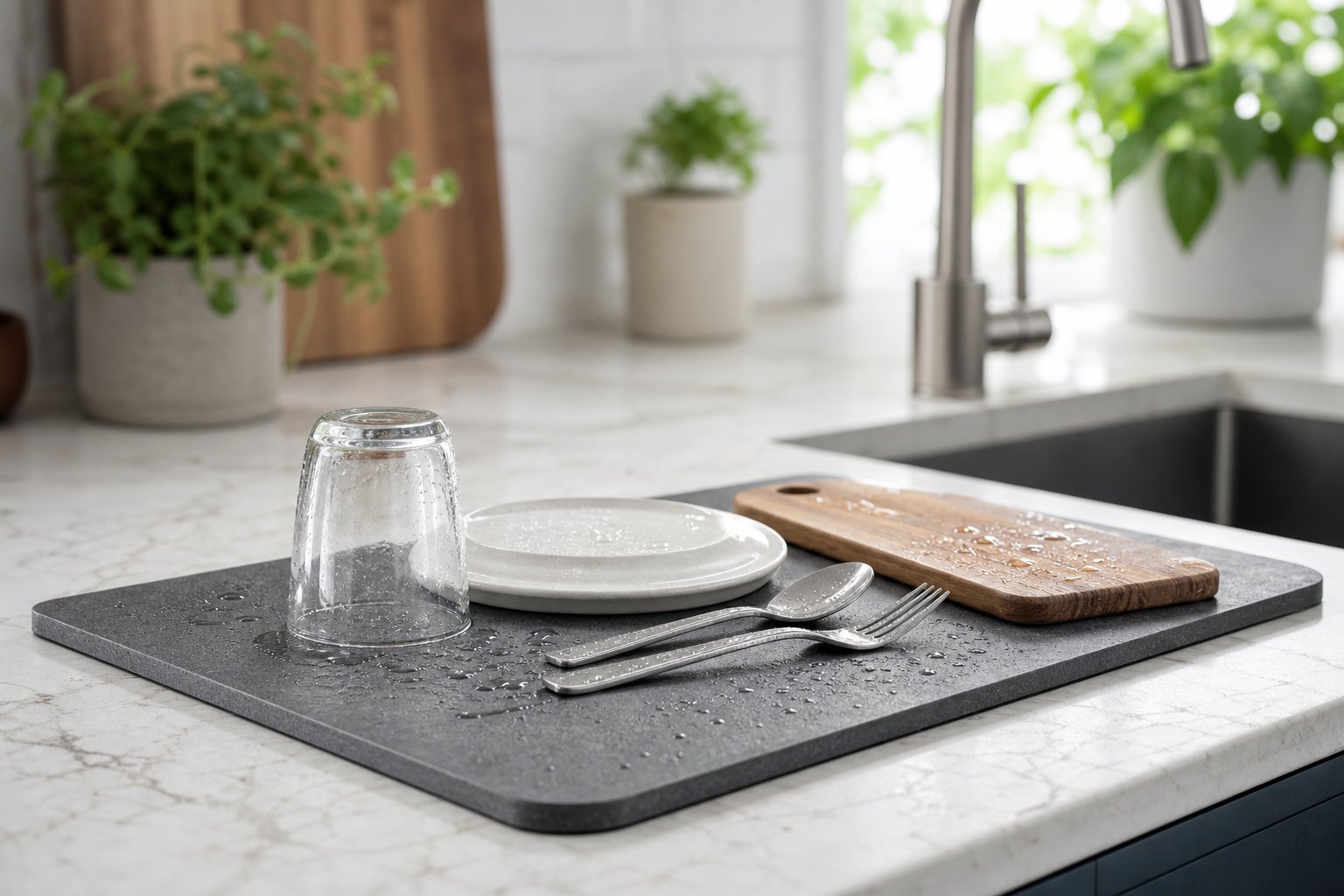
Check out our latest drying mats collection!
Water rings, soggy towels, and musty dish mats can make a clean kitchen feel messy. Stone drying mats offer a slim, fast-drying alternative made from porous diatomaceous earth. The material draws water into microscopic channels, spreads the moisture across a large internal surface, and releases it through evaporation, helping dishes and countertops dry faster.
These mats work well for dishes, glassware, utensils, bottles, and small appliances that drip. Their rigid surface needs simple care, and hot, greasy, or very heavy items require extra caution.
This guide explains how stone drying mats absorb water, where to use them, what items are safe, and how to clean and protect the mat for long-lasting performance.
Key Takeaways
- Stone drying mats soak up water instantly through microscopic pores in diatomaceous earth, evaporating moisture within seconds
- They’re best for dishes, glassware, utensils, and kitchen tools. Skip heavy cookware that might crack the surface
- These mats need almost no maintenance and naturally resist bacteria, so you can skip the constant washing that fabric mats require
What Makes Stone Drying Mats Unique?
Stone drying mats use diatomaceous earth to soak up water through millions of microscopic pores. That lets them dry dishes, utensils, and other wet items in minutes, without musty smells or endless laundry like fabric mats require.
Composition and Material Science
Manufacturers make stone drying mats mainly from diatomaceous earth, which is a sedimentary rock formed from fossilized algae called diatoms. They compress the material and shape it into a solid mat, sometimes adding a bit of natural binder to keep things together.
You end up with a rigid, smooth surface that’s full of invisible channels. These little tunnels pull moisture from whatever you set down, spreading the water throughout the mat instead of letting it puddle up.
Unlike silicone or fabric mats, stone mats don’t bother with extra layers or fancy coatings. The raw material does all the heavy lifting.
Diatomaceous Earth Explained
Diatomaceous earth is made up of fossilized organisms with incredibly detailed, hole-filled shells. When you press these organisms into a mat, those holes stick around, creating a network of air pockets inside the material.
That structure gives the mat two big advantages. First, there’s a large amount of surface area, far more than you would expect from something that size, so it can soak up a surprising amount of water. Second, all those pores let air flow through, which helps water evaporate fast.
The same stuff that makes diatomaceous earth useful for industrial filters and absorbents turns out to be perfect for a kitchen drying mat.
How Absorbency Sets It Apart
A good stone drying mat pulls up water almost instantly, drawing moisture off dishes the second you put them down. The mat itself usually dries out in an hour or two, depending on how humid it is and how much water it’s taken in.
That’s a huge difference from fabric mats, which just sit there wet for hours and start to stink if you don’t wash them. Stone mats don’t hold onto moisture, so bacteria don’t get a chance to grow, and you don’t have to keep washing them.
Just wipe the mat down now and then and let it air out. No laundry cycles, no fuss with fabric softener, no waiting for it to dry.
The Science Behind Quick-Dry Technology
Stone drying mats use diatomaceous earth, a super-porous rock, to draw water through thousands of tiny channels and let it evaporate into the air in just minutes. This material mixes physical absorption with fast evaporation, keeping your counters dry and free from the dampness and odors that come with fabric mats.
Microporous Structure and Capillary Action
Diatomaceous earth packs millions of tiny pores into every square inch, creating instant pathways for water to travel through the mat. Set a wet dish or glass down, and those channels pull the moisture in before it can pool up.
Inside, the mat works kind of like a sponge, except it doesn’t trap water in fibers. Instead, it spreads the liquid out over a huge internal surface area. That’s why the mat stays dry to the touch, even when it’s busy soaking up drips.
Fabric mats get soggy and stay that way, but stone mats never really feel wet because water moves through them so efficiently. They can handle a stack of dishes without losing their absorbency.
Rapid Evaporation Process
Once the water’s inside the mat, air moves through those pores and helps it evaporate from within. The same channels that pull in moisture also let air work its magic, turning water into vapor and sending it off in under a minute, or a few minutes if it is very damp.
If you put the mat on a rack or something that lets air reach the bottom, it dries even faster. Temperature and humidity make a difference, sure, but stone mats always beat fabric ones, which just trap water for hours.
That quick drying means you don’t get the lingering dampness that bacteria love. Water just doesn’t stick around long enough to cause trouble.
Antibacterial and Odour-Resistant Qualities
Since the mat dries so fast, bacteria barely get a chance to settle in. Microbes need steady moisture to thrive, and stone mats dry out before they can really get going.
Plus, diatomaceous earth itself isn’t a great place for mold or mildew. There’s nothing for them to eat, unlike fabric mats that start to smell musty after a couple of days.
Stone mats need a lot less upkeep than fabric ones. You don’t have to keep washing them to keep smells away, and you won’t get that gross, mildewy odor that means bacteria have moved in.
Everyday Uses in Canadian Kitchens
Stone drying mats are perfect for handling wet dishes, glassware, and all those little kitchen tools. They soak up moisture right away, so you don’t end up with puddles on your countertop. They slide easily into the same spots where you used to keep fabric mats, or anywhere you’ve battled standing water.
Replacing Fabric Dish Mats
Honestly, fabric dish mats just create more work. They stay damp, start to smell after a few uses, and you’re constantly tossing them in the wash to keep them from getting nasty.
With a stone drying mat, water disappears in seconds and the mat dries out in minutes. Go ahead and put down wet mugs, rinsed veggies, or water bottles without soggy fabric or bacteria hiding underneath.
Cleaning is simple: wipe it down with a damp cloth, and it’s good to go almost right away.
In Canada, where humidity swings all over the place, the fast-drying stone mat keeps mildew away, even in summer or stuffy kitchens. The surface doesn’t soak up odors or stains from coffee, tea, or whatever else you’re working with.
Under Dish Racks and Small Appliances
If you stick a stone mat under your dish rack, it catches drips that would otherwise pool on the counter or collect in a tray you’d have to empty. The stone just absorbs the runoff, so you’re not mopping up water all day.
We also like using these mats under coffee makers, kettles, and any small appliances that tend to sweat or spill a bit. The mat protects your counter from water rings and heat, keeping everything tidy.
This setup is a lifesaver in small kitchens where you can’t spare extra space. The mat sits flat, doesn’t slide around, and handles both appliance drips and hand-washed items without a fuss.
Minimizing Countertop Moisture
Standing water can ruin countertops, especially around sinks. Laminate can swell, wood finishes can peel, and the result is a mess. A stone mat soaks up splashes before they spread, so you don’t have to keep wiping down the counter or worry about water sneaking into seams.
We keep mats right next to the sink to catch everything from veggie rinses to hand-washing splashes. The mat grabs the droplets before they go anywhere.
In the winter, when the air inside gets super dry, the mat keeps working without becoming brittle or losing its absorbency. Some silicone or plastic mats might crack in those conditions, but stone mats hold up well.
Ideal Items to Dry on Stone Mats
Stone drying mats handle most kitchen gear really well, from heavy pots to delicate glasses. The surface soaks up water fast and gives you a stable, non-slip spot that won’t scratch your dishes.
Cookware and Bakeware
Heavy pots and pans? No problem. Stainless steel, enameled cast iron, and non-stick cookware all dry faster on stone because the mat pulls water away from the bottom instead of letting it sit.
If you’ve got baking sheets or roasting pans, just make sure you’ve got a mat big enough (15 inches or more is usually plenty). The stone doesn’t flex or slide around, which is a big plus if you’re setting down something hefty like a Dutch oven.
Just a heads-up: always let cast iron cool before putting it on the mat. A hot pan can crack the diatomaceous earth, and that’s not a fun lesson to learn the hard way.
Glassware and Utensils
Wine glasses and tumblers dry without those annoying water spots because the stone pulls moisture right from the base. We usually put glasses upside down, and the mat wicks away the last drops.
Cutlery spreads out nicely on the flat surface. Forks, knives, and spoons air-dry in about 10 minutes, and you’re not digging them out of a crowded rack.
Wooden utensils and cutting boards also benefit from the quick drying, since too much moisture can warp wood. Just don’t set them down dripping wet, or you might overwhelm the mat.
Reusable Water Bottles and Food Containers
Drying water bottles with narrow openings is usually a pain. We flip them over on the stone mat, and the inside dries out without that stale smell you get from fabric mats.
Plastic and glass containers dry lid-side down without leaving behind that cloudy residue you sometimes see on silicone trays. If you’ve got the space, you can dry both the container and lid at once.
Sippy cups, travel mugs, and insulated tumblers with lots of parts all fit on the mat. The stone’s antibacterial properties mean you’re not creating a germy zone while things air-dry.
Safety Tips and Best Practices
Stone drying mats are tough and easy to care for, but a few simple habits will help them last longer. Knowing what’s safe to put on them, how to handle heavier stuff, and how to clean them properly makes a difference.
What Not to Place on Your Stone Drying Mat
Skip putting raw meat, poultry, or fish on your stone mat. Those can leave bacteria that sink into the pores, and it’s tough to get them truly clean after that.
Don’t put hot pots or pans straight from the stove on the mat. The sudden heat can crack the material, especially if the mat is cool or a bit damp.
Be careful with sharp or pointy things. The stone is sturdy, but knife tips or metal edges can chip or scratch it over time.
Keep these off your mat:
- Raw proteins and their juices
- Hot cookware above 60°C
- Items with food dye that might stain
- Oily residue that clogs pores
Heavy or Fragile Items Considerations
You can dry cast iron and heavy ceramic dishes on a stone mat, but set them down gently. Dropping heavy stuff can crack both your dish and the mat.
Fragile glassware and fine china do well on the mat, since it’s a bit softer than a bare counter. Still, it is firm stone. If something tips over, the mat will not stop it from breaking.
Don’t stack heavy items on top of each other. Spread them out across the mat instead, especially if you’re drying anything that weighs more than a couple of kilos.
Cleaning and Preventing Damage
Keeping your stone drying mat in good shape really just comes down to regular, simple care. We usually wipe ours down each day with a damp cloth to clear away any surface gunk before it dries and clogs up the pores.
When it needs a deeper clean, we grab a soft brush or sponge, add a little mild dish soap, and use warm water. Scrub in gentle circles, rinse it off, and stand the mat upright or at an angle to air dry.
If you notice the mat isn’t soaking up water as quickly, chances are the pores have gotten clogged. You can just sand the top layer lightly with fine-grit sandpaper (220-400 grit) and it’ll bounce back. This only takes a few minutes and honestly, it can make your mat last years longer.
Weekly care routine:
- Rinse with warm water
- Scrub with a soft brush if it needs it
- Let it air dry standing upright
- Check how fast it absorbs water about once a month
Don’t toss your stone drying mat in the dishwasher. The intense heat and harsh detergents will mess with the stone and wreck its ability to wick moisture.
Beyond the Kitchen: Versatile Options
Stone drying mats work just as well on bathroom counters, laundry surfaces, and in entryways as they do next to the sink. We’ve tried them in just about every room where wet stuff needs a quick place to dry, and they tackle water puddles with no fuss.
Bathroom and Laundry Room Uses
We like to put stone drying mats under toothbrush holders, soap dispensers, and hand soap bottles to keep the bathroom counter dry and free of those annoying water rings. The mat’s porous surface pulls moisture away from the base of each item, so you don’t get that sticky film that builds up on tile or laminate.
After a shower, a stone drying mat works as a compact foot pad for stepping out of the tub. It soaks up drips a lot faster than a cotton bath mat and dries between uses without staying damp. We also toss one on the laundry counter to catch water from hand-washed clothes or freshly rinsed spray bottles.
Since the mat stays flat (unlike fabric), you can stash it on narrow shelves or in a linen closet when you’re not using it. After heavy use, just rinse it, wipe it down, and let it air dry before putting it away.
Pet Bowls and Entryway Solutions
We use stone drying mats under pet water bowls to catch spills and splashes, so there are no more soggy towels. The mat soaks up overflow quickly, keeps the floors cleaner, and you can rinse and wipe it down whenever you need.
In the entryway, a stone drying mat grabs moisture from wet shoes, umbrellas, or water bottles brought in from the car. It handles light moisture easily, though if you’re dealing with heavy snow or mud, you might want a bigger rubber tray. The mat’s flat profile lets you tuck it under a console table or by the coat rack without adding any bulk.
For key trays or mail sorters near the door, a small stone mat keeps condensation from cold keychains or damp mail from marking up your wood surfaces.
Frequently Asked Questions
Stone drying mats absorb water through microscopic pores and release it through evaporation. They are suitable for most cooled, clean dishware and need simple rinsing, thorough air drying, and occasional light sanding.
What's happening inside a stone drying mat that makes it dry dishes so quickly?
Diatomaceous earth contains microscopic pores that draw water inward through capillary action. The moisture spreads across the mat's internal surface, then evaporates as air moves around the mat.
How long does a stone drying mat typically take to dry after you've used it?
Surface moisture often disappears within several minutes, while the mat may need one to three hours to dry fully. Humidity, airflow, and the amount of water affect timing. Stand it upright after use to speed drying.
What items are safe to place on a stone drying mat, like glassware, knives, cast iron, or nonstick pans?
Use it for glassware, ceramic dishes, utensils, cooled cookware, nonstick pans, and cast iron at room temperature. Avoid hot cookware, raw food, greasy items, and sharp impacts that may stain, clog, chip, or crack the mat.
Will a stone drying mat scratch delicate dishes, wine glasses, or countertop surfaces?
The smooth surface is generally safe for dishes and glassware. However, grit trapped underneath may mark softer counters. Lift the mat instead of dragging it, and keep both the mat and countertop clean.
How do you clean and maintain a stone drying mat so it stays absorbent and doesn't get funky?
Rinse the mat with water and wipe or gently scrub it with a soft sponge. Let it dry upright. Avoid dishwashers, harsh cleaners, and soaking. If absorption slows, lightly sand the dry surface with fine-grit sandpaper.
Where should you not use a stone drying mat, like under hot cookware, oily items, or in tight small-space setups?
Do not use it under hot cookware, raw meat, oily items, or outdoors in freezing conditions. Avoid tightly enclosed setups that block airflow. If it stays beneath a dish rack, remove it regularly for cleaning and complete drying.
Share:
How to Organize Low Pantry Cabinets With Stack-Friendly Square Glass Jars
How to Set Up a Coffee Station With a Stone Drying Mat for Mugs and Brewing Tools