

Check out our latest home & kitchen collection!
A messy spice drawer can turn dinner into a scavenger hunt. You dig through lookalike jars, squint at worn-out labels, and somehow always grab cinnamon when you’re after cumin. It’s annoying, slows you down, and makes you wonder why you have three containers of oregano in the first place.
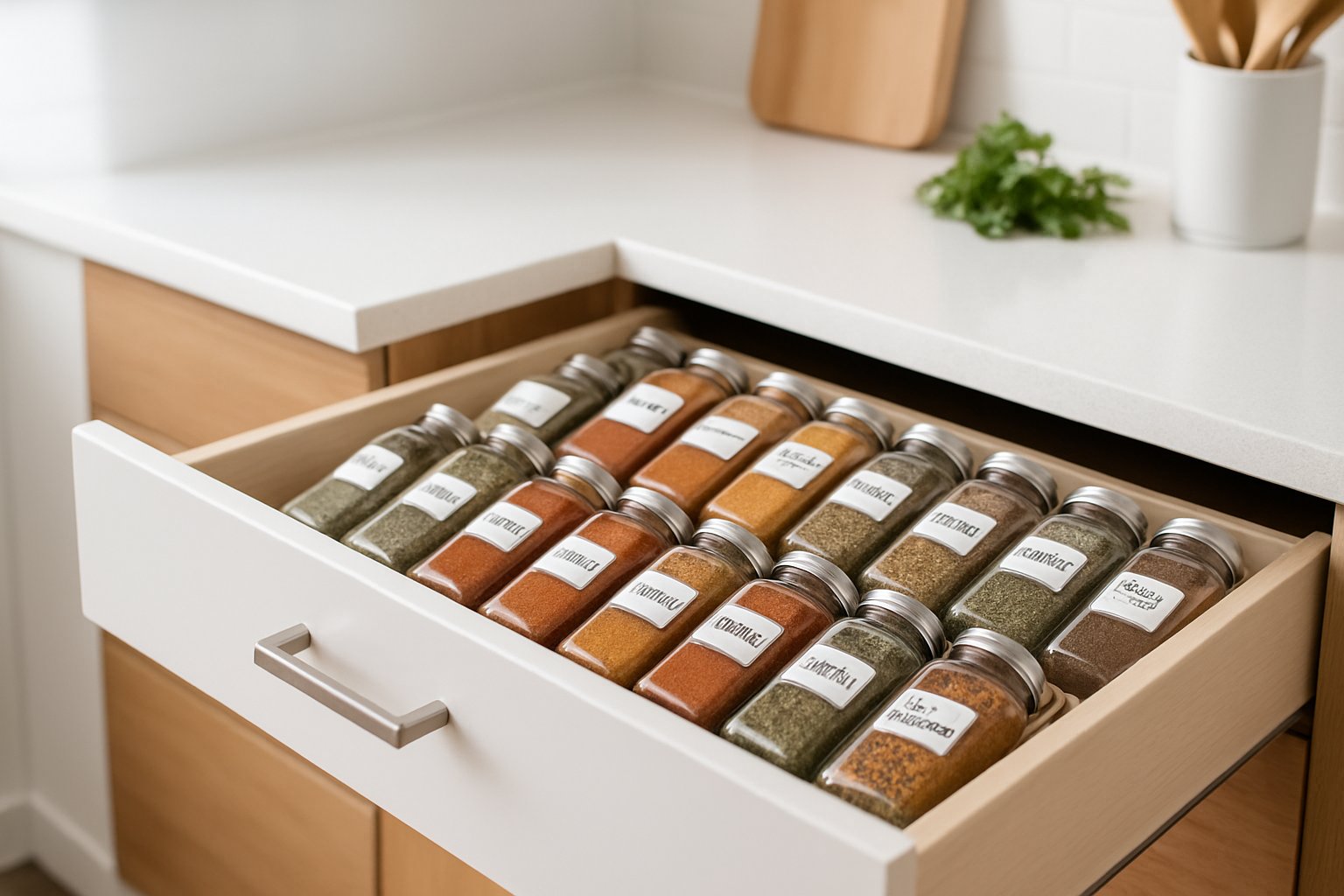
Honestly, the trick to an accessible spice drawer is pretty simple: use matching containers with clear top labels and some kind of tiered insert or divider.
When every jar has its own spot and you can see what you’ve got without shuffling everything around, cooking feels easier, maybe even fun. Here’s how to set up a system that actually works in a real home, not just for a magazine shoot.
If you’re dealing with a skinny drawer by the stove or a deep one that’s basically a spice pit, the right setup makes all the difference.
Let’s talk about picking containers, figuring out a layout, and keeping things organized for the long haul.
Key Takeaways
- Use matching containers with top labels and tiered inserts so you can see everything—no more digging
- Put your go-to spices up front, and stash the weird or special stuff toward the back
- Audit for expired spices once in a while and keep your containers the same size and style
Why a Well-Organized Spice Drawer Matters
A neat spice drawer changes the way you cook. No more hunting for ingredients or breaking your rhythm mid-recipe. When you know where each spice lives, you just grab and go.
Benefits for Cooking and Meal Prep
Getting your spice drawer in shape really does change things. You see all your options and might even get inspired to try new flavors. Plus, you stop buying another cumin just because you couldn’t find the one you already have.
You save time, too. Instead of pulling out every bottle to find paprika, you spot it instantly. This is a lifesaver on busy nights.
Fresh spices mean better food. Sorting your drawer usually means checking for expired stuff and tossing what’s old. You’ll actually use your spices before they go bland, and you won’t end up wasting money on things that just sit there.
Meal prep gets smoother when everything’s within reach. No need to interrupt yourself searching for that elusive bay leaf. You just keep cooking.
Improved Kitchen Workflow
Having ingredients at your fingertips is huge for kitchen flow. A cluttered spice drawer makes you stop, dig, and lose momentum. An organized one keeps things moving.
You can free up counter space, too. When spices have a home in the drawer, you don’t need racks or spinning trays on the counter. More room to prep, less clutter.
Honestly, it’s just less stressful. You stop worrying about where the cinnamon went or if you’re out of oregano. Cooking feels lighter, less like a chore.
Storing spices in a drawer protects them from heat and sunlight better than leaving them out. That means they last longer and taste better—no more sad, flavorless herbs.
Choosing the Best Spice Drawer Location
Where you put your spice drawer matters more than you’d think. Quick access is key, but you also want to think about the size and shape of the drawer itself.
Proximity to Cooking Area
Keep your spice drawer close to where you cook—within arm’s reach of the stove or main prep spot. Studies have shown drawers at waist or chest level cut down search time a ton compared to high cabinets.
Ideally, you want the drawer about a foot or so from your cooktop. That’s close enough to grab what you need, but not so close that heat will ruin your spices.
Don’t put the drawer right under the stove. Heat rises and gets trapped there, which kills spice shelf life. Pick a drawer next to your main cooking area or near where you season food before it hits the pan.
Drawer Size and Depth Considerations
Most kitchen drawers are between 14 and 24 inches deep. Shallow drawers (14-16 inches) work best for single-layer storage with vertical dividers, while deeper ones (18-22 inches) can handle tiered setups.
Make sure you’ve got at least 5.5 inches of vertical space for standard spice jars plus their labels. Most jars are 3.5 to 5 inches tall. Less space just makes things awkward.
Width counts, too. A 24-inch drawer fits 20-30 standard jars with enough room to grab one without knocking over the rest. Give yourself 1.5-2 inches between bottles.
If your drawer’s narrow (like 12-15 inches), just pick your top 10-12 spices instead of cramming everything in. A smaller, well-organized drawer beats a jam-packed mess any day.
Prepping Your Spice Collection
Before you start organizing, you’ve got to know what you’re dealing with. This is the part where you get real about what you actually use and toss what’s just taking up space.
Decluttering and Taking Inventory
Take everything out. Seriously, every single jar. Check expiration dates. Ground spices lose their punch after 2-3 years, while whole spices last up to 4 if you store them right.
If a spice doesn’t smell like anything, it’s done—even if the date says otherwise. Toss duplicates, too. No one needs three bottles of cinnamon.
Once you’ve weeded out the old stuff, count up what you have left. Write down each spice you’re keeping. That way, if you want to switch to matching containers, you know exactly how many you need.
Sorting Spices by Use and Type
Now, group your spices in a way that makes sense for how you cook. Baking spices—cinnamon, nutmeg, ginger—go together. Savory stuff like cumin, paprika, oregano? Another group.
Put your everyday essentials in one pile and the “use once in a blue moon” stuff in another. The ones you reach for all the time should be front and center.
If you cook a lot of different cuisines, try sorting by type—like Italian, Indian, or baking. Grouping by category makes it easier to find what you need when you’re in the zone.
Selecting Spice Containers and Drawer Organizers
Good containers and organizers turn chaos into order. Uniform jars fit better, and the right organizer keeps everything in place and visible.
Types of Spice Containers and Bottles
Square or rectangular containers make the best use of drawer space. They fit snugly, so you don’t waste room.
Glass jars are great because you can see what’s inside, and they don’t pick up smells. Plastic is lighter and less likely to break if you drop one. Most spice jars come in 4- or 6-ounce sizes, which is plenty for home cooks.
Pick containers with labels on the lid, not the side. Since you’re looking down into the drawer, top labels just make sense. Some brands include dual labels for both views.
Shaker tops and pour spouts are handy, but double-check your drawer’s height first. Most standard drawers fit jars up to 2.5 inches tall.
Drawer Organizer Solutions
Tiered racks let you see all your spices at once. They come in bamboo, wood, or plastic and fit most standard drawers.
Expandable organizers are nice for odd-sized drawers. They usually have 2-3 angled tiers so you can read every label without moving jars.
If your drawer is shallow, flat tray organizers work. They stop jars from sliding, though you won’t see everything as easily.
A few things to keep in mind:
- Material: Bamboo handles moisture, plastic’s easy to clean
- Tier angle: 15-30 degrees is perfect for reading labels
- Fit: Measure your drawer’s depth and width before you buy anything
Using Adjustable Dividers for Customization
Adjustable dividers help you make custom sections for different sizes or spice types. Spring-loaded ones are easy to install and keep everything in place.
You can separate daily-use spices from the oddballs or group by cuisine. Dividers stop jars from shifting around when you open and close the drawer.
Honeycomb dividers are extra flexible and can hold all sorts of bottle shapes in one space.
You can use dividers with tiered organizers, too. Put your favorites up front with a divider, and stash backups or less-used spices in the back.
Organization Methods for Maximum Accessibility
How you arrange your spices can make or break your cooking flow. A little strategy up front saves you time and frustration later.
Arranging by Frequency of Use
Put your most-used spices front and center. Salt, black pepper, garlic powder—whatever you reach for constantly—should be easiest to grab. Less-used stuff (cardamom, fenugreek, etc.) can hang out in the back or off to the side.
This setup works great with tiered organizers. The front row is your main zone, and specialty spices go on higher tiers. If your cooking habits change, just swap things around—suddenly obsessed with Thai food? Move the lemongrass and fish sauce up front.
Honestly, frequency-based organization just fits real life. If you use cinnamon every morning, it deserves a prime spot, alphabetical order be damned.
Alphabetical and Categorical Systems
Alphabetical order is great if you have matching jars with clear top labels. You can scan from allspice to turmeric without overthinking. No decisions, just follow the alphabet.
Grouping by category works if you cook by cuisine or flavor. Maybe you have an Italian section (basil, oregano, rosemary), an Indian section (cumin, coriander, turmeric), and a baking section (cinnamon, nutmeg, vanilla). Adjustable dividers help keep these groups tidy.
Both systems have their perks. Alphabetical is best for big, varied collections. Categorical shines if you cook the same types of food often. Some folks even combine both—alphabetize within each category.
Labeling for Easy Identification
Top labels are a must for drawer storage. You want to spot what you need without lifting jars or craning your neck. A label maker keeps things neat, but hand-written labels work if you’re not picky.
Add the purchase date to each label. Ground spices lose flavor after a year or two, whole spices after three or four. Dates help you keep things fresh and avoid bland food.
For opaque containers, labels are even more important. You can’t tell what’s inside otherwise. Use big, bold text—no one wants to squint while cooking. Some people jot down common uses, like “chili, tacos” under cumin, as a quick reminder.
Popular Spice Drawer Layouts and DIY Inspiration
The right layout can turn a disaster drawer into a cook’s dream. We’ve tried a bunch of setups, and tiered, magnetic, and DIY solutions all have their place depending on your space and spice stash.
Tiered and Vertical Arrangements
Tiered risers make every label visible—no more digging. Short jars go up front, tall ones in back, stadium-style. You see what you need, grab it, and get back to cooking.
Standard tiered organizers work in drawers at least 3 inches deep. Bamboo or acrylic risers come in adjustable widths, so you can make them fit. Some people like angled inserts that tilt jars 30-45 degrees for even better visibility.
If you’ve got a deep drawer, try vertical storage with jars standing upright. Label the tops, not the sides, and you can fit way more—sometimes double what you’d get with flat storage. Uniform jars work best for this, but honestly, use what you’ve got if it fits.
Magnetic and Pull-Out Solutions
Magnetic strips on drawer sides or lids let you use vertical space that usually goes to waste. We like to mount metal-lidded jars right to these strips, leaving the drawer bottom open for bulkier stuff like grinders or measuring spoons.
Pull-out spice racks slide out to show off several rows of jars at once. These racks work especially well in cabinets, but you can find smaller ones that fit regular kitchen drawers too. If you cook a lot and need to grab 30+ spices on the fly, these are a lifesaver.
Magnetic base jars stick right to metal drawer bottoms, so jars don't clatter around every time you yank the drawer open. It's a cheap fix compared to full-blown spice rack systems, and it keeps everything where it should be.
DIY Spice Rack and Custom Inserts
If you’re handy, building a DIY spice rack from wood means you can make it fit even the weirdest drawer shapes. We cut 1x2 inch boards into strips, then make angled slots for the jars. A saw and a little patience are all you need.
Cardboard dividers are the fastest hack. Just measure your drawer, cut up some cardboard, and slot the strips together in a grid. It costs nothing and lets you test out different setups before committing to a permanent organizer.
Foam board inserts are another wallet-friendly option. Trace the jar bases onto foam, cut out circles a bit smaller than the jar, and pop them in the drawer. Each jar gets its own little nest and stays put.
| Layout Type | Best For | Cost Range |
|---|---|---|
| Tiered risers | Shallow drawers with uniform jars | $15-$40 |
| Magnetic strips | Deep drawers with vertical space | $20-$50 |
| DIY wood inserts | Custom drawer dimensions | $10-$30 |
| Pull-out racks | Cabinet conversion or deep drawers | $40-$100 |
Maintaining an Organized Spice Drawer Long-Term
An organized spice drawer only stays that way if you keep up with it. We’ve learned you need to build some easy habits: clean the jars, check expiration dates, and keep labels readable so you’re not playing “guess the spice” mid-recipe.
Routine Cleaning and Restocking
Every couple of months, wipe down your spice drawer to clear out dust and spilled seasonings. Take everything out, vacuum up any crumbs, and wipe the surface with a damp cloth. It’s surprisingly satisfying and keeps pests away.
While you’re at it, check expiration dates. Ground spices lose their punch after a year or two, and whole spices last maybe three or four. If a spice smells bland or the color’s gone, don’t hesitate—toss it.
Keep a running list on your phone for restocking. When you notice a jar running low, add it right away. This way you’re not caught mid-chili with an empty paprika jar.
Try to put new spices in the same spot every time. It’s tempting to just cram them wherever there’s room, but that’s how chaos sneaks back in.
Refreshing Labels and Spices
Labels fade, peel, or just get gross—especially if you cook a lot. Swap out worn labels right away so you don’t end up with a mystery powder situation. Waterproof labels or covering paper ones with clear tape helps them last.
We like to jot down the purchase date on each label when we restock. That way, you know if that cumin is from last fall or…well, who even knows. A tiny sticker with the month and year does the trick.
When you add new spices, move older jars to the front. That “first in, first out” rule isn’t just for grocery stores. It keeps you using spices while they’re still worth using.
Frequently Asked Questions
Let’s get into some of the nitty-gritty questions we hear all the time—because organizing a spice drawer isn’t just about pretty labels or matching jars. There’s always something that makes you wonder if you’re doing it right.
What's the secret to maintaining a clutter-free spice drawer?
Honestly? It’s about being ruthless with what you keep. Every few months, pull everything out, ditch duplicates, toss expired spices, and donate anything unopened you’ll never use.
Try a “one in, one out” rule. If you’re buying turmeric, maybe it’s time to finally give up on that ancient bottle of fenugreek.
And always put your spices back in the same spot. It sounds obvious, but it’s the one habit that keeps things from spiraling out of control when you’re rushing through dinner.
Can dividers and tiered shelves truly make a difference in spice accessibility?
Absolutely. Dividers keep jars from sliding all over the place, so you’re not constantly tidying up after every drawer pull.
Tiered shelves or stepped inserts let you see what’s in the back without moving everything in front. If you’ve got a deep drawer, this is a game-changer.
We’ve tried both fixed and adjustable dividers, and adjustable wins every time. You can tweak the sections to fit your jars, and it’s worth it for the time and frustration you’ll save.
Are round or square spice jars more efficient for maximizing drawer space?
Square or rectangular jars definitely fit together better—no wasted space between them. You can squeeze more jars into the same area than with round ones.
Round jars are easier to grab and are fine if you don’t have a huge collection. Plus, most store-bought spices come in round jars, so you might already have plenty.
If you’re starting from scratch and tight on space, go square. But if you already have round jars and they work, there’s no reason to overhaul everything just for a little extra space.
What are some creative labeling techniques to quickly identify spices?
Top labels are a must for drawer storage—you can see what’s what at a glance. Label makers, chalkboard stickers, or just masking tape and a sharpie all work.
Color-coding helps too. Try different colored labels or dots for categories like baking, herbs, hot spices, or blends.
Some people add purchase or expiration dates right on the label, which is handy. For spices you rarely use, jotting down a common use—like “cardamom: baking”—can save you a Google search later.
How often should you declutter your spice collection for peak freshness?
Ground spices are best for one to three years, whole spices up to four. Give your collection a check every six months and sniff anything you’re unsure about.
If a spice smells weak or the color’s faded, it’s time to let it go. Old spices won’t hurt you, but they won’t do much for your food either.
Mark purchase dates on new jars so you know when to swap them out. For pricier spices like saffron or vanilla beans, we keep a note on our phones to track freshness.
What are the pros and cons of using a pull-out cabinet versus a static spice drawer?
Pull-out cabinets make it a lot easier to see all your spices at once. Just slide the unit out and, boom, everything's right there. If you've got a big collection or those extra-deep cabinets, pull-outs really shine.
Static drawers? They're straightforward—no fancy hardware or tricky installs. You can usually save some cash, too. As long as you stick to some sort of organizer and don't let things get out of hand, they work just fine.
Pull-outs can get pricey, and installing them isn't always a breeze. Static drawers, on the other hand, can turn into a mess if they're too deep, but honestly, a good tiered organizer usually sorts that out. If your spice stash is massive or your cabinets are awkward, maybe go for the pull-out. Otherwise, a tidy static drawer does the trick.
Share:
How to Store Seasonal Produce for Longer Shelf Life
How to Store Seasonal Produce for Longer Shelf Life