

Check out our latest compact vacuum sealer for food collection!
Weeknight cooking feels a lot easier when the right tools do part of the work for you. The best kitchen upgrades are not the flashy gadgets that end up in a drawer. They are the tools that speed up prep, reduce cleanup, and help you cook with less effort.
From sharp chef’s knives and immersion blenders to air fryers and efficient prep tools, some upgrades truly earn their place in your kitchen.
This article explores which tools actually make cooking faster and easier, and how to choose the ones that fit the way you cook.
Key Takeaways
- Sharp knives and efficient prep tools like rotary peelers make chopping and prepping way faster
- Multi-use appliances such as air fryers and immersion blenders simplify cooking and reduce cleanup
- Choosing tools that match your actual cooking style makes the biggest difference in kitchen efficiency
Cutting Down Prep Time With Essential Kitchen Tools
Want to prep faster? Use tools that handle repetitive tasks better and keep your space organized. A sharp blade, a stable cutting board, and a good scraper can take you from “what’s for dinner?” to “let’s eat” with a lot less hassle.
Chef's Knife Versus Kitchen Shears: Which Slashes Tasks Faster?
The chef’s knife is the go-to for most cutting—onions, carrots, herbs, proteins, you name it. When it’s sharp and feels good in your hand, chopping turns into a kind of rhythm instead of a chore. That’s why we reach for it first.
But kitchen shears? They’re a secret weapon for quick jobs. Snipping herbs into a pot takes seconds. Cutting bacon, trimming scallions, opening packaging—no need for a cutting board or extra cleanup. We even use them for slicing pizza or trimming poultry.
So which is better? Honestly, it depends on the job. For detailed chopping, the knife wins. For quick snips or awkward tasks, shears save you time. Having both on hand covers all your speed bases.
Choosing The Right Cutting Board For Maximum Efficiency
A big cutting board gives you space to work—chop on one side, push scraps to the other, no need for extra bowls. You’re not chasing runaway onions or trying to dice on a postage stamp.
But if the board slides around, every cut gets slower and more dangerous. A damp towel underneath fixes that instantly. We like boards that don’t dull knives or hold onto strong smells.
Wood and bamboo boards feel great and are gentle on your knives. Plastic boards are lighter, easy to clean, and you can toss them in the dishwasher after cutting raw meat. We keep both and switch depending on what we’re making.
Bench Scraper: The Quick-Prep Secret Weapon
A bench scraper might look like a minor tool, but once you start using it, you’ll wonder how you managed without it. It scoops up chopped veggies in a single motion—no more balancing piles on your knife or losing half the garlic to the floor.
We use it to clear flour and dough from the counter after baking, portion dough, or just keep things tidy by scraping up stray bits. It’s not a huge time saver in one go, but over a week’s worth of meals? The minutes add up. Less mess, fewer trips between board and bowl, more control.
Speedy Mixing, Measuring, And Prep Gadgets For Home Cooks
The right prep tools can turn chaotic meal prep into something that almost feels relaxing. Investing in sturdy mixing bowls, accurate measuring tools, and utensils that actually work makes a surprising difference.
Mixing Bowls That Make Prepping A Breeze
We keep a range of mixing bowl sizes on hand—they’re our prep HQ. Stainless steel bowls are our favorite for their durability, but glass is handy when you want to see what’s going on.
Non-slip bases are a must. Bowls that don’t slide around when you’re whisking or mixing just make life easier. Nested sets save space (because who actually has enough cabinet room?), and 3-5 sizes cover most needs.
Bowls with measurement marks inside mean you don’t have to dirty another cup for liquids. Pour spouts are a nice bonus, especially for batter or sauces.
You’ll want at least one big bowl for things like salads or dough, plus a couple small ones for prepping ingredients. It’s not overkill—it just keeps everything in reach.
Digital Kitchen Scale And Measuring Spoons For Precision
A digital scale changes the game, especially for baking. You can measure straight into your bowl, zeroing out between ingredients. No more guessing if you’ve got the right amount.
Scales that switch between grams and ounces are best. We like ones with a flat, easy-to-clean surface and a display you can actually read even with a big bowl on top.
Measuring cups and spoons still have their place for quick jobs. Stainless steel sets with clear markings last longer. Magnetic measuring spoons that nest together? Game changer for keeping the drawer organized. The double-ended ones fit both narrow spice jars and wide containers.
Silicone Spatula And Whisk: Stirring Up Efficiency
We use silicone spatulas every single day. They scrape bowls clean, which means less waste and less cleanup. The flexible heads get into every corner, and heat-resistant ones (up to 230°C) can go straight to the stove.
Small spatulas are perfect for jars; big ones handle folding batters or stirring thick stuff. As for whisks, a balloon whisk beats eggs and blends batters in seconds, while a flat whisk is perfect for making sauces in a pan.
Having a good whisk and a quality spatula means you can mix and transfer ingredients without swapping tools constantly.
Peel, Grate, And Zest: Tools That Make Prep Fly
A sharp peeler cuts down prep time, a microplane zests and grates in seconds, and a good cheese grater gets you fresh toppings without breaking a sweat.
The Vegetable Peeler Advantage
We’ve actually timed it—a solid Y-peeler can peel a carrot in 15 seconds. Try that with a knife and you’ll be there all day.
Y-peelers just fit better in your hand and glide over veggies with barely any pressure. Less hand fatigue, especially if you’re peeling a bunch for meal prep.
Look for a stainless steel blade and a comfy grip. Some have a little potato eye remover, which is handy. A julienne attachment lets you make veggie strips for salads or stir-fries in no time. Both types fit easily in a drawer and go in the dishwasher—no fuss.
Why Every Kitchen Needs A Microplane And Fine Grater
A microplane zests a lemon in three quick strokes. Box graters don’t even come close—half the zest just gets stuck.
The sharp, fine teeth on a microplane only grab the flavorful outer skin, not the bitter pith. That’s what you want for adding citrus to dressings or finishing a dish. We use ours for garlic too—it minces a clove in seconds, no cutting board needed.
It’s also perfect for hard cheese, ginger, nutmeg, or chocolate. Rubber feet help keep it steady on a counter or bowl. The flat, handleless models are easier to clean; just rinse right after use and any bits come off with a brush. Dishwasher safe, but honestly, it takes 20 seconds to wash by hand.
Cheese Grater For Quick Toppings
A box grater with different hole sizes handles everything from mozzarella to aged cheddar. Big holes for pizza, medium for tacos.
Fresh-grated cheese melts better—no weird anti-caking agents. It’s cheaper too. We can grate enough cheese for a week’s breakfasts in two minutes.
The box shape catches the cheese as you go, keeping your counter tidy. Look for a non-slip base so it stays put. Ours lives in a lower cabinet (it’s kind of bulky), but we use it all the time.
Some have slicing blades for veggies, but honestly, peelers do a better job there. The main thing is to keep it sharp so you’re not working harder than you have to.
Game-Changing Cooking Appliances For Busy Kitchens
Modern appliances can turn meal prep from a slog into something you might actually look forward to. These three get the heavy lifting done so you can focus on other stuff—or just relax.
Multi-Cooker Magic: One-Touch Operation For Fast Meals
A multi-cooker rolls several appliances into one. Pressure cooking, slow cooking, sautéing, steaming, even making yogurt—it all happens in the same pot.
One-touch programs take out the guesswork. Just pick a preset for rice, soup, stew, whatever, and it figures out the timing and temp. Dump in your ingredients, hit a button, walk away.
Pressure cooking is where it really shines. Meals that usually take hours—like pulled pork or beef stew—are done in 30 to 45 minutes. The sealed pot keeps steam and pressure in, so food cooks faster and stays moist.
Most have a delayed start timer. Load it up in the morning, set the timer, and come home to dinner ready to go. The keep-warm mode holds everything at the right temp for hours.
Rice Cooker For Perfect Grains Without Fuss
Rice cookers make fluffy rice with zero babysitting. Add rice, add water, close the lid, and let it do its thing while you handle the rest of dinner.
Modern ones use fuzzy logic to adjust cooking time for different grains. They sense moisture and temp as they cook, so you get perfect results whether it’s jasmine, brown rice, or even quinoa.
When it’s done, the keep-warm function kicks in automatically. Rice stays hot and ready for hours. Many models come with a steamer basket, so you can cook veggies or fish at the same time.
Air Fryer: Crispy Results, Minimal Effort
Air fryers blast hot air around your food for a crispy finish—like deep frying, but with barely any oil.
They heat up in minutes, way faster than a regular oven. Most foods cook 20–30% quicker than usual. Frozen stuff like chicken wings or fries goes straight from freezer to basket—no thawing.
Cleanup is a breeze. The baskets are nonstick and dishwasher safe, so no greasy mess or lingering fried smell. Honestly, once you try it, you’ll probably use it more than you expect.
Specialty Tools That Save Time On Everyday Cooking
Some bigger kitchen tools just make life easier. An immersion blender lets us skip messy transfers, a food processor blitzes through bulk prep, and good cookware heats up fast and actually listens when you turn the dial.
Immersion Blender: No-Mess Blending In Seconds
Honestly, once we started using an immersion blender, we wondered why we ever bothered with the old blender for soups or sauces. This gadget lets us blend right in the pot or bowl—no risky pouring of hot liquids back and forth.
It’s so simple. Pureeing butternut squash soup on the stove? Done in under two minutes. No waiting for things to cool, no extra dishes, no heavy jars to lug around.
Some big perks:
- Variable speeds—delicate emulsions or chunky soups, it’s got it covered
- Stainless steel shafts detach and go straight in the dishwasher
- Takes up way less space than a countertop blender
- Most come with a whisk attachment for eggs or cream
Cleanup is almost too easy. A quick rinse under the tap, and that’s it. Compared to taking apart a regular blender, it feels like cheating.
Food Processor: Chop, Slice, And Puree Without Sweat
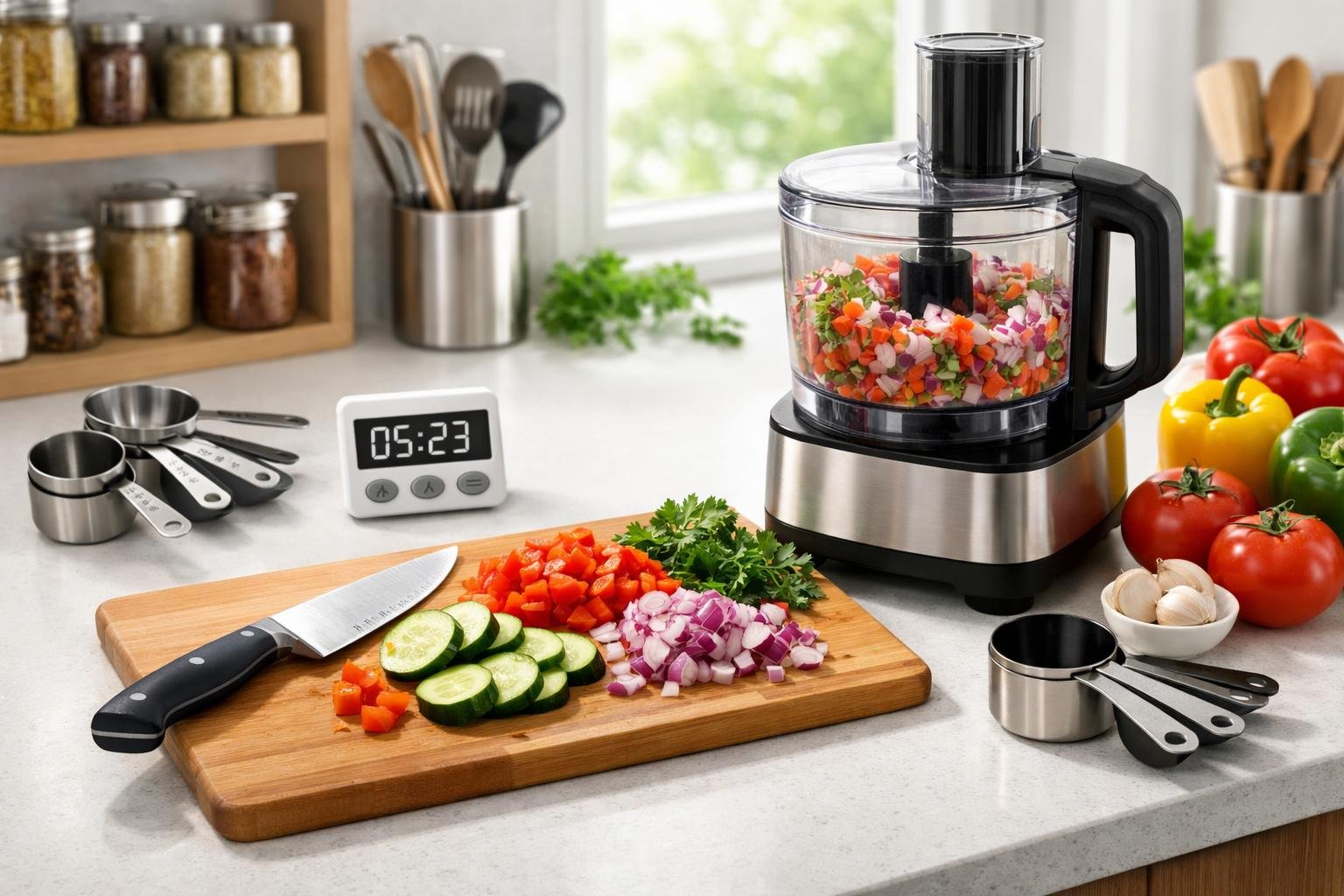
When we’re staring down a pile of veggies for a big meal, the food processor is the only way. What would take ages with a knife takes seconds with the pulse button.
Ours handles everything from shredding cabbage for slaw to slicing potatoes for gratin and mixing pie dough. The different blades mean we don’t need a drawer full of gadgets. Here’s what usually comes in the box:
- S-blade for chopping nuts, making pesto, or grinding meat
- Slicing disc for even veggie cuts
- Shredding disc for cheese, carrots, or zucchini
- Dough blade for pastry and bread
The wide feed tube on newer models fits whole veggies—no need to pre-cut just to get them in. We’ve filled a bowl with shredded carrots before we even finish peeling them by hand. For batch cooking, a 10-cup bowl or larger is a must.
Saucepans And Skillets That Heat Up Quick
We used to think all pots and pans were basically the same, but it turns out, the good ones really do make a difference. Cookware that heats up and cools down fast saves so much time.
Stainless steel layered with aluminum or copper heats evenly and responds quickly when you adjust the burner. No more waiting forever for water to boil or dealing with burned garlic and raw onions. Responsive pans help us sear without overcooking.
Quick comparison:
| Material | Heat-Up Speed | Temp Control | Best For |
|---|---|---|---|
| Stainless steel (clad) | Fast | Excellent | Everyday cooking |
| Cast iron | Slow | Not great | High-heat searing |
| Non-stick aluminum | Very fast | Good | Quick meals |
Heavy pans keep their heat longer, so you use less energy. Handles stay cooler—less scrambling for potholders. Look for thick, flat bases that actually touch the burner.
Smart Kitchen Habits And Upgrades That Elevate Efficiency
Sometimes it’s not about fancy appliances. A clever tool here or a smarter storage setup there can make cooking way faster and less stressful.
Salad Spinner For Fresh, Crisp Greens
Soggy lettuce ruins salads, and nobody likes limp greens. A salad spinner gets water off in seconds, so salads stay crisp and dressing sticks instead of puddling at the bottom.
It’s not just for lettuce. We use it to dry herbs, rinse berries, and even wash little veggies like cherry tomatoes. It saves paper towels and speeds up prep.
Why we love it:
- Greens last longer in the fridge when dry
- Dressings coat leaves evenly instead of sliding off
- Doubles as a colander or storage bowl
Most models are compact and nearly indestructible—no complicated parts to break.
Meat Thermometer And Instant-Read Thermometer For Stress-Free Roasts
Guessing when meat’s done is a gamble. A meat thermometer tells us exactly when food’s safe and still juicy—no more cutting into chicken and hoping for the best.
Instant-read versions give a number in less than five seconds. We poke it in, check, and move on. No more losing juices or second-guessing.
What we check most:
- Chicken breasts (74°C)
- Pork chops (63°C, then rest)
- Steaks (depends, but 52°C for medium-rare)
Some Bluetooth models send alerts to your phone when it’s ready, so you can actually relax or prep other stuff.
Upgrade Your Kitchen With Space-Saving Storage Solutions
We spend way too much time hunting for stuff. Clear containers show what’s inside and how much is left, so we don’t buy doubles or waste food.
Drawer dividers keep utensils from turning into a tangled mess. Stackable bins use up vertical space in cabinets and pantries, making awkward corners useful.
Upgrades we actually use:
- Magnetic knife strips (frees up counter space)
- Pull-out shelves in lower cabinets (no more crawling on the floor)
- Lazy Susans for spices and oils (just spin to find what you need)
When our favorite gadgets have logical homes, cooking feels less like a scavenger hunt and more like, well, cooking. It’s not about being perfect—just making things a little smoother.
Frequently Asked Questions
The right kitchen tools can save time, simplify prep, and make cleanup easier. Here are quick answers to common questions.
What high-tech gadgets are total game-changers for speeding up meal prep?
A digital meat thermometer gives fast, accurate readings without guesswork. Immersion blenders are great for soups and sauces because you can blend right in the pot. Rice cookers and multi-cookers are ideal for hands-off meals and faster cooking.
How can I optimize my kitchen layout to shave minutes off my cooking routine?
Keep everyday tools close to your prep area. Store similar items together so they are easier to grab. Set up your kitchen flow from fridge to prep to stove to serving.
Could you spill the beans on the essential containers for keeping my ingredients super fresh?
Use clear food storage containers for pantry staples so you can see contents quickly. Choose produce containers that help manage moisture for fruits and vegetables. Glass containers with secure lids work well for leftovers and meal prep.
Are there any slicing and dicing tools that'll make my veggies fear my culinary prowess?
A sharp chef’s knife is the most important tool for fast, clean cuts. A microplane helps with garlic, ginger, and zest. Kitchen shears and a bench scraper also speed up everyday prep.
I'm all ears for the scoop on how to marinate meats in record time, any tips?
Use a sealed bag so the marinade coats the meat evenly. Cut meat into thinner pieces or pound it to an even thickness. Add a little acid like lemon juice or yogurt to help flavor absorb faster.
What's the secret for quick and efficient clean-up that doesn't skimp on sparkle?
Clean as you go to prevent buildup and save time later. Use a silicone spatula to scrape bowls and pans more thoroughly. Keep a small scrap bowl nearby and let used tools soak in hot soapy water while you cook.
Share:
How Do You Build A More Efficient Kitchen Routine
How Can You Improve Food Texture During Cooking