

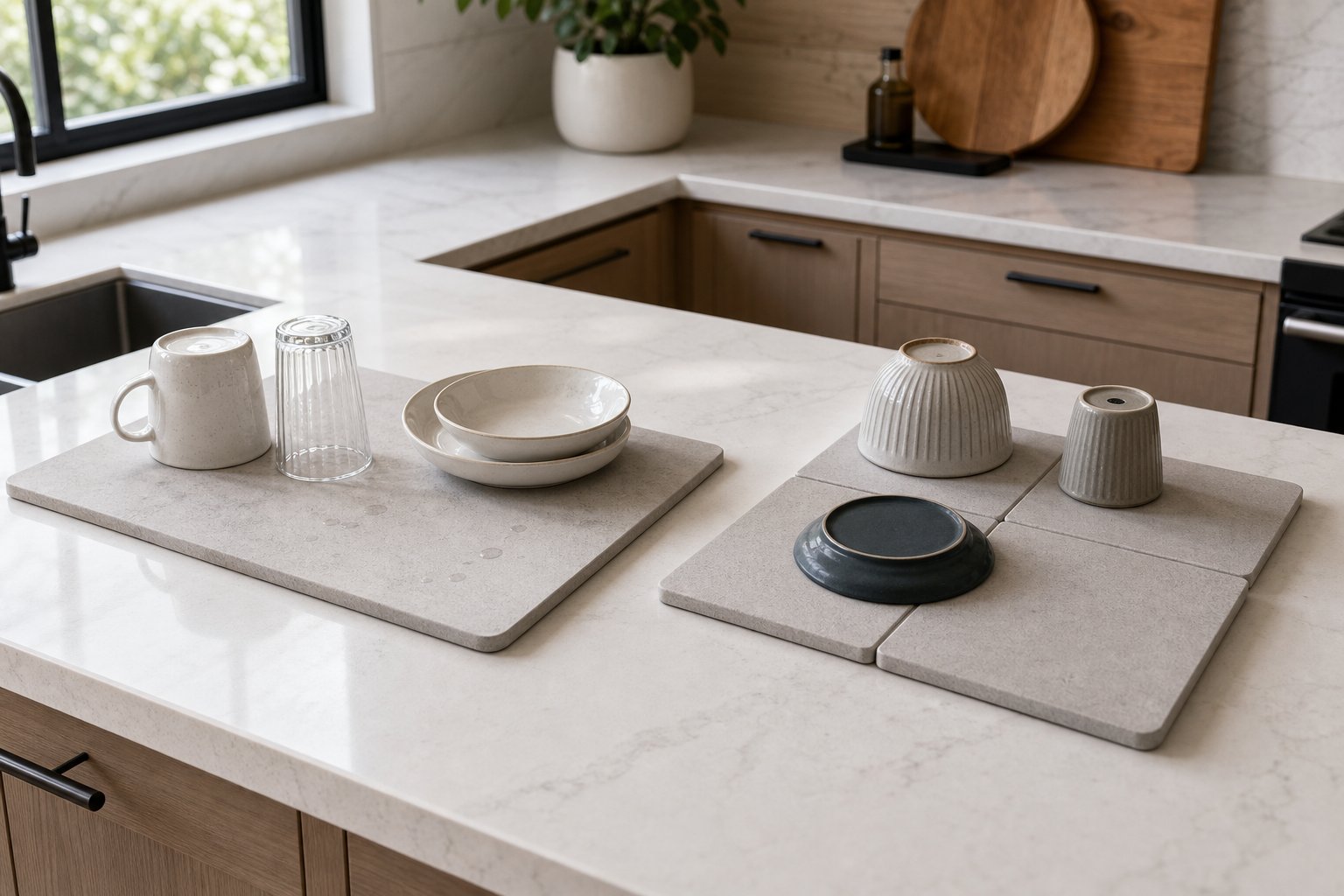
Entdecken Sie unsere neueste Kollektion an Abtropfmatten!
Eine einteilige Abtropfmatte aus Stein bietet Ihnen eine einzige, durchgehende Oberfläche, während eine modulare Anordnung separate Abschnitte verwendet, die an Ihre Arbeitsplatte angepasst werden können. Die richtige Wahl hängt weitgehend von Ihrem verfügbaren Platz, der typischen Geschirrmenge und Ihrer bevorzugten Trockenroutine ab. Modulare Matten bieten mehr Flexibilität in der Anordnung, während einteilige Matten eine einfache, ununterbrochene Abdeckung bieten.
Keine Küchenarbeitsplatte ist wirklich eine Einheitsgröße, daher sollte Ihre Abtropfkonfiguration zu der Art passen, wie Sie Ihren Raum nutzen. Einige Küchen haben nur einen schmalen Streifen neben dem Spülbecken, während andere Platz für eine spezielle Abtropfstation haben. Die Wahl des richtigen Formats kann Ihnen helfen, Ihre Arbeitsplatte besser zu nutzen, ohne unnötigen Unrat zu schaffen.
Im Folgenden vergleichen wir, wie modulare und einteilige Abtropfmatten aus Stein alltägliche Geschirrmengen, Arbeitsplattenlayouts, Materialüberlegungen, Reinigung und langfristige Pflege bewältigen. Am Ende sollten Sie eine klarere Vorstellung davon haben, welche Einrichtung zu Ihrer Küche und Routine passt.
Wichtige Erkenntnisse
- Modulare und einteilige Abtropfmatten aus Stein passen zu unterschiedlichen Küchenlayouts und Geschirrspülroutinen.
- Materialqualität, Stabilität, Belüftung und Reinigungsanforderungen können die langfristige Leistung beeinflussen.
- Die beste Wahl hängt von Ihrem verfügbaren Arbeitsplattenplatz, der typischen Geschirrmenge und der bevorzugten Einrichtung ab.
Wie jedes Abtropfmatten-Format funktioniert
Viele Abtropfmatten aus Stein verwenden Diatomit, ein Material auf Kieselgurbasis oder einen anderen porösen Mineralverbundwerkstoff, der dazu bestimmt ist, Oberflächenfeuchtigkeit aufzunehmen. Der Hauptunterschied zwischen modularen und einteiligen Designs besteht darin, wie die Abtropffläche auf Ihrer Arbeitsplatte angeordnet ist.
Modulare Platten, Ebenen und flexible Layouts
Modulare Abtropfmatten bestehen aus separaten Abschnitten, die zusammen oder auseinander positioniert werden können. Je nach Produktdesign können die Abschnitte nebeneinander liegen, an einem Rahmen befestigt werden oder mit erhöhten Stützen arbeiten.
Diese Flexibilität ermöglicht es Ihnen, den Abtropfbereich an die Geschirrmenge des Tages anzupassen. Sie können einen kompakten Abschnitt neben dem Spülbecken für Tassen und Gläser bereithalten und die Anordnung dann erweitern, wenn Sie mehr Teller, Kochgeschirr oder Besteck zum Trocknen haben.
Der Kompromiss ist, dass modulare Systeme mehr einzelne Teile enthalten. Sie können im Vergleich zu einer einzelnen Platte zusätzlichen Aufbau, Lagerung oder Ausrichtung erfordern, aber diese Flexibilität kann nützlich sein, wenn der Arbeitsplattenplatz begrenzt ist oder sich im Laufe des Tages ändert.
Durchgehende Abdeckung und einfache Platzierung
Eine einteilige Abtropfmatte aus Stein besteht aus einer durchgehenden Platte oder einem Paneel. Es ist nicht notwendig, separate Abschnitte anzuordnen, so dass sie neben dem Spülbecken platziert und sofort verwendet werden kann.
Dieses Design funktioniert gut, wenn Ihre Küche einen speziellen Abtropfbereich hat und Ihre Routine ziemlich konstant bleibt. Die ununterbrochene Oberfläche kann es auch erleichtern, größere Geschirrstücke zu platzieren, ohne sich um Nähte zwischen den Abschnitten kümmern zu müssen.
Die Haupteinschränkung ist die Flexibilität. Eine einzelne Platte kann nicht in kleinere Abtropfzonen unterteilt werden, so dass sie weniger praktisch sein kann, wenn Ihr verfügbarer Arbeitsplattenplatz häufig wechselt.
Wie poröse Steinmaterialien Feuchtigkeit bewältigen
Diatomit und ähnliche poröse Materialien enthalten kleine Hohlräume in ihrer Struktur, die es ermöglichen, Oberflächenfeuchtigkeit aufzunehmen und zu verteilen. Nachdem Feuchtigkeit in das Material eingedrungen ist, hilft die Exposition gegenüber zirkulierender Luft, sie mit der Zeit verdunsten zu lassen.
Der grundlegende Prozess ist unkompliziert:
- Absorption: Die poröse Oberfläche nimmt Feuchtigkeit von nassem Geschirr und Besteck auf.
- Verteilung: Feuchtigkeit verteilt sich durch das verfügbare poröse Material, anstatt in einer kleinen Pfütze konzentriert zu bleiben.
- Verdunstung: Luftzirkulation hilft der aufgenommenen Feuchtigkeit, das Material allmählich zu verlassen.
Eine gute Luftzirkulation sowohl um das Geschirr als auch um die Matte bleibt wichtig. Eng gepackte Gegenstände können Feuchtigkeit zwischen den Oberflächen halten, unabhängig von der Art der darunter liegenden Abtropfmatte.
Passen Sie die Einrichtung an Ihre Arbeitsplatte und Geschirrmenge an
Bevor Sie sich zwischen einer modularen und einer einteiligen Abtropfmatte aus Stein entscheiden, prüfen Sie Ihren verfügbaren Arbeitsplattenplatz und die Menge an Geschirr, die Sie normalerweise spülen. Die richtige Wahl hängt davon ab, wie viel Abtropffläche Sie benötigen und wo diese Fläche bequem Platz findet.
Beste Layouts für eine kleine Küche
Modulare Matten können in kompakten Küchen besonders nützlich sein, da Sie nur die Abschnitte verwenden können, die Sie zu einem bestimmten Zeitpunkt benötigen. Ein Abschnitt kann neben dem Spülbecken bleiben, während die restlichen Teile gelagert werden, bis zusätzlicher Abtropfplatz benötigt wird.
Diese Flexibilität kann dazu beitragen, mehr von der Arbeitsplatte für die Essenszubereitung, Geräte oder andere alltägliche Aufgaben freizuhalten.
Einige potenzielle Vorteile für kleine Küchen sind:
- Leichtere Lagerung einzelner Abschnitte
- Mehr Flexibilität rund um Geräte und Arbeitsplattenzubehör
- Die Möglichkeit, den Trockenbereich bei Bedarf zu erweitern oder zu verkleinern
Wann eine große Fläche mehr Sinn macht
Wenn Sie einen großzügigen, offenen Bereich der Arbeitsplatte neben dem Spülbecken haben, kann eine größere einteilige Abtropfmatte die einfachere Option sein. Sie bietet eine durchgehende Oberfläche, ohne dass Sie mehrere Abschnitte neu positionieren müssen.
Dies kann für Haushalte nützlich sein, die regelmäßig größere Mengen an Tellern, Schüsseln, Töpfen und Pfannen spülen. Eine breite, ununterbrochene Fläche kann auch das Positionieren sperriger Gegenstände erleichtern, vorausgesetzt, die Matte ist dafür ausgelegt, sie zu tragen.
Platz für Teller, Tassen und Stielgläser
Die Art des Geschirrs, das Sie spülen, ist genauso wichtig wie die Gesamtmenge. Modulare Matten ermöglichen es Ihnen, separate Bereiche für Teller, Tassen, Besteck und Gläser zu schaffen, wenn Ihre Arbeitsplatte ausreichend Platz bietet.
Das Trennen von empfindlichen Gläsern von schwererem Geschirr kann auch unbeabsichtigten Kontakt beim Trocknen reduzieren. Welches Layout Sie auch wählen, stellen Sie Gläser und Stielgläser sicher ab und vermeiden Sie es, sie am Rand der Matte zu balancieren.
Positionierung neben dem Spülbecken
Messen Sie die Arbeitsplatte neben Ihrem Spülbecken, bevor Sie eine Matte auswählen. Achten Sie sowohl auf Länge als auch auf Tiefe sowie auf die Position von Armaturen, Seifenspendern, Geräten und anderen Einrichtungsgegenständen.
Modulare Teile können sich leichter an unregelmäßige Räume anpassen. Eine einteilige Matte ist in der Regel am einfachsten zu verwenden, wenn Sie einen klaren rechteckigen Bereich haben, der ihren Abmessungen genau entspricht.
Die Matte nahe am Spülbecken zu halten, kann auch die Menge an Wasser reduzieren, die beim Umfüllen des Geschirrs über die Arbeitsplatte tropft.
Kapazität, Stabilität und tägliche Geschirrpflege
Die Kapazität ist nur eine Überlegung beim Vergleich von Abtropfmatten. Stabilität, Luftstrom, Oberflächentextur und die Art der Geschirranordnung beeinflussen auch, wie praktisch eine Einrichtung im täglichen Gebrauch empfunden wird.
Trennung von Nass- und Trockenzonen
Modulare Stein-Setups erleichtern das Erstellen separater Trockenzonen. Sie können einen Bereich für frisch gespültes Geschirr und einen anderen für fast trockene Gegenstände festlegen.
Eine einteilige Matte kann dieselbe allgemeine Routine unterstützen, aber ihre Trockenfläche bleibt fest. Sie können Geschirr immer noch in verschiedene Bereiche organisieren, obwohl Sie die Abschnitte nicht physisch trennen können.
In beiden Setups vermeiden Sie es, Geschirr zu eng zusammenzupacken. Ausreichender Abstand ermöglicht eine bessere Luftzirkulation um Teller, Schüsseln und Gläser.
Sicheres Tragen von schwerem Kochgeschirr
Abtropfmatten aus Stein und Mineralverbundwerkstoffen unterscheiden sich in Dicke, Konstruktion und Belastbarkeit. Bevor Sie schweres Kochgeschirr wie Gusseisenpfannen oder Bräter auf eine Abtropfmatte stellen, überprüfen Sie die Pflege- und Gebrauchsanweisungen des Herstellers.
Gehen Sie nicht davon aus, dass eine dickere oder größere Matte automatisch für schweres Kochgeschirr geeignet ist. Der gesamte Gegenstand sollte auf einer stabilen Oberfläche ruhen, und Kochgeschirr sollte vorsichtig behandelt werden, um das Risiko von Absplitterungen, Rissen oder Stoßschäden zu reduzieren.
Verhindern, dass Gläser verrutschen
Ein stabiler Stand und eine sichere Platzierung des Geschirrs sind besonders wichtig beim Trocknen von Gläsern. Einige Produkte verfügen über strukturierte Oberflächen, Silikonkomponenten, Füße oder separate rutschfeste Schichten, um Bewegungen zu reduzieren.
Bei modularen Designs stellen Sie sicher, dass jeder Abschnitt sicher positioniert ist, bevor Sie empfindliche Gläser hinzufügen. Einteilige Matten eliminieren Nähte zwischen einzelnen Abschnitten, aber Gläser sollten wann immer möglich von exponierten Kanten entfernt platziert werden.
Verwendung von Racks und erhöhten Stützen
Eine Abtropfmatte aus Stein kann auch mit einem kompatiblen Geschirrhalter oder erhöhten Stützen verwendet werden, wenn zusätzliche Organisation oder Luftzirkulation erforderlich ist.
Erhöhte Racks können Schüsseln und Teller getrennt halten und gleichzeitig die Luftzirkulation um einen größeren Teil ihrer Oberfläche ermöglichen. Wenn Sie ein Rack mit einer Steinmatte kombinieren, stellen Sie sicher, dass das Rack stabil und für die Abmessungen und Konstruktion der Matte geeignet ist.
Sie müssen nicht unbedingt einen vorhandenen Geschirrhalter ersetzen. In einigen Küchen können ein Rack und eine steinerne Abtropffläche als Teil derselben Abtropfstation zusammenarbeiten.
Materialqualität und Eigenschaften, die es sich zu prüfen lohnt
Abtropfmatten aus Stein können sich in Konstruktion und Verarbeitung erheblich unterscheiden. Materialzusammensetzung, Dicke, Kantenqualität, Basisdesign und Aufbewahrungsfunktionen können alle beeinflussen, wie gut eine Matte in Ihre Küche passt.
Dicke, Dichte und Rissbeständigkeit
Die Dicke kann beeinflussen, wie massiv sich eine Steinmatte anfühlt, sollte aber nicht als einziger Indikator für Haltbarkeit behandelt werden. Materialzusammensetzung, Herstellungsqualität, Unterstützung unter der Matte und die tägliche Handhabung spielen ebenfalls eine Rolle.
Suchen Sie vor dem Kauf nach klaren Produktspezifikationen und Pflegeanweisungen. Eine gut gestützte Matte, die vorsichtig behandelt wird, ist weniger anfällig für unnötige Belastungen durch Stöße, unebene Oberflächen oder schwere Gegenstände.
Aussagen zur Lebensmittelechtheit des Materials und ihre Bedeutung
Wenn ein Hersteller eine Abtropfmatte oder ihre Komponenten als lebensmittelecht, BPA-frei oder für den Kontakt mit Küchengeschirr geeignet beschreibt, überprüfen Sie die spezifischen Produktinformationen, die diesen Behauptungen zugrunde liegen.
Begriffe wie „lebensmittelecht“ sollten nicht als Ersatz für klare Materialinformationen oder anwendbare Testdetails behandelt werden. Dies ist besonders wichtig, wenn Sie planen, Lebensmittel direkt auf die Oberfläche zu legen, anstatt die Matte nur für sauberes Geschirr und Besteck zu verwenden.
Überprüfen Sie bei Matten mit Silikonkanten, rutschfesten Pads, Beschichtungen oder anderen zusätzlichen Materialien auch die Spezifikationen des Herstellers für diese Komponenten.
Faltbare und zusammenklappbare Optionen
Einige Abtropfmatten aus Stein oder Mineralverbundwerkstoffen verwenden segmentierte oder faltbare Designs, die sie bei begrenztem Arbeitsplattenplatz leichter zu lagern machen.
Dies kann in kleinen Küchen, Wohnungen oder anderen Räumen, in denen eine Abtropfmatte nicht dauerhaft auf der Arbeitsplatte bleiben kann, hilfreich sein. Bevor Sie sich für ein faltbares Design entscheiden, prüfen Sie, wie die Abschnitte verbunden sind, und befolgen Sie die Anweisungen des Herstellers zum Falten, Lagern und Reinigen.
Erhöhte Basen und Belüftung unter der Matte
Einige Trocknungssysteme verwenden erhöhte Stützen oder Basen, die einen Abstand zwischen Matte und Arbeitsplatte schaffen. Dieses Design kann die Luftzirkulation unter der Matte verbessern und es erleichtern, dass Feuchtigkeit um die Basis herum verdunstet.
Eine stabile, rutschfeste Basis ist ebenfalls eine Überlegung wert, insbesondere wenn Sie regelmäßig größere Geschirrstücke oder Kochgeschirr auf die Trockenfläche stellen.
Reinigung, Flecken und Langzeitperformance
Die Langzeitperformance hängt teilweise davon ab, wie eine Abtropfmatte aus Stein gereinigt, getrocknet und behandelt wird. Da Materialien und Oberflächen variieren, sollten Sie immer die Pflegehinweise für Ihre spezifische Matte priorisieren.
Umgang mit Mineralablagerungen, Kaffeerändern und Lebensmittelflecken
Poröse Oberflächen können sichtbare Spuren von hartem Wasser, Kaffee, Lebensmittelresten oder anderen Verschüttungen entwickeln. Das schnelle Reinigen von Flecken kann ihre Handhabung erleichtern.
Verwenden Sie die vom Hersteller empfohlene Reinigungsmethode. Einige Matten vertragen eine sanfte Reinigung mit Wasser und einem weichen Tuch oder einer Bürste, während andere spezifischere Pflegeanforderungen haben können.
Vermeiden Sie die Verwendung von Bleichmitteln, scheuernden Reinigungsmitteln oder anderen starken Chemikalien, es sei denn, der Hersteller bestätigt ausdrücklich, dass sie für das Material geeignet sind. Diese Produkte können die Oberfläche, das Finish oder die Saugfähigkeit einiger Matten beeinträchtigen.
Auffrischen der porösen Oberfläche mit Sandpapier
Einige Abtropfmatten aus Stein können leicht geschliffen werden, wenn Mineralablagerungen oder Oberflächenrückstände die Absorption mindern. Schleifen ist jedoch nicht für jedes Material oder Finish geeignet.
Wenn der Hersteller Schleifen empfiehlt, befolgen Sie seine Anweisungen bezüglich Körnung, Druck und Reinigung nach dem Schleifen. Arbeiten Sie gleichmäßig über den vorgesehenen Bereich, anstatt aggressiv eine einzige Stelle zu schleifen.
Entfernen Sie anschließend jeglichen Schleifstaub und lassen Sie die Matte vollständig trocknen, bevor Sie sie wieder verwenden.
Trocknen der Matte zwischen den Anwendungen
Auch die Abtropfmatte selbst benötigt zwischen den Anwendungen eine ausreichende Luftzirkulation. Ein gründliches Trocknen hilft, anhaltende Feuchtigkeit und unerwünschte Gerüche zu reduzieren.
Wenn die Anweisungen des Herstellers dies zulassen, können Sie die Matte aufrecht stellen oder so positionieren, dass die Luft um einen größeren Teil ihrer Oberfläche zirkulieren kann.
Modulare Matten können in dieser Hinsicht praktisch sein, da einzelne Teile zum Trocknen getrennt werden können. Größere einteilige Matten benötigen möglicherweise mehr Platz für Lagerung und Belüftung.
Praktische Hygienegewohnheiten rund um feuchtes Geschirr
Halten Sie die Matte sauber und lassen Sie sie zwischen den Anwendungen trocknen. Anhaltende Feuchtigkeit und Speisereste können ungeachtet des Materials einen unhygienischen Trockenbereich schaffen.
Vermeiden Sie Kreuzkontaminationen, indem Sie Oberflächen oder Utensilien, die mit rohem Fleisch, Geflügel, Meeresfrüchten oder anderen potenziell kontaminierenden Lebensmitteln in Kontakt gekommen sind, von Ihrem Abtropfbereich für sauberes Geschirr fernhalten. Wenn eine Kontamination auftritt, befolgen Sie die vom Hersteller empfohlene Reinigungsanleitung, bevor Sie die Matte erneut verwenden.
Die richtige Einrichtung für Ihre Routine auswählen
Die richtige Einrichtung hängt davon ab, wie Sie Ihre Arbeitsplatte nutzen, wie viel Geschirr Sie normalerweise spülen und ob Sie eine flexible Anordnung oder eine einzige durchgehende Oberfläche bevorzugen.
Wählen Sie Modulare für anpassungsfähiges, mehrzoniges Trocknen
Eine modulare Abtropfmatte ist eine gute Wahl, wenn Ihre Arbeitsplatte den ganzen Tag über mehrere Zwecke erfüllt. Separate Teile können einen Abtropfbereich neben dem Spülbecken schaffen, während andere Abschnitte für die Kaffeezubereitung, Essenszubereitung oder Geräte zur Verfügung stehen.
Sie können den Abtropfbereich für eine größere Geschirrladung erweitern und ihn wieder verkleinern, wenn nur wenige Tassen oder Besteckteile Platz benötigen.
Dies macht modulare Systeme besonders praktisch, wenn Ihr verfügbarer Arbeitsplattenplatz von Tag zu Tag wechselt.
Wählen Sie einteilig für eine breite, ununterbrochene Abdeckung
Eine einteilige Steinmatte ist sinnvoll, wenn Sie einen einzelnen, durchgehenden Abtropfbereich ohne Nähte zwischen den Abschnitten bevorzugen.
Die einfache Einrichtung kann für Teller, Auflaufformen, Kochgeschirr und andere größere Gegenstände praktisch sein, vorausgesetzt, die Matte ist so konzipiert, dass sie deren Größe und Gewicht trägt.
Wenn Sie ausreichend permanenten Arbeitsplattenplatz haben und Ihren Abtropfbereich selten neu anordnen müssen, bietet ein einteiliges Design eine unkomplizierte Abdeckung mit minimalem Einrichtungsaufwand.
Berücksichtigen Sie doppelten Verwendungszweck über das Geschirrspülen hinaus
Einige Hersteller genehmigen ihre Matten möglicherweise auch für andere Zwecke als das Trocknen von sauberem Geschirr, aber diese Anwendungen hängen vom spezifischen Material und der Konstruktion ab.
Gehen Sie nicht davon aus, dass eine Abtropfmatte aus Stein als hitzebeständige Unterlage, Pflanzenmatte, Essenszubereitungsfläche oder Haustier-Futtermatte geeignet ist, es sei denn, der Hersteller gibt ausdrücklich an, dass diese Verwendung angemessen ist.
Wenn Sie eine Mehrzweckmatte wünschen, überprüfen Sie vor dem Kauf die angegebenen Temperaturgrenzen, Reinigungsanforderungen und Verwendungszwecke des Produkts.
Eine kurze Checkliste für die Arbeitsplatte vor dem Kauf
Messen Sie vor dem Kauf Ihre Arbeitsplatte und überlegen Sie, wie Sie Ihren Trockenbereich tatsächlich nutzen.
- Zuerst messen: Überprüfen Sie die verfügbare Länge und Tiefe neben Ihrem Spülbecken.
- Berücksichtigen Sie Ihre Geschirrmenge: Überlegen Sie, wie viel Geschirr Sie typischerweise auf einmal spülen.
- Denken Sie in Zonen: Wählen Sie ein modulares Setup, wenn separate oder verstellbare Trockenbereiche nützlich wären.
- Pflegehinweise für das Material prüfen: Überprüfen Sie die Anweisungen des Herstellers für Reinigung, Trocknung und Oberflächenpflege.
- Bestätigen Sie die vorgesehenen Verwendungszwecke: Wenn Sie eine Mehrzweckmatte wünschen, stellen Sie sicher, dass diese Verwendungszwecke für das spezifische Produkt genehmigt sind.
Diese Checkliste kann Ihnen helfen, eine Abtropfmatte basierend auf den Realitäten Ihrer Küche und nicht nur auf dem Aussehen auszuwählen.
Häufig gestellte Fragen
Was ist der Unterschied zwischen einer modularen Abtropfmatte aus Stein und einem einteiligen Design?
Eine modulare Einrichtung verwendet separate Abschnitte, die an Ihre Arbeitsplatte angepasst werden können. Eine einteilige Matte bietet eine durchgehende Trockenfläche. Modulare Designs bieten mehr Layoutflexibilität, während einteilige Designs eine einfachere, nahtlose Einrichtung bieten.
Welche Abtropfmatte aus Stein lässt sich leichter um einen Küchenhahn oder Spülbecken-Zubehör herum anbringen?
Modulare Matten lassen sich in der Regel leichter um Armaturen, Seifenspender und andere Arbeitsplattenarmaturen anordnen, da einzelne Abschnitte neu positioniert werden können. Eine einteilige Matte erfordert einen freien Bereich, der ihren festen Abmessungen entspricht.
Sind modulare Abtropfmatten aus Stein einfacher zu reinigen als einteilige Matten?
Einzelne modulare Abschnitte lassen sich während der Reinigung möglicherweise leichter anheben und handhaben. Die beste Reinigungsmethode hängt jedoch vom Material und den Pflegehinweisen des Herstellers ab und nicht nur vom Mattenformat.
Welche Option funktioniert besser für kleine Küchenarbeitsplatten?
Modulare Matten sind für begrenzten Arbeitsplattenplatz oft praktischer, da Sie nur die Abschnitte verwenden können, die Sie benötigen. Eine einteilige Matte nimmt immer ihre volle Stellfläche ein.
Können modulare Abtropfmatten aus Stein die gleiche Geschirrmenge aufnehmen wie einteilige Matten?
Sie können eine ähnliche Trockenkapazität bieten, wenn ihre gesamten nutzbaren Flächen vergleichbar sind. Der Hauptunterschied besteht darin, wie diese Oberfläche angeordnet werden kann, nicht einfach darin, ob die Matte modular oder einteilig ist.
Welche Abtropfmatten-Konfiguration ist am besten für Haushalte geeignet, die häufig Geschirr spülen?
Beide Formate können gut für häufiges Geschirrspülen funktionieren. Modulare Matten sind nützlich, wenn Sie verstellbare Trockenzonen wünschen, während einteilige Matten praktisch sind, wenn Sie genügend permanenten Arbeitsplattenplatz für einen durchgehenden Trockenbereich haben.
Teilen:
Wie schnell trocknet eine Steintrockenmatte, und was beeinflusst ihre Saugfähigkeit?
So hält man den Bereich um das Spülbecken mit einer Abtropfmatte aus Stein beim täglichen Abwasch trockener