

Check out our latest drying mats collection!
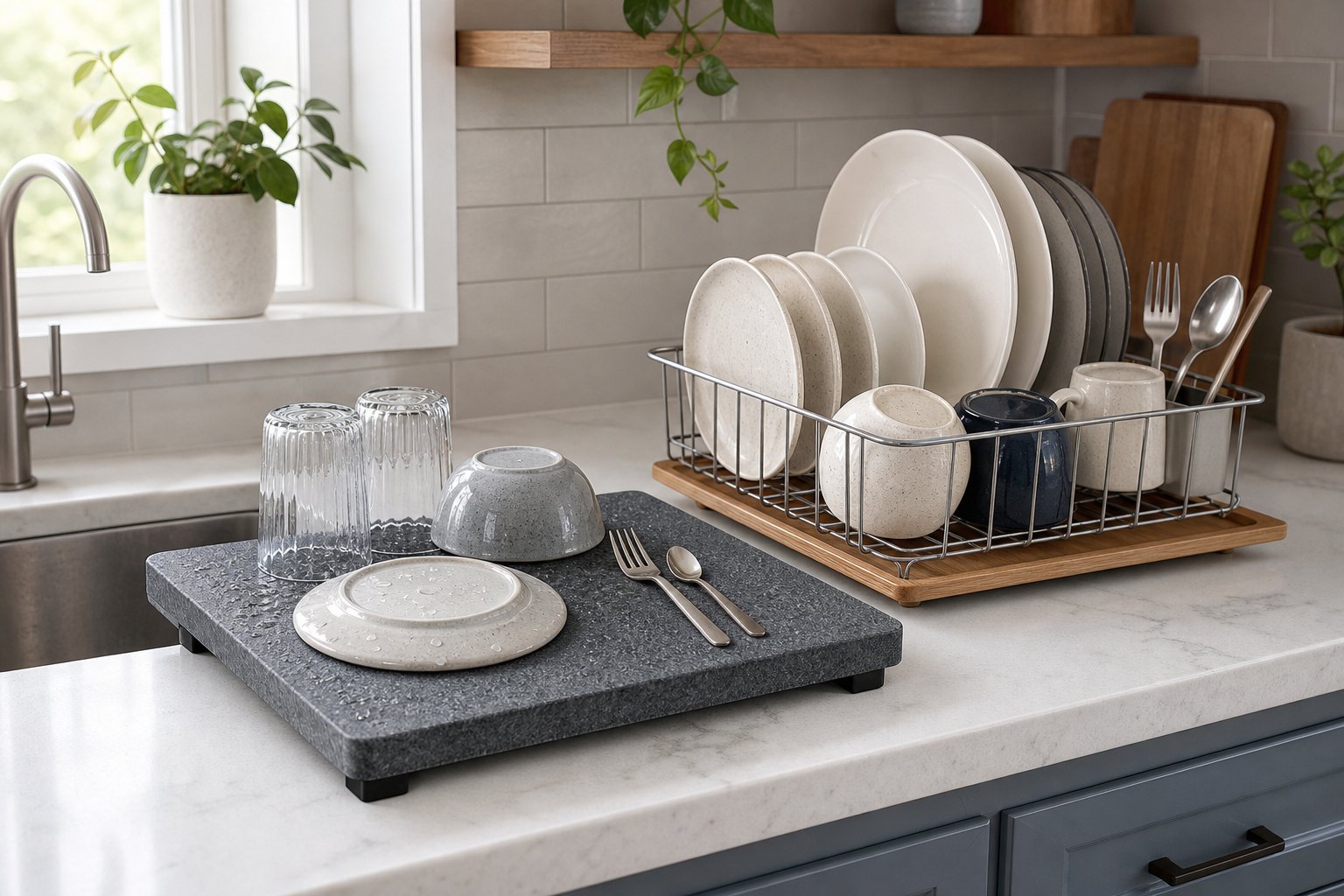
A crowded counter can make even the simplest cleanup feel frustrating. When space is limited, the choice between a stone drying mat and a traditional dish rack matters more than it seems. For most small kitchens, a stone drying mat is the cleaner, sleeker option for daily dishes, while a dish rack is better for larger loads and heavier cookware.
Stone mats absorb moisture through diatomaceous earth, then dry flat and store easily. Dish racks use airflow and vertical storage, which helps with plates, pots, and batch washing. This guide compares drying speed, hygiene, durability, storage, and daily convenience so you can choose the best fit for your kitchen routine.
Key Takeaways
- Stone drying mats clear up counter space and look neater but work best for lighter loads like glassware and a few daily dishes
- Traditional dish racks handle more dishes and heavier cookware thanks to their structure and airflow
- What you pick really comes down to how many dishes you wash, your counter space, and whether you care more about easy storage or drying a big load at once
How Stone Drying Mats Work
Stone drying mats use diatomaceous earth, which is a naturally porous material made from fossilized algae, to suck up water from dishes in minutes. The inside of this material has thousands of tiny channels that pull moisture away from your plates and push it into the air almost right away.
Diatomaceous Earth and Its Unique Absorbency
Diatomaceous earth sits at the heart of every stone drying mat I’d actually recommend. It’s a powder that comes from fossilized single-celled algae, which piled up on old ocean floors over millions of years.
That fossilization leaves behind a honeycomb-like structure you can’t see, but it’s there. Each bit has tons of tiny pores that act like little straws, pulling water in through surface tension. (You might’ve heard of this stuff for pest control, but in kitchen gear, it’s food-grade and totally safe.)
Most stone dish drying mats get this diatomaceous earth pressed into a solid pad, then backed with food-grade silicone. The silicone keeps the mat from sliding around. This combo gives you a sturdy surface that supports plates and glasses while actively pulling moisture away.
A good stone mat soaks up several times its own weight in water. You can often see water vanish from the surface seconds after you set a wet dish down.
The Science Behind Rapid Drying
Diatomaceous earth doesn’t just absorb water like a sponge, it speeds up evaporation with its crazy surface area.
When water hits those microscopic pores, it spreads out through millions of little chambers. That spreads water out, exposing more of it to the air. Instead of sitting in a puddle where only the top dries, the water disperses inside the mat.
The stone itself doesn’t hang onto moisture like a cloth does. Traditional fabric mats stay damp for hours, but stone drying mats let water vapor escape as long as there's air flow.
Room temperature and humidity play a role, but most stone mats dry out in one to two hours. That quick drying makes it tough for bacteria and mold to get a foothold.
Stone Dish Drying Mat Designs for Modern Kitchens
You can find stone drying mats in rectangular or circular shapes to fit different counters. Rectangles usually run from 12x16 inches up to 18x24 if you’ve got more space.
Designs mostly stay simple. The natural beige or gray of diatomaceous earth looks neutral and works with just about any kitchen. Some brands add subtle patterns or textures, but function comes first.
Most mats are about 0.3 to 0.5 inches thick, enough to absorb water but still slim enough to tuck in a drawer. The silicone backing adds grip but not much bulk.
You’ll usually see:
- Non-slip silicone base to keep it steady on slick counters
- Rounded edges so it won’t chip easily
- Raised micro-textures for airflow under your dishes
- Lightweight build so you can move and store it easily
A few mats come with a removable silicone tray underneath, which catches extra water before it gets absorbed. That helps most with really wet stuff, like freshly washed pots.
Traditional Dish Racks and Dish Drying Mats Explained
Dish racks and mats tackle the same job differently. Racks hold your dishes upright and let water drain away, while mats just soak up whatever drips off.
Material Choices: Metal, Plastic, Bamboo, and More
Most dish drying racks use stainless steel, coated metal, plastic, or bamboo. Metal racks last and resist rust if they’re coated well, but cheap ones can rust. Plastic racks are light and cheap, but they might stain or crack if you’re rough on them.
Bamboo racks look nice and feel natural, and they handle water okay, but you’ll need to dry them out so they don’t warp or get moldy.
Traditional dish drying mats use cotton, microfiber, or silicone. Cotton and microfiber mats fold up for storage but stay wet for hours. Silicone mats have raised patterns to channel water into trays, but they don’t absorb anything.
Which material you pick changes how fast things dry and how often you’ll need to clean or replace them.
How Dish Racks and Mats Handle Drips and Airflow
Dish racks lift plates and bowls so air gets all around. Most have a sloped drip tray that guides water into the sink or a catch tray. That keeps water moving away from your dishes and off the counter.
Mats just soak up water. The water drips onto the mat and spreads out through the fibers or channels. Cotton and microfiber mats trap water until it finally evaporates, which can take six to eight hours.
If you’re short on space, that matters. A damp counter can start to smell or grow bacteria. Racks dry dishes faster but need more space and can’t just disappear when you’re done.
Comparing Drying Performance and Hygiene
Stone drying mats pull water right into their surface, while dish racks let air and gravity do the work. Both have pros and cons for bacteria, odors, and moisture based on how you wash and clean up.
Drying Dishes Faster: Absorption vs Air Circulation
A stone drying mat made from diatomaceous earth grabs water as soon as you set a dish down and evaporates it through the stone. In my experience, dishes on a good stone mat look dry within minutes because the water wicks away so fast. But the mat itself still needs a little time to dry out, usually an hour or two if your kitchen’s got decent airflow.
Dish racks work differently. They prop dishes up so water drips off and air gets all around. This works especially well for things like measuring cups or mixing bowls. Plates and bowls dry quicker upright in a rack than lying flat on a mat.
The main difference? Stone mats keep your counter dry while you dry dishes, but racks dry the dishes themselves a bit faster. If you’re just washing a mug or a couple plates, the mat’s great. If you’ve got a full load, racks usually win.
Reducing Odors, Mold, and Bacteria on the Counter
Stone mats resist bacteria better than fabric mats because they don’t stay wet. Diatomaceous earth naturally keeps bacteria at bay if you let the mat dry between uses. I’d let your stone mat air out for at least an hour before putting it away or using it again.
Dish racks made from stainless steel or plastic don’t soak up water, so the rack itself won’t get smelly or moldy. The tricky part? The drip tray underneath collects standing water, and that can get gross if you don’t empty and clean it every day. Seriously, I’ve seen trays go slimy in just a couple days if you forget.
Maintenance at a glance:
- Stone mat: Quick rinse monthly, sand out stains every few months, air dry after each use
- Dish rack: Empty drip tray daily, wash tray weekly, wipe down rack weekly
Both options stay clean if you keep up with them, but if you let things slide, they fail in different ways. A forgotten stone mat gets chalky and loses its magic. A neglected dish rack grows mold in the tray and rubber parts.
Maximizing Space on a Small Kitchen Counter
If you’re working with a tiny counter, every inch matters. A stone drying mat folds flat or stands up out of the way, while a regular dish rack just sits there unless you move it every time.
Footprint and Storage: Which Saves More Room?
A dish drying mat covers about 12x18 inches when you use it but disappears into a cabinet or behind something when you’re done. Stone mats slide right into gaps or lean against the wall, which is perfect when you need that space for meal prep.
Traditional dish racks take up a fixed space, usually 14x17 inches or more. Even a bamboo rack looks better than a plastic one, but it still lives on your counter unless you move it after every wash. Most of us just leave it out.
Honestly, mats win for storage. A dish drying mat needs maybe an inch of space when stored, while even foldable racks need several inches and a specific spot to fit.
Stackability and Versatility in Small Kitchens
Stone drying mats work for plates, cups, and silverware, but they struggle with tall stuff like wine glasses or big pots. Everything sits flat, so there’s no vertical organization.
Dish racks have slots and compartments that keep everything separated and upright. That’s a lifesaver when you’re drying a full load after dinner. Racks hold wine glasses upside down, keep cutting boards standing, and stop bowls from nesting while wet.
Some people use both. The mat handles quick daily washes, and a compact bamboo rack comes out for big loads. If you’ve got a spot to stash the rack when you’re not using it, this combo works well.
Maintenance and Long-Term Durability
Stone drying mats just need a quick sanding now and then, while dish racks need regular scrubbing to stay clean and rust-free. Both last years if you take care of them, but the work involved feels pretty different.
Cleaning Routines for Each Drying Solution
A dish drying rack needs a weekly scrub to keep mineral deposits, soap scum, and mildew from building up. Take it apart if you can and wash with warm, soapy water, especially the utensil holder and drip tray where water collects.
Bamboo racks need a bit more attention since wood warps or cracks if it stays wet. Wipe them down weekly and let them dry completely between uses to keep mold away.
Stone drying mats are low-maintenance. Just rinse them under warm water to get rid of residue, and let them air dry. The porous surface naturally keeps bacteria from settling in, so you don’t have to deep-clean as often as you would with fabric mats.
Fabric dish drying mats need a trip through the washing machine every few days to keep odors and bacteria under control. Silicone mats just need a wipe since water sits on top instead of soaking in.
Sanding, Staining, and When to Replace
Stone mats lose their absorbency over time as minerals and oils clog the pores. A light sanding with fine-grit sandpaper (220-grit is good) brings them back to life. I usually sand mine every three to six months, depending on how hard the water is.
Dish racks show their age differently. Metal racks can rust where the coating chips, especially around welds. Bamboo racks might need a little oiling to stop them from drying out or cracking, but that adds a step.
Swap out a dish drying rack when rust spreads, plastic cracks, or it gets wobbly. Good ones last three to five years if you’re careful. Replace a stone drying mat if sanding doesn’t fix absorption anymore, usually after five to seven years of daily use.
Choosing the Right Option for Your Kitchen and Lifestyle
Your counter space, how you wash dishes, and what you want your kitchen to look like will decide whether a stone drying mat or dish rack fits you best. Honestly, matching the product to your real routine matters way more than any trend.
Best Scenarios for Stone Mats vs Racks
Stone drying mats really shine if you wash just a handful of dishes here and there throughout the day. When you’re rinsing off a coffee mug, a wine glass, or a cereal bowl and want it dry fast, the diatomaceous earth surface totally handles that. It’s honestly impressive how quickly these mats soak up water.
I’d say go for stone mats when:
- Your counter depth is under 12 inches
- You mostly hand-wash glassware or smaller plates and bowls
- You want something you can stash flat in a drawer
- You like keeping your counter looking clean and uncluttered
- You’re setting up a coffee or bar area
On the other hand, a dish drying rack just works better if you’re washing a whole dinner set or big cookware on the regular. Racks give you vertical space and airflow, which comes in handy for drying sheet pans, mixing bowls, or a family’s worth of dishes at once.
Pick a bamboo dish rack or wire rack if:
- You usually hand-wash 8+ items at a time
- You’re always drying pots, pans, or bakeware
- You’ve got a spot on the counter dedicated to drying dishes
- You wash in big batches once or twice a day
Combining Stone Mats with Bamboo or Wire Racks
Honestly, a lot of us end up using both instead of picking just one. I like putting a stone mat under or next to a small dish rack, which catches drips and keeps my counter safe from water stains or rust.
This combo is a lifesaver in tiny kitchens. You can stack plates and bowls in a little bamboo rack, and let glasses or mugs dry right on the stone mat. The mat stops water from pooling under the rack, so you don’t need an extra drip tray.
Some practical setups I’ve seen:
- Stone mat right in front of a vertical plate rack
- Two mats on either side of a small utensil caddy
- Stone mat under a collapsible rack that you tuck away after
With both, you get more flexibility depending on what you’re washing, and you don’t have to give up a chunk of your counter just for drying dishes.
Frequently Asked Questions
Here are quick answers to the most common questions about stone drying mats and dish racks for small kitchens.
Which drying option keeps a small counter drier and less prone to water pooling?
Stone drying mats usually keep counters drier because they absorb water into the surface instead of letting it sit in a tray. Dish racks can work well, but the drip tray needs regular emptying to prevent standing water.
Do stone drying mats actually dry faster than fabric, silicone, or microfiber mats?
Yes, stone mats usually dry faster than fabric or microfiber mats because diatomaceous earth pulls in moisture and releases it into the air. Silicone mats do not absorb water, so dishes may stay wet longer unless water drains away.
How much counter space does a compact dish rack really save compared to a flat drying mat?
A compact rack still takes up fixed counter space, even when it has a small footprint. A flat drying mat is easier to store in a drawer or cabinet, which makes it more flexible for very small kitchens.
What is the easiest option to clean and keep from smelling funky over time?
Stone mats are simple to clean with a quick rinse and full air dry. Dish racks need more attention because trays, joints, and utensil holders can collect residue and moisture.
Will a diatomaceous earth stone mat scratch or dull common countertop surfaces like quartz or granite?
Most stone mats are safe for quartz, granite, and laminate when they have a soft backing or non-slip base. To protect delicate surfaces, lift the mat instead of dragging it across the counter.
What should you look for if you want a drying mat that can also handle pots, pans, and heavier dishes?
Choose a thicker stone mat with a stable, textured surface if you plan to dry heavier dishes. For large pots, sheet pans, or cookware, a sturdy rack may still offer better support and airflow.
Partager:
Which Dry Ingredients Are Easier to Store in Vacuum Canisters Than Original Packaging?
What Makes a Modular Drying Stone Mat Useful for Cups, Plates, and Daily Dishwashing?