

Check out our latest golf collection!
A great golf gift should make practice feel easier, not more complicated. Beginner golfers who want to practice at home need simple tools that fit their space, help them build real skills, and keep them motivated between rounds.
The best golf gifts for beginners are compact training aids, putting mats, alignment tools, chipping nets, and simple feedback devices that support better practice without a full course setup.
The right gift solves a clear practice need. A putting mat can help with stroke control, alignment sticks can improve setup, and a compact chipping net can make short game practice more fun.
This guide will help you choose practical golf gifts that beginners can actually use at home.
Key Takeaways
- Go for compact training aids that give instant feedback and work in tight spaces
- Prioritize putting and alignment tools since short game practice pays off fastest
- Consider performance-tracking tech and learning resources to help beginners see real progress
Key Considerations When Selecting Golf Gifts for At-Home Practice
Picking the right practice gift means looking at skill level, space, and how much hassle someone wants to deal with. We stick with gifts that actually help you practice, not stuff that ends up being more trouble than it's worth.
Matching Skill Level and Interests
Beginner golf gifts shine when they match where someone is in their golf journey. If they're still figuring out how to grip the club, they don't need a launch monitor tracking spin rates and club path angles.
Start with the basics. Putting mats are great for golfers who want to work on their short game without getting lost in swing mechanics. Alignment sticks help set up and posture, way more important at this stage than swing speed data.
Think about what got them into golf in the first place. If they love being outside, a chipping net for the backyard is a winner. If they like structure, go for training aids that give clear feedback on specific moves.
It's easy to get caught up in flashy tech, but that can backfire. A golf simulator might sound amazing, but if someone can't make consistent contact yet, it's just overwhelming. Simple tools that build confidence get used way more than complicated gadgets.
Balancing Value and Functionality
Beginner golf gifts should actually help you practice, not just look fancy. We've seen plenty of affordable tools outperform expensive ones because they focus on doing one thing well.
A solid putting mat in the $50-$100 range can last for years and gets used way more than a $300 swing analyzer that needs an app, calibration, and spits out data you can't really use yet.
Look for stuff that pulls double duty. A good practice net works for chipping, pitching, and even short irons. Practice golf balls are durable and cheap, no need for pricey tour balls that beginners will just lose.
Don't fall for the idea that "premium means better" at this stage. Sure, quality matters, but practical use matters more. A $20 foam practice ball set lets you swing indoors without breaking anything or needing a ton of space.
Space and Setup Requirements
At-home practice gifts need to fit real living spaces. We always check how much room someone has and whether they're okay with leaving stuff set up or need it to stash away easily.
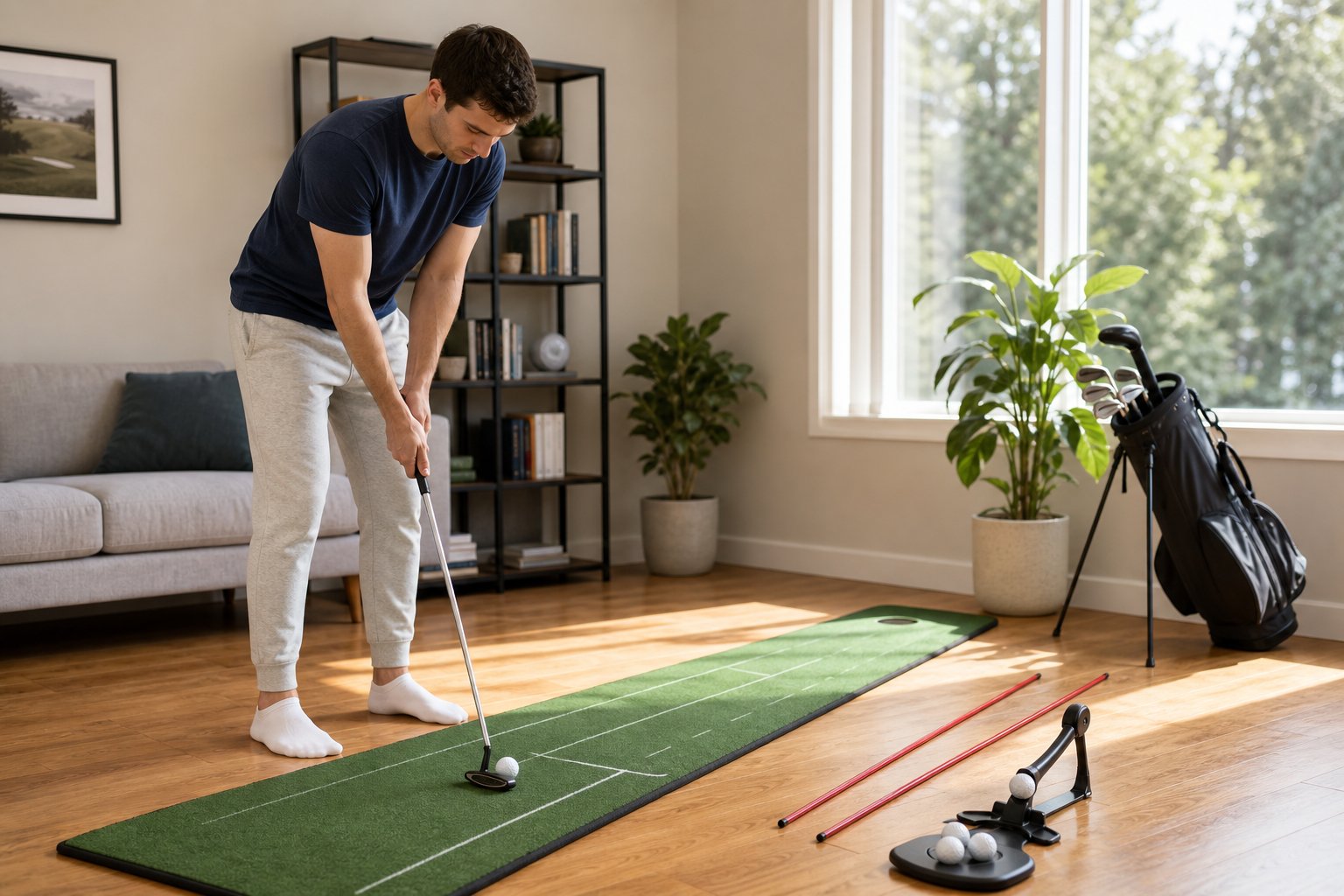
Putting mats are perfect for apartments since they roll up and slide under a bed or into a closet. Most are 2-3 metres long and slim enough to fit in a hallway or living room without moving furniture.
Chipping nets take a bit more planning. You need 2-3 metres of clearance and enough ceiling height if you're inside. Collapsible models that fold flat are best for small spaces.
Setup time matters, too. If a gift takes 15 minutes to assemble, it probably won't get used much. The best beginner golf gifts are ready in under a minute, pop-up nets, roll-out mats, and simple alignment tools are all good examples.
Storage is just as important as practice space. Measure your closet or garage before buying anything big. If a hitting mat doesn't fit anywhere easy to grab, it'll just get in the way.
Ease of Use for Beginners
The simplest gifts get used the most. We like items that need almost no instruction and give feedback right away, no complicated setup, no head-scratching.
Putting mats with alignment guides show you exactly where the ball should go and if your stroke is straight. No apps, no batteries, no wondering if you're doing it right. Just roll the ball, watch, adjust, repeat.
Training aids should make sense right away. A grip trainer that snaps onto any club is a no-brainer. An impact bag shows instantly if you hit the right spot. These work because beginners "get it" without a big learning curve.
Skip the gifts that need a long explanation or spit out confusing results. Swing weight tools, lie angle boards, and pressure plate systems might help advanced golfers, but they just make beginners scratch their heads.
We look for practice tools that help you build habits by repeating simple moves, not overanalyzing every detail. At this point, it's about getting comfortable and consistent, not chasing perfection. A couple of alignment sticks teach better stance than a video system that points out ten problems at once.
Fundamental Training Aids for Building Skills at Home
Building a solid golf swing takes repetition, and the right tools. A few smart training aids can help beginners develop muscle memory without needing a driving range. Swing trainers guide your form, hitting mats protect your floors and feel like real turf, and feedback devices show you what's actually happening with each swing.
Golf Swing Trainers for Consistent Improvement
Golf swing trainers teach beginners the right path and tempo without guessing. These tools range from weighted training clubs that build strength and rhythm to alignment sticks that show you where your body should be during the swing. Weighted trainers are especially useful because they slow you down and make you focus on good mechanics.
Impact bags are another great option for home practice. You can work on the most important part of the swing, impact, without hitting actual balls. The bag pushes back, so you feel what a solid strike is like and build a strong lead side. Unlike hitting a tire or something else hard, impact bags are made for golf and won't mess up your clubs or hurt you.
The best swing trainers for beginners help with just one or two basics at a time. This way, it's easier to get the hang of things step by step.
Golf Hitting Mats and Turf Mats
A good golf hitting mat protects your floors and gives you a realistic surface for practice swings and short iron shots. The best mats use turf that feels like real grass, so your club moves naturally instead of bouncing or grabbing. We think mats at least 4 by 5 feet give you enough room for a full stance and follow-through.
Thicker mats with some cushion help your wrists and elbows, especially if you practice a lot. Look for ones with a rubber backing so they don't slide around while you hit.
Portable turf mats work in garages, basements, or outside, and most pair well with practice nets for full swings. Together, a hitting mat and net make a solid home practice setup that fits in most houses.
Swing Path and Instant Swing Feedback Devices
Seeing what happens during your swing is huge for improvement, and modern feedback devices show you right away. Simple alignment rods and swing path trainers use visual cues to show if your club's moving on the right plane. They're surprisingly effective because they make mistakes obvious.
Some newer options clip onto your club and give feedback with lights or sounds. They'll let you know if the club face is open or closed at key points in the swing. Getting that feedback right away means you can adjust on the spot instead of repeating the same mistake.
Launch monitors are the top tier here, measuring ball speed, launch angle, and spin. They're pricier, but even basic models for home use now track clubhead speed and swing path, so you can actually measure progress.
Short Game Tools: Putting and Chipping Essentials
Beginner golfers take about 60% of their shots within 100 yards of the green, so practicing the short game at home is probably the fastest way to get better. Putting greens, technique aids, and chipping nets help new players build confidence and consistency without needing to hit the range.
Indoor Putting Greens for Any Space
An indoor putting green turns any room into a practice zone for putting stroke and reading greens. For apartments or small spaces, a 3x9 foot mat is a great start. You can practice meaningful 6- to 8-foot putts without moving all your furniture around.
Most good indoor greens have several cup positions and gentle contours to mimic real greens. Go for ones with stimp ratings between 9 and 11, this matches typical public courses, so you don't develop a stroke that's too wild for the real thing.
Mats with foam backing stay flat on carpet or hardwood. Some have alignment guides printed right on the surface, though honestly, those are most helpful early on. The real key is practicing regularly, even 10 minutes a day beats a random hour at the course.
Putting Aids for Technique
Putting aids target the mechanical issues that trip up beginners. Alignment lasers clip onto your putter and shine a line to the target, making it obvious if you're aimed correctly. We've seen new golfers improve almost instantly once they see their aim was off.
Gate drills use rails or rods to force a straight-back, straight-through stroke on short putts. Just set up two rods or gates a bit wider than your putter head, about 6 inches on each side of the ball. If you hit the gates, you know your path is off.
Putting mirrors with alignment marks help you check ball position, eye placement, and shoulder alignment. Drop one down during practice to see if your eyes are over the ball and your shoulders are square. Training balls with lines show you how the ball rolls after impact, which tells you a lot about your stroke.
Golf Chipping Nets and Target Pockets
A chipping net lets beginners practice trajectory and distance control in the backyard or garage. Pop-up nets with three target pockets at different heights teach you to pick the right shot. The lowest pocket is for bump-and-run chips; the higher ones are for lofted pitches.
We like nets between 24 and 36 inches wide with a weighted base so they don't blow over. Most fold flat in less than 30 seconds and weigh under 3 pounds, so you can stash them easily.
Target pockets with scoring zones turn practice into a game, which keeps things interesting. Try shots from 10, 15, and 20 yards to get a feel for different wedge swings. Foam balls are safe indoors, but real balls outdoors give better feedback on strike and spin. Aim for 20 reps per distance before changing things up.
Performance-Tracking Tech for Home Practice
If a beginner wants to get serious about improvement, performance-tracking tech can turn guesswork into real progress. Launch monitors give instant feedback on ball speed and swing, and golf GPS devices help track consistency over time.
Launch Monitors and Mobile Options
A portable launch monitor is one of the most useful tools for beginner golfers practicing at home. These gadgets measure things like ball speed, carry distance, and club head speed, so you can actually see your improvement.
A mobile launch monitor can be useful here. Some models use camera or radar tracking to capture spin rate and launch angle, helping beginners understand why their shots curve or come up short. Seeing your actual ball speed makes practice more focused than just hitting into a net and hoping for the best.
Most mobile launch monitors connect to your phone via Bluetooth. They usually need about 8 to 10 feet of ball flight for good data, which works in garages or backyards. A radar-based launch monitor is a solid budget-friendly option, while more advanced mobile models can give extra spin information if you want to spend a bit more.
For beginners, stick with models that show ball speed, carry distance, and club speed. These three numbers help you spot tempo issues and learn your real distances with each club, super helpful when you start playing on the course.
Golf GPS Devices for Data-Driven Progress
Golf GPS devices can really help beginners see what’s actually happening on the course and figure out which parts of their game need more attention at home. These handy wearables or handheld gadgets track how far you hit each shot and start to reveal patterns you might not notice otherwise.
I usually suggest GPS devices with stat-tracking features, things like fairways hit, greens in regulation, and putts per round. If you keep coming up short on approach shots, you’ll know it’s time to work on those distances at home with your launch monitor.
Most of today’s golf GPS watches sync up with smartphone apps, so you can keep all your practice and play stats in one place. This makes it easier to see if your at-home work is actually paying off on the scorecard. Some devices even offer virtual course play, letting you “play” famous courses while hitting into your home net. Honestly, that makes winter practice way less boring and gives you something to shoot for.
Practical Accessories to Elevate the At-Home Practice Routine
Little things can make a big difference when you’re putting together a home practice setup. Stuff like cleaning tools, repair kits, and starter packs help beginners keep their gear in shape and build good habits right from the start.
Golf Essentials Kits and Accessory Sets
A golf essentials kit is honestly a lifesaver for beginners who don’t realize what they’ll need until it’s too late. These sets usually have tees, ball markers, divot tools, and maybe a brush or towel. I’d go for a kit that comes in a pouch or case so you can toss it in your golf bag or keep it handy in your practice space.
Giving a complete kit is a nice way to introduce new golfers to the little things they’ll use all the time. Most beginners are surprised by how often they reach for a ball marker or run out of tees, even just practicing at home.
Pick kits with sturdy, well-made items. Cheap ones don’t last and just end up in the trash. If you can find a set with a scorecard holder or a solid pitch mark repair tool, even better, those extras add value but don’t take up much space.
Towels and Cleaning Tools for Gear Care
A golf microfiber towel is, hands down, one of the most useful things you can have for at-home practice. Microfiber absorbs moisture better than cotton and won’t leave lint all over your clubs. I’ve found that a towel around 40 by 60 centimeters is just about perfect for cleaning grips and clubheads after practice.
Get a towel with a clip, if you can. That way, it’s always right there on your bag or clipped to your net frame, and you’re more likely to use it instead of forgetting about it in a drawer.
Keeping grips clean actually helps you hold the club better and makes your clubs last longer. Wiping down your clubs after hitting into a net or using training aids keeps dirt from building up. Plus, a dedicated golf towel keeps your practice area a lot cleaner than just grabbing a random dish towel from the kitchen.
Divot Tools and Repair Essentials
Every golfer, beginner or not, should have a divot tool. Even if you’re just starting, fixing ball marks on greens is part of learning proper etiquette. These tools are tiny but make a big difference for the course.
At home, you can use a divot tool to check how you’re interacting with the turf when you hit off mats that show where you made contact. Some mats actually last longer if you smooth them out with a repair tool now and then.
Go for a simple two- or three-prong metal design. Skip the ones with too many bells and whistles. Metal tools last longer than plastic, and some come with a ball marker attached, which is pretty handy.
Books and Learning Resources for Beginner Golfers
Books and guides give beginners a solid foundation in the basics, so you can learn the “why” behind the swing without needing to go to the course. They break down complicated moves into plain English, which makes your practice time way more productive.
Best Golf Books for Fundamentals
A classic golf fundamentals book is still one of the best learning gifts for beginners. It covers the grip, stance, and swing plane with clear drawings and explanations that haven’t really changed since the book came out. I always recommend it to anyone who wants to understand what good technique actually means.
It’s great for at-home practice because you can flip to specific sections while you’re working on a certain part of your swing. A lot of golfers keep it nearby during range sessions or backyard practice to check their form. The no-nonsense advice helps you avoid bad habits before they start.
Other good picks include books about course management, the mental game, and etiquette. These round out the technical stuff and get you ready for actual rounds.
Instructional Guides and Video Aids
Video instruction is everywhere now, and for good reason. Beginners can actually see what a movement looks like and pause or rewind to compare their own swing. Instructional DVDs and online courses often have slow-motion and multiple angles, stuff you just can’t get from a book.
Combining video with written materials works best, in my experience. Videos help you get a feel for tempo and rhythm, while books go deeper into the technical side you can revisit as needed. Lots of beginners just prop up their phone or tablet during practice to check their form right away.
Many digital platforms offer drills designed for home practice. These help you organize your practice time and actually see improvement over weeks and months.
Other Thoughtful Gift Ideas for Home-Based Beginners
Besides practice gear, beginner golfers working at home really appreciate comfortable clothes, simple alignment tools, and storage solutions to keep everything organized.
Golf Apparel and Gloves for Comfort
Golf gloves make great gifts since everyone needs them and they wear out pretty fast. I’d suggest starting with an all-weather glove for their main hand (left for righties). A good glove improves grip and keeps blisters away during longer sessions.
Look for gloves with reinforced palms and breathable backs. Cabretta leather feels best, but synthetic gloves last longer and work well if things get sweaty or wet. Most beginners don’t realize they should swap out gloves every 10-15 rounds or practice sessions, especially once the palm starts to wear.
Golf clothes that move with you are more important than most beginners think. Moisture-wicking polos and stretchy pants let you swing without feeling stiff or restricted. Features like stretchy waistbands and seams that move with your shoulders make a surprising difference.
For home practice, comfortable jogger-style golf pants or performance shorts are perfect. No need to dress up just to hit balls into a net in your garage, just wear what lets you focus on your swing.
Alignment Sticks for Straight Shots
Golf alignment sticks are simple but super effective for beginners working on setup. These cheap rods help you line up your feet, shoulders, and clubface without any fancy tech.
I usually lay alignment sticks on the ground parallel to the target line during practice. It’s a quick way to see if your feet, hips, and shoulders are actually lined up. Most beginners accidentally aim their body right of target, and the sticks make it obvious.
Some ways to use alignment sticks:
- Place one along your toe line to check foot alignment
- Lay another parallel to it toward your target for ball position
- Stick one vertically in the ground to check your swing plane
- Hold one across your chest during rotation drills to watch your shoulder turn
Good alignment sticks are made from lightweight fiberglass or composite, so they won’t snap with normal use. I’d get a set of two, they usually come in bright colors and have pointed ends to stick into grass or mats.
Golf Bags and Organisational Picks
Beginner golfers collect gear faster than they expect, so a decent golf bag is a practical gift early on. For home practice, a stand bag or cart bag makes more sense than a big staff bag, they’re lighter and easier to move around.
A lightweight stand bag with organized dividers is a strong pick for beginners. It should be sturdy, easy to carry, and light enough for regular use. The 14-way divider keeps your clubs from tangling up.
If you’re setting up a home practice spot, a garage organizer or wall rack might be better. These keep clubs visible and easy to grab, which encourages more practice. Simple tube racks hold 6-8 clubs and are easy to mount to the wall.
Storage tips for home practice:
- Club protection: Padded dividers keep shafts and grips safe
- Accessory pockets: Separate spaces for gloves, balls, and alignment tools
- Accessibility: Grab clubs without moving everything else
- Space efficiency: Vertical racks save room in the garage or basement
A ball shag bag or bucket is also a smart buy for collecting practice balls. They hold 50-100 balls and save your back from constant bending.
Frequently Asked Questions
Here are quick answers to common questions about choosing practical golf gifts for beginner golfers who want to practice at home.
What are the most useful at-home practice gifts for a beginner golfer who is short on space?
A putting mat, alignment sticks, foam practice balls, and a compact chipping net are the most useful picks. They are easy to store, quick to set up, and work well in apartments, garages, basements, or small backyards.
Which golf practice gifts help a new golfer build a repeatable swing without overcomplicating things?
Choose simple tools that give clear feedback, such as alignment sticks, a basic swing connection trainer, a putting mirror, or an impact bag. These help beginners practice setup, posture, tempo, and contact without relying on complicated data.
How do you pick between a putting mat, putting green, or putting trainer for someone just starting out?
Start with a putting mat if the golfer is new or short on space. Choose a larger putting green if they have a dedicated area. Add a putting trainer later if they need help with stroke path, aim, or distance control.
What should you look for in a beginner-friendly chipping net or backyard practice setup?
Look for a foldable net with stable support, clear target pockets, and enough width for safe practice. A small turf mat and foam balls are helpful for indoor use, while real balls give better feedback outdoors.
Are golf swing trainers and alignment aids actually helpful for beginners, and which features matter most?
Yes. They are helpful when they focus on one skill at a time. The best options are easy to understand, quick to set up, and give instant feedback through feel, sound, visual guides, or ball flight.
What's a smart budget-friendly gift bundle for a new golfer to practise at home year-round?
A practical bundle could include a putting mat, alignment sticks, a compact chipping net, foam practice balls, and a golf towel. This covers putting, setup, short game practice, and gear care without needing a large space or expensive technology.
Share:
Indoor Golf Chipping Practice: Setup, Safety, and Space Planning
Vacuum Sealer Machine vs Vacuum Sealer Set: Which Option Fits Your Kitchen Routine?