

Check out our latest golf collection!
A golf practice net can help you improve iron and driver accuracy at home, but it works best when your sessions have a clear purpose. Simply hitting ball after ball without structure can reinforce inconsistent habits. A better approach is to use your home setup to train the things you can observe, including strike quality, setup, start direction, tempo, and repeatability.
For golfers who cannot make frequent trips to the range, indoor golf practice can provide a convenient way to work on specific parts of the swing. The key is choosing drills that provide useful feedback instead of relying on ball flight that you cannot see.
Whether your net is set up in a garage, basement, backyard, or dedicated practice space, the fundamentals remain similar. This guide covers safe setup, practical feedback methods, and focused drills for irons, drivers, wedges, and short-game practice.
Key Takeaways
- A safe, organized practice station provides the foundation for productive accuracy drills.
- Consistent setup and alignment are essential when training for accuracy.
- Strike location, start direction, video, and other feedback tools can make net practice more useful.
Build a Safe, Feedback-Ready Practice Station
Start with a suitable net, mat, and ball combination. Then consider swing clearance, net placement, and simple feedback tools that can make each practice session more purposeful.
Choose the Right Net, Mat, and Ball Type
Choose a golf net designed for the type of practice you plan to do. If you will be making full swings with irons, fairway woods, or a driver, confirm that the net is intended for full-swing practice and for the type of golf ball you plan to use. Side protection can also provide an additional layer of security for off-center shots.
Pair the net with a stable hitting mat designed for repeated golf swings. A supportive mat can provide a more suitable hitting surface than a hard floor and can make it easier to practice consistent setup and ball position.
Real golf balls provide familiar feel and sound, but they should only be used when your net and practice area are designed for them. Foam or limited-flight balls can be useful in more confined spaces, although their impact feedback will differ from that of a standard golf ball.
Set Up Safe Swing Clearance and Net Distance
Before hitting any balls, check your full swing radius with your longest club. Make several slow practice swings and confirm that the club cannot contact walls, ceilings, light fixtures, shelves, furniture, or other objects.
There is no universal safe distance between the golfer and every practice net. Follow the net manufacturer's setup instructions and allow enough room for the netting to absorb impact without contacting anything behind it. Leave additional space around the sides and behind the hitting area whenever possible.
Remove fragile objects, keep other people and pets outside the hitting area, and inspect the net regularly for worn or damaged material before practicing with real golf balls.
Add Simple Targets and Alignment References
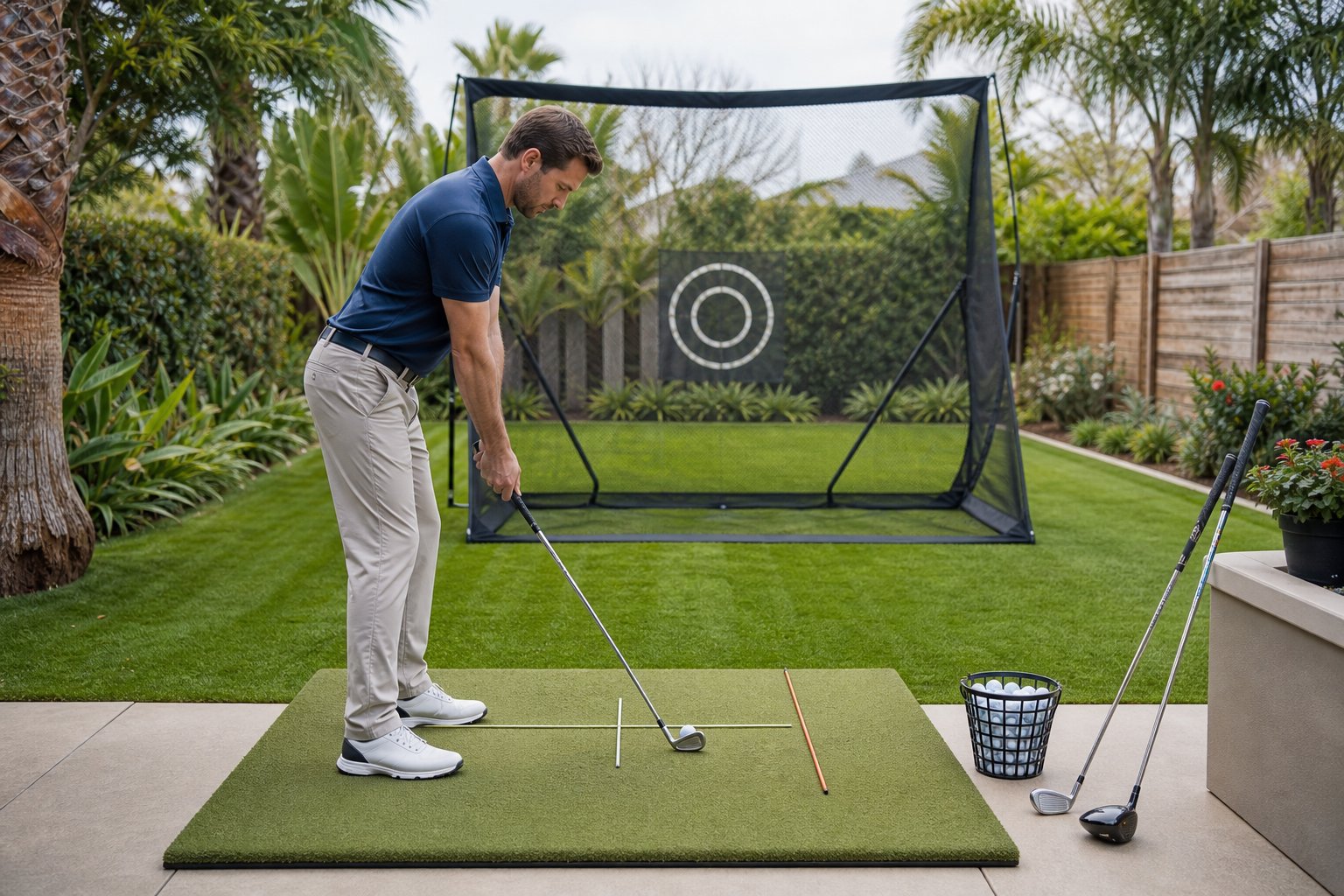
You do not need complicated equipment to create useful feedback. Place one alignment stick along your foot line and another along your intended target line. These references make it easier to check whether your stance and aim remain consistent from shot to shot.
For strike quality, use impact tape or another clubface-safe method to see where the ball contacts the face. Consistently centered marks can indicate improving contact, while scattered marks show that strike location is still changing from swing to swing.
Set Up for Repeatable Accuracy Before Every Swing
Every net session should begin with the same fundamentals you would check on the course, including ball position, grip, alignment, and balance. Repeatable setup makes it easier to determine whether changes in your results are coming from the swing rather than from inconsistent preparation.
Match Ball Position to Irons and Driver
Ball position changes with the club being used, so it is worth checking before each practice set.
As a general starting point, shorter irons can be played near the center of the stance, with longer irons positioned progressively farther forward. This supports the descending strike commonly used with iron shots.
With the driver, a common starting position is near the inside of the lead heel. This places the ball farther forward than it would be for most iron shots.
| Club | General Ball Position |
|---|---|
| Short irons | Near the center of the stance |
| Mid irons | Slightly forward of center |
| Long irons | Farther forward than mid irons |
| Driver | Near the inside of the lead heel |
These positions are useful starting points rather than fixed rules for every golfer. Alignment sticks can help you reproduce your chosen ball position consistently.
Check Grip, Balance, and Aim
Grip pressure can influence how freely you swing and how securely you control the club. Excessive tension may restrict movement, while an overly loose grip can make the club feel unstable. Aim for a secure grip that still allows a natural swing.
Balance is equally important. Use a comfortable stance that allows you to rotate without losing stability. Driver stances are typically wider than iron stances, but the goal is to remain balanced throughout the motion.
Aiming indoors can be difficult because there is no visible fairway. Use a target reference on or behind the net and align your feet and shoulders consistently with your intended target line.
Use a Consistent Pre-Shot Routine
A repeatable pre-shot routine can help you approach each practice swing with the same rhythm and preparation. Choose a target, make a purposeful practice swing if needed, address the ball, and then swing.
The routine does not need to be complicated. It simply needs to be consistent enough that you are not changing your preparation from one shot to the next.
Repeating the same process also makes net practice more transferable to the course because you are practicing both the swing and the preparation that comes before it.
Improve Iron Contact and Start-Line Control
Productive iron practice should focus on consistent contact, low-point control, and a repeatable starting direction. The following drills can help you train those skills without relying entirely on visible ball flight.
Use the Towel Drill for Ball-First Contact
Place a folded towel a short distance behind the ball where the club would contact the ground if the low point occurred too early. Hit controlled shots with a wedge or short iron while trying to avoid the towel.
If the club repeatedly catches the towel before reaching the ball, focus on improving your low-point control rather than simply swinging harder. The goal is to create more consistent ball-first contact.
Once you can perform the drill reliably with a shorter club, progress to a mid-iron and repeat the exercise.
Train a Stable Impact Position With an Impact Bag
An impact bag can help you rehearse the feeling of a stable impact position without hitting a golf ball. Use the bag according to its instructions and make slow, controlled movements rather than full-speed swings.
For many iron shots, a stable lead wrist and hands that are slightly ahead of the clubhead can be useful impact references. The goal is not to force excessive forward shaft lean, but to develop a controlled and repeatable position.
This drill can also make an early release easier to notice because you can compare different impact positions at a slower speed.
Use a Gate Drill to Refine Club Delivery
Create a small gate with two tees or other safe markers, leaving enough room for the clubhead to pass through without making contact. Align the gate with your intended target line and begin with slow swings.
If the club repeatedly clips one of the markers, it indicates that the club is not moving through the intended corridor consistently. The drill itself does not identify every underlying swing fault, so use it primarily as a feedback tool for repeatability.
Once you can move through the gate consistently at a controlled speed, gradually work toward normal swings.
Progress From Wedges to Mid-Irons
Begin contact drills with a pitching wedge or another shorter iron. Shorter clubs generally make it easier to focus on strike location and balance before adding the challenge of a longer shaft.
Once your contact becomes consistent, move gradually through your iron set. For example, you might progress from a pitching wedge to a 9-iron, then a 7-iron, and eventually a longer iron.
Focus on a manageable number of quality repetitions with each club rather than trying to hit as many balls as possible.
Build Driver Accuracy Without Chasing Maximum Power
Driver practice with a net should prioritize repeatable setup, centered contact, start direction, and tempo. Because you cannot see the full ball flight, avoid judging a swing only by how hard the ball reaches the net.
Create a Target Window on the Net
Create a clearly visible target area near the center of the net using a hanging target or another method that is safe for your setup. The purpose is to give each shot a consistent visual reference rather than simply aiming somewhere into the net.
Track whether your shots repeatedly start to the left, center, or right of your intended reference. This provides useful information about start direction, although it cannot confirm the complete flight or final dispersion of the shot.
Record a small set of swings and look for patterns over time. If you consistently miss the target reference on the same side, review your setup, alignment, strike location, and swing with additional feedback before making major changes.
Dial In Tee Height and Setup
Tee height can influence where the ball contacts the driver face, so use a consistent starting point and adjust based on your strike pattern.
A common reference is to tee the ball so roughly half of it sits above the top edge of the driver at address. This is a starting point rather than a requirement for every golfer or driver.
Quick setup checks:
- Use a repeatable tee height.
- Position the ball near the inside of the lead heel as a general starting point.
- Check strike location on the clubface rather than judging the swing by sound alone.
Impact tape or another clubface-safe marking method can help you determine whether your contact is moving toward the center of the face as you practice.
Use Controlled-Speed Reps Before Full Swings
Begin driver practice at a comfortable, controlled speed. Slowing the swing down temporarily can make it easier to focus on balance, strike location, and clubface awareness.
As contact becomes more consistent, gradually increase speed while trying to preserve the same setup and rhythm. Avoid jumping immediately from slow practice swings to maximum effort.
The goal is to build a driver swing that remains repeatable as speed increases.
Use Net Feedback for Wedges, Pitching, and Chipping
A golf net cannot show you the full carry distance or rollout of a wedge shot, but it can still help you work on strike quality, swing length, tempo, and start direction.
Create Swing-Length Windows for Wedge Shots
Develop wedge control by practicing several repeatable backswing lengths instead of trying to estimate exact yardage indoors. For example, you can rehearse shorter, medium, and longer swings while maintaining a similar tempo.
Without measured ball-flight data, the goal is not to assign exact distances to those swings. Instead, you are learning to reproduce distinct swing lengths consistently.
Periodically test those swings outdoors or with reliable launch data so you can connect each motion with its actual carry distance.
Practice Start-Line Accuracy for Chips and Pitches
Because a net prevents you from seeing the ball land and roll out, focus on the parts of a short-game shot that you can observe. Set a clear target on the net or use an alignment reference on the ground to establish your intended starting direction.
Then score each repetition based on simple criteria:
- Solid strike and intended start direction: one point
- Thin or heavy contact: no point
- Clear miss to the left or right: no point, then recheck alignment and setup
A short set of scored repetitions can make your practice more focused and gives you a simple way to compare consistency between sessions.
Read Strike and Start-Line Cues Carefully
Sound and feel can provide useful clues about contact, but they should not be used alone to diagnose a swing. Combine them with visible strike marks on the clubface, video, and a consistent target reference.
The point where a ball reaches the net can also help you compare shots within the same setup, particularly when you are monitoring starting direction. However, it does not reliably reveal the complete swing path, clubface angle, spin, or final ball flight.
Ball rebound should not be treated as a swing diagnostic because it can be affected by net tension, impact location, net design, and surrounding surfaces.
Track Progress and Transfer Practice to the Course
Net practice can provide valuable feedback on contact, setup, and swing consistency, but improvement should eventually be checked against actual ball flight. Use additional feedback to confirm whether changes made at home are producing the results you want.
Use Video and Launch Data to Verify Changes
Recording your swing with a phone can help you review visible elements such as setup, posture, balance, tempo, and overall movement. Use the same camera position whenever possible so comparisons between sessions are more meaningful.
Video is especially useful for tracking changes over time, but standard phone footage may not provide enough information to measure details such as exact clubface angle or club path at impact.
If you have access to a launch monitor, metrics such as launch direction, launch angle, ball speed, spin, and other measured data can provide additional feedback that a basic net setup cannot show.
Follow a Focused Weekly Practice Plan
A simple practice schedule can help you give each session a clear purpose. For example:
| Day | Focus |
|---|---|
| Monday | Iron contact and strike quality |
| Wednesday | Driver setup, start direction, and face contact |
| Friday | Combined drills with shorter practice sets |
A practice journal can also help. Record what you worked on, what changed, and whether your strike pattern or consistency improved. Over several sessions, those notes can reveal which drills are helping and which areas still need attention.
Consistent, purposeful repetition is generally more useful than occasional sessions with no specific goal.
Know When to Ask a Golf Professional for Help
Net practice is useful for reinforcing skills you understand, but it has limitations. If you are practicing consistently and the results are not transferring to the course, the issue may require feedback that your home setup cannot provide.
A qualified golf instructor can assess your swing in context and help determine whether the changes you are practicing address the actual cause of the problem.
Professional feedback can be particularly useful when you are making a significant swing change, dealing with a persistent miss, or are unsure how to interpret what you are seeing in video or launch data.
Frequently Asked Questions
Here are concise answers to common questions about net sizing, ball choice, practice space, and measuring progress with irons and drivers.
What size golf practice net is best for safely hitting irons and a driver at home?
There is no single minimum size that is right for every space. Choose a net specifically designed for full swings and large enough to cover your likely miss pattern. Side protection can be valuable when practicing with longer clubs. Always follow the manufacturer's setup and clearance instructions.
Can I use a real golf ball with a practice net, or should I use foam balls?
Use real golf balls only if the net is designed for them and your practice area provides adequate protection and clearance. Foam or limited-flight balls can be a practical option in tighter spaces, although they provide different impact feedback.
How much space do I need behind the net to practice driver shots safely?
The required space depends on the net's design and how much the netting moves when struck. Follow the manufacturer's instructions and leave enough clearance for the net to absorb the shot without contacting walls, windows, furniture, or other objects behind it.
How can I tell if I am improving my iron accuracy when hitting into a net?
Track strike location, setup consistency, and start direction across multiple sessions. More consistent centered contact is a positive sign, but use outdoor ball flight or measured launch data when possible to confirm whether your practice is improving overall shot accuracy.
What drills can help improve driver accuracy with an at-home golf net?
Use alignment references, a consistent target on the net, controlled-speed swings, and clubface strike tracking. These drills can help you monitor setup, start direction, contact, and repeatability without relying on visible full ball flight.
Do I need a hitting mat to practice irons and drivers with a golf practice net?
A hitting mat is strongly recommended when practicing on hard or unsuitable surfaces. Choose a stable mat intended for golf practice that provides enough room for your stance and swing. A suitable mat also makes it easier to maintain consistent ball position and setup.
Share:
How to Use a Golf Hitting Mat to Practice Low-Point Control and Cleaner Ball Contact
Putting Mat vs Practice Green: What Can You Realistically Improve at Home?