

Check out our latest golf collection!
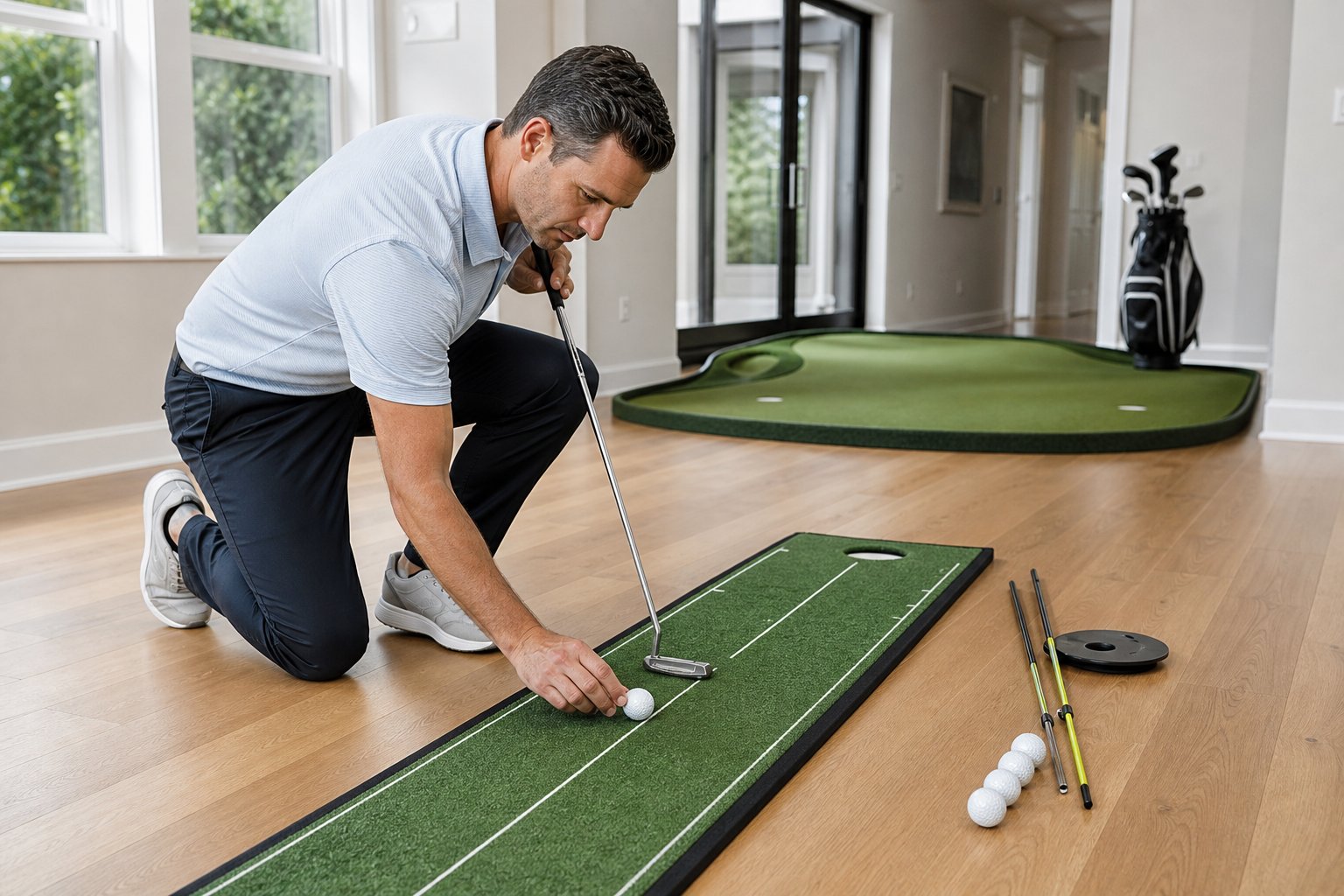
A putting mat can help you develop a more repeatable stroke, but it cannot fully reproduce the breaks, changing speeds, surface conditions, and pressure you encounter on a real golf green. If you want to improve at home, a mat is particularly useful for working on stroke consistency, tempo, face control, alignment, and short distance control on a predictable surface.
The main difference between a compact putting mat and a larger indoor practice green comes down to what you want to improve. A compact mat works well for frequent, focused practice in a hallway, office, or spare room. A larger practice green can provide more space for distance control and may include contours that introduce basic breaking putts.
The best choice is the setup that matches your available space and practice goals. Below, we explain what each option does well, where indoor putting practice has limitations, and how to build a home routine that supports better putting fundamentals.
Key Takeaways
- Home putting mats can help develop consistent mechanics, alignment, and short distance control.
- A larger practice green may provide more room for longer putts and basic contour practice.
- Indoor practice cannot fully replicate changing grass conditions, complex breaks, or the pressure of putting during a round.
- The most useful setup is one that fits your space, practice goals, and preferred routine.
What Each Home Practice Setup Does Best
A putting mat and an indoor practice green may serve similar purposes, but they can support different types of practice. Understanding those differences makes it easier to choose a setup that fits your game.
What a Putting Mat Teaches Well
A putting mat is primarily a repetition tool. Its consistent surface makes it useful for working on a repeatable stroke, face control at impact, alignment, tempo, and short putts.
Many indoor mats use synthetic turf designed to provide a relatively consistent roll. Because the surface changes less from putt to putt than a natural green, it can make mechanical inconsistencies easier to identify.
Putting mats are also compact and easy to fit into a hallway, office, or other small area. Their main limitation is that most flat mats do not reproduce the slopes, complex breaks, or changing surface conditions found on a golf course.
What a Practice Green Adds
A larger indoor practice green can provide more room for different distances and angles. Some designs also include contours, tiers, or adjustable features that allow you to practice basic breaking putts rather than putting only along a straight line.
That additional space can be useful if you want to spend more time on pace control or vary your practice positions. A larger surface may also provide a more immersive practice environment, although the feel and speed will still depend on the specific materials and construction.
Practice greens generally require more floor space and may involve a larger investment than a simple roll out mat. The extra space is most useful when you intend to practice regularly and want more variety than a compact mat can provide.
Where Both Options Fall Short
Neither setup can fully replace practice on natural grass. Real greens introduce changing speeds, slopes, moisture levels, surface imperfections, and grass characteristics that an indoor surface cannot completely reproduce.
Indoor practice also removes many of the variables you encounter during a round, including uneven stances, changing weather, unfamiliar greens, and the pressure associated with scoring.
For that reason, home putting setups are best treated as tools for developing repeatable fundamentals. Practice on real greens remains important for learning how to adapt those fundamentals to changing conditions.
Skills You Can Realistically Improve Indoors
A putting mat is especially useful when you want to isolate specific parts of your technique without the additional variables found on a natural green.
Start Line and Face Control
Your putter face angle at impact is a major influence on the direction the ball starts. Indoor practice gives you a controlled environment for checking that start direction repeatedly.
Alignment markings, a putting mirror, or a simple gate made with tees can provide useful visual feedback. For example, place two tees slightly wider than the ball along your intended start line and try to roll putts cleanly through the gate.
If the ball repeatedly starts outside the intended line, review your alignment, face position, and stroke rather than assuming the surface caused the miss.
Stroke Path, Eye Position, and Setup
Home practice is also useful for developing a consistent setup. You can work on ball position, shoulder alignment, posture, grip pressure, and the relationship between your eyes and the target line without feeling rushed.
A putting mirror can help you monitor these positions and check whether your setup changes from one repetition to the next. The goal is not to force every golfer into one exact position, but to develop a setup that is repeatable and supports a comfortable stroke.
Useful checkpoints include:
- Consistent eye position relative to the ball and target line
- Shoulders aligned appropriately for your intended start line
- A square putter face at address
- Consistent ball position and grip pressure
Pace Control From Short Range
A consistent putting surface can be useful for practicing short distance control because it allows you to compare one stroke with the next without major changes in surface conditions.
Try setting several targets at different distances and focus on rolling each ball to the intended finishing zone. This helps connect stroke length and tempo with the amount of energy needed for different putts.
The limitation is space. Compact mats are not designed to reproduce the feel of long lag putts across a full size green, so longer distance control should also be practiced outdoors when possible.
Building Repeatable Practice Habits
One advantage of a home setup is convenience. Short practice sessions can be easier to fit into a regular schedule than frequent trips to a course or practice facility.
Consistency is more useful when the repetitions have a clear purpose. Rather than rolling putts randomly, choose a specific skill, use a target or feedback tool, and track whether your execution becomes more repeatable.
Practice Limits That Require a Real Green
Indoor putting tools are useful for mechanics and repetition, but some skills depend heavily on real green conditions.
Reading Slope and Breaking Putts
A flat putting mat cannot teach you how to read complex slopes. Contoured indoor greens and adjustable break trainers can introduce basic breaking putts, but they still provide a limited range of slopes compared with a golf course.
Real greens require you to evaluate the overall surface, identify subtle changes in elevation, choose a starting line, and match that line with the appropriate speed.
If green reading is an area you want to improve, combine indoor stroke practice with regular sessions on a natural practice green.
Adapting to Changing Green Speeds
Green speed can be measured using a Stimpmeter, but the speed a golfer experiences can vary among courses and can also change with maintenance, moisture, weather, and other surface conditions.
An indoor mat typically provides a more consistent roll. That consistency is useful for mechanical practice, but it does not teach you to recalibrate your pace for an unfamiliar green.
Before a round, spending time on the course's practice green can help you adjust your feel to the conditions you are likely to encounter that day.
Learning Long Putt Distance Control
Long lag putts require a larger movement and greater sensitivity to slope and speed than short putts. Compact home mats provide limited room for this type of practice.
Distance markers can still help you vary stroke length indoors, but they do not fully reproduce the visual and physical experience of watching a ball travel across a long section of natural green.
For long distance control, combine home practice with sessions on a full size practice green whenever possible.
Choosing a Mat That Supports Your Goals
Not all putting mats are designed for the same type of practice. Surface consistency, dimensions, alignment features, storage requirements, and optional accessories can all influence how useful a mat will be in your space.
Surface Quality and Roll Consistency
Look for a surface that lies flat and produces a reasonably consistent roll. Dense, evenly constructed synthetic turf can make it easier to compare one putt with the next without unexpected bumps or changes in direction.
If a manufacturer provides an estimated green speed, treat it as a comparison point rather than a guarantee that the mat will feel exactly like a particular golf course. Surface preparation, floor conditions, and the construction of the mat can all affect how it performs.
A stable backing is also important. A mat that slides, wrinkles, or develops raised edges can interfere with both setup and ball roll.
Size, Storage, and Room Layout
A longer mat gives you more options for distance practice, but it also requires additional floor space. Measure the area before choosing a mat and leave enough room for your stance and putting stroke.
If you share the room or need to store the mat between sessions, consider how easily it rolls, folds, or moves. A convenient setup is more likely to become part of a regular practice routine.
A general space guide is:
- Small space: A compact mat around 6 to 8 feet long
- Medium space: A mat around 9 to 10 feet long with comfortable stance room
- Large space: A mat 12 feet or longer for more distance variation
These are general planning ranges rather than requirements. Choose dimensions that suit the room and the type of practice you expect to do most often.
Alignment Features and Target Design
Alignment markings can make practice more structured by giving you a visual reference for face position and start direction.
Multiple targets or putting positions can also add variety by allowing you to change distances and angles instead of repeating exactly the same putt throughout a session.
Choose features that support the skills you actually want to develop. A simple mat with clear alignment references may be more useful than a complicated setup filled with features you rarely use.
Ball Returns and Useful Extras
A ball return can reduce the need to retrieve balls repeatedly and make longer practice sessions more convenient.
Other accessories may include alignment mirrors, putting gates, tempo tools, distance markings, or adjustable contour features. These are optional, but they can provide additional feedback when they match a specific practice goal.
If you are building a straightforward home setup, a consistent surface, clear target, stable backing, and enough usable length can cover the core requirements.
Matching Mat Types to Your Practice Priorities
Once you know whether your priority is surface feel, alignment, distance control, portability, or breaking putts, it becomes easier to narrow down the type of setup that makes sense for your home.
Premium Surfaces for a More Natural Feel
If surface feel is a priority, look for a mat designed to provide an even roll with a stable, dense putting surface. Higher quality construction may also help the mat lie flatter and maintain a consistent texture with regular use.
No synthetic surface will reproduce every characteristic of natural grass, so focus on consistency rather than expecting an exact match to a particular course.
Training Mats for Alignment and Repetition
Golfers working primarily on start direction and stroke consistency may benefit from mats with alignment lines, distance markings, putting gates, or other built in references.
These features can make it easier to structure drills and identify whether your setup and starting direction remain consistent over repeated putts.
Budget and Compact Choices
A simple roll out mat can be enough for short putt practice when space or budget is limited. Look for a surface that stays reasonably flat and offers enough room to address the ball comfortably.
Portability can be particularly useful in apartments, offices, or multipurpose rooms where the practice area cannot remain set up permanently.
Break Trainers and Digital Feedback Systems
If you want more feedback than a flat mat provides, adjustable break trainers and contoured practice surfaces can introduce basic slopes and different starting lines.
Digital systems may add information about factors such as ball speed, start direction, or stroke characteristics, depending on the technology used. Review the capabilities and setup requirements of any system carefully because available measurements and accuracy vary.
These tools can add variety to home practice, but they should complement rather than replace time spent learning to read and adapt to natural greens.
A Simple Home Practice Plan That Transfers to the Course
A putting mat is most useful when each session has a clear purpose. A simple routine can combine start direction, pace control, and occasional outdoor practice without requiring long sessions.
Daily Start Line Routine
Begin with a start line drill. Place two tees or use alignment markings to create a narrow gate a short distance in front of the ball. Roll putts through the gate from a comfortable distance.
Focus on starting the ball along the intended line rather than whether every putt reaches a hole. A small set of focused repetitions can provide useful feedback without turning the drill into mindless repetition.
Distance Control Sessions
After working on start direction, add several distance targets. For example, choose three points along the mat and roll several balls toward each one.
Try to finish the ball within a small target zone instead of focusing only on whether it reaches a cup. Keep track of successful attempts so you can compare your consistency over time.
The goal is to develop a better relationship between stroke length, tempo, and finishing distance. That skill can then be adjusted to the speed of the greens you encounter outdoors.
How to Combine Indoor Reps With Course Practice
Home practice can help make your mechanics more repeatable, while a real green allows you to test those mechanics under changing conditions.
Before a round, spend some time on the practice green checking both short putts and longer pace control. Pay attention to how the ball responds compared with your indoor surface.
This combination helps separate two important skills: developing a consistent stroke at home and learning to adapt that stroke to the speed, slope, and surface conditions of the course.
Frequently Asked Questions
Can a putting mat actually help improve my putting stroke and consistency?
Yes. A consistent putting surface can help you practice setup, start direction, tempo, face control, and short distance control through repeated drills. It cannot replace practice on real greens, but it can be a useful tool for developing repeatable fundamentals.
What putting skills can I practice at home, and which ones still need work on a real green?
At home, you can work on setup, stroke path, face control, alignment, tempo, and distance control within the length of your mat. Reading complex breaks, adjusting to changing green speeds, and practicing long lag putts are better suited to a real practice green.
How much space do I need for an effective home putting setup?
It depends on your goals. A compact space of about 6 to 8 feet can support short putt and stroke drills, while a longer area provides more options for distance control. Allow enough width for a comfortable stance and unrestricted putting stroke.
Should I choose a putting mat or a larger practice green?
Choose a putting mat if you want a compact setup for frequent stroke and alignment practice. Consider a larger practice green if you have more space and want greater distance variation or basic contour practice.
How often should I practice putting at home?
There is no single ideal schedule. Regular, focused practice is generally more useful than simply accumulating repetitions. Choose a routine you can maintain and give each session a specific goal, such as start direction or pace control.
What features matter most when choosing a putting mat?
Prioritize a consistent surface, stable backing, suitable dimensions, and useful alignment or target markings. Ball returns, mirrors, gates, contours, and digital feedback can be helpful extras when they support a specific practice goal.
Share:
How to Practice Iron and Driver Accuracy With a Golf Practice Net at Home
Do Vegetables Need to Be Blanched Before Vacuum Sealing for Freezer Storage?