

Check out our latest compact vacuum sealer for food collection!
We've all been there, wiping down the counters, running the dishwasher, and putting things away, only to walk back into the kitchen and feel like something's still off. The surfaces are clean, there's no visible grime, but the space feels chaotic when we try to cook.
A clean kitchen and an organized kitchen are not the same thing, and the difference comes down to how we store items, arrange our space, and establish daily habits.
The issue isn't really about cleanliness. It's about whether we can find what we need when we need it, if our counters actually help us cook, and whether the layout matches how we move. When stuff has a spot and our routines work with the setup, the kitchen feels calm, even if we're in a rush.
This gap between "clean" and "organized" explains why we can tidy up and still feel frazzled when dinner rolls around. Spotting what causes that disorganized feeling lets us make changes that last, turning our kitchens into spaces that work for us, not against us.
Key Takeaways
- Cleaning removes dirt while organizing creates functional systems that support how you actually cook
- Storage placement and kitchen layout directly impact whether the space feels chaotic or calm during use
- Daily reset habits and intentional storage solutions prevent clutter from building up between deep cleans
The Illusion of Cleanliness Versus Organization
A kitchen can sparkle from top to bottom and still somehow feel like a headache to work in. This happens when we focus more on wiping surfaces than on creating setups that actually help us cook and store food.
Visual Clutter and Mental Stress
Open a cabinet and get hit by a jumble of mismatched containers or pots without lids? That instant stress isn't just in your head. Disorganized spaces crank up anxiety because our brains can't process all the competing visuals. Even if the counters gleam, hidden chaos behind doors slows us down every time we try to grab something.
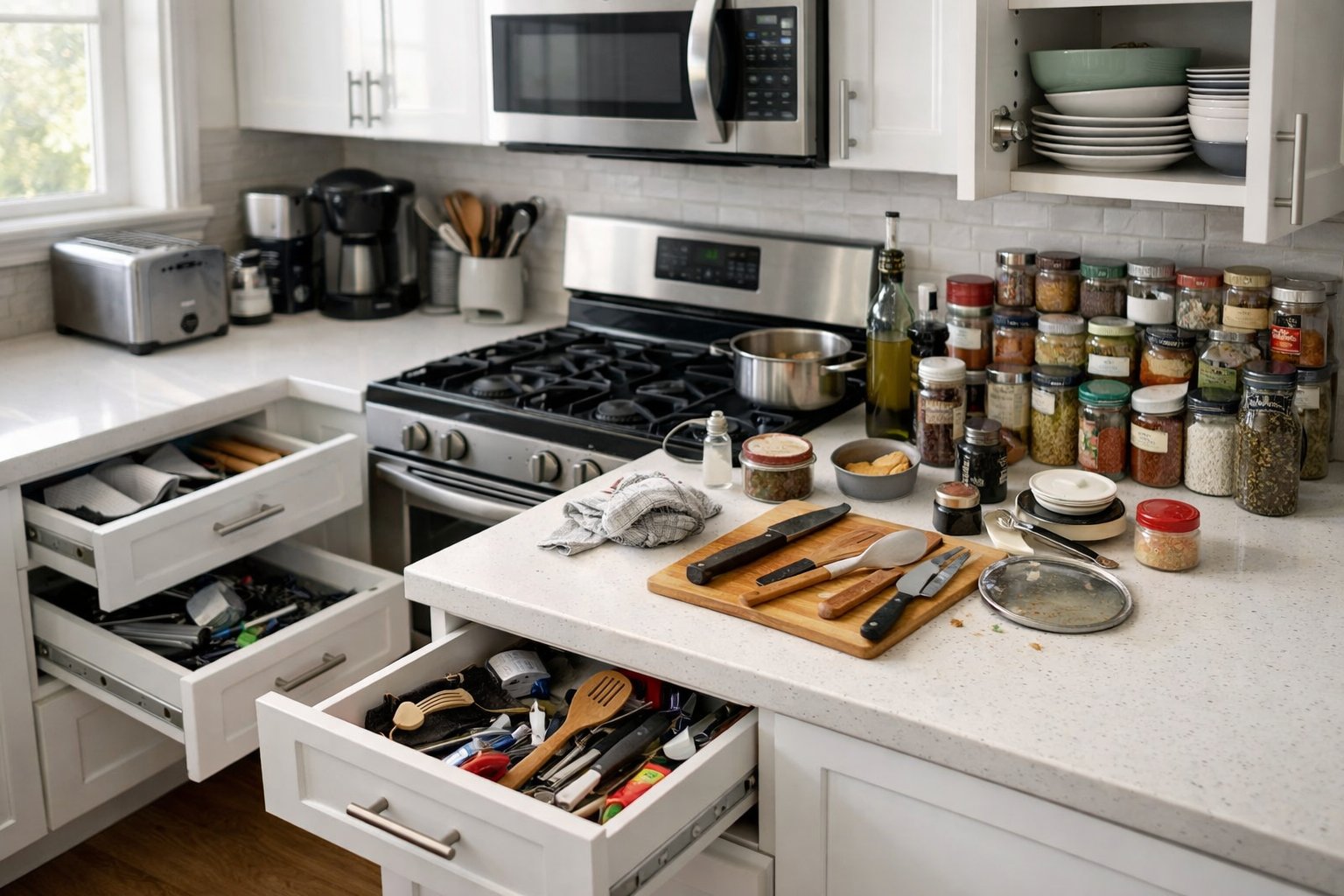
Kitchen clutter hits hardest during meal prep. That drawer overflowing with spatulas and gadgets? It forces us to sort and decide with every reach. All those little choices add up, and before we've even chopped an onion, we're already tired.
The Difference Between Clean and Organized
Clean means the surfaces are wiped and the dishes are done. Organized means you can grab the rice without moving a whole shelf, and your favorite spices are right next to the stove.
Ever had a "clean" pantry where every shelf is stuffed and you can't find anything? Canned goods vanish behind cereal boxes, baking stuff mingles with snacks, and you end up buying more of what you already have. An organized kitchen puts things together by type and how often you use them, so the space actually helps you cook.
Food storage is where this really shows. A clean fridge still wastes food if leftovers get lost in the back or produce goes mushy in mystery drawers.
Why Clutter Returns Without Systems
Cleaning only removes the mess for a bit; organization keeps it from coming back. If stuff doesn't have a real home, we just shove it wherever there's space. That's why the junk drawer fills up again in a week, and counters end up crowded with appliances we barely use.
Visual clutter sneaks in when our storage doesn't match how we actually live. If we bake twice a year but leave the mixer out all the time, we're giving up prime space for something we rarely touch. Bulk pantry goods without labels or containers? Good luck remembering what you have.
It's not about more cleaning. It's about setting up systems that fit how we cook, what we actually use, and which tools we reach for every day.
Common Culprits of a Disorganized-Looking Kitchen
Even if the counters are wiped and the dishes are put away, some things just make kitchens look messy. The real troublemakers? Everyday stuff we keep close—appliances, containers, and specialty gadgets that pile up before we notice.
Countertop Overload
Our countertops turn into parking lots for everything—mail, keys, you name it—but the kitchen stuff is the real problem. Coffee makers, toasters, knife blocks, fruit bowls, and utensil holders all fight for space.
It gets worse when we add cutting boards propped against the backsplash, paper towels, and that parade of cooking oils we swear we need. Each thing seems necessary, but together, they crowd the space and make meal prep feel tight.
Honestly, we need about 36 inches of clear counter for comfy cooking. When every appliance is out because "we use it daily," we're kidding ourselves—how often do you really use that bread maker?
The look of these items matters too. Big, dark appliances add more visual clutter than sleek, smaller ones, even if they take up the same room.
Overflowing Cabinets and Drawers
Opening a cabinet shouldn't feel like a puzzle game, but most of us cram things wherever they'll fit. Without zones or drawer dividers, utensils get tangled with measuring cups, and spices end up buried behind canned goods.
The junk drawer curse spreads easily. Rubber bands, chip clips, takeout menus, batteries—they all get tossed in with actual kitchen tools. When drawers are a mess, we can't find what we need, so stuff ends up on the counter, making things look messier.
Cabinets don't fare much better. Mismatched containers tumble out, lids and bases never seem to match, and stacking things too high means we only use what's in front. The back turns into a graveyard for forgotten snacks.
Storage solutions like shelf risers and organizers help, but only if we've already ditched the extras and the expired stuff.
Excess Small Appliances
The kitchen gadget world wants us to own a tool for everything. Air fryers, Instant Pots, blenders, food processors, stand mixers, slow cookers, rice cookers, kettles—it never ends.
But let's be real: most of us use two or three of these regularly. The rest just hog space on the counter or in cabinets, adding to the clutter.
We keep these appliances thinking, "Maybe I'll use it someday," but that spiralizer from 2022? It's probably not making a comeback. Unused appliances eat up space and add visual noise.
Take a look—what have you actually used in the last month? If something hasn't seen the light of day in six months, it's probably time to stash it elsewhere or let it go.
Serving Platters and Bulk Items
Serving platters, cake stands, and special-occasion dishes are tricky to store. They're big, flat, and don't stack well, so they end up leaning in cabinets or taking over shelves, even though we only use them a couple of times a year.
Bulk buys from warehouse stores are another headache. Huge packs of paper towels and family-size cereal boxes just don't fit in regular cabinets. We buy them to save money, but then they take over the kitchen because there's nowhere else for them.
Big serving bowls and seasonal bakeware do the same thing. We need them, but keeping them in the main kitchen area wastes space we use every day.
A vertical file organizer actually works great for platters and baking sheets. If you can, stash bulk items in a basement, garage, or closet to free up the kitchen for stuff you use all the time.
How Kitchen Layouts Affect Organization
The way your kitchen is set up shapes how easily you can cook and where things end up. Bad layout choices create bottlenecks, make you take weird detours, and leave you with nowhere to put things—even after decluttering.
Work Triangle and Cooking Flow
The work triangle connects your sink, stove, and fridge so you don't have to trek back and forth a hundred times. If these three are too far apart, you waste steps. Too close, and you're bumping into people or can't open appliances all the way.
A good work triangle keeps each leg between 4 and 9 feet. This lets you move from washing veggies to chopping to cooking without running laps. If your fridge is on the opposite side from the prep area, you'll probably leave stuff out instead of putting it away.
Secondary things like prep sinks or drink stations matter too. A small sink near the stove lets you fill pots without hiking across the kitchen. Little tweaks like this make cooking flow better and cut down on the mess that piles up when you have to keep doubling back.
Traffic Patterns and Spatial Boundaries
You want at least 42 inches between cabinets or between an island and everything else. Anything tighter turns into a traffic jam, especially if someone's loading the dishwasher or digging in a lower cabinet.
When the main path to the backyard cuts through your prep zone, you can't keep a system going because you're always moving stuff out of the way for someone passing through.
Islands are a big factor. An oversized island might look cool, but it can box you in. If you can't move around it easily, things pile up on the island just because it's the only spot you can reach.
Appliance Placement and Workflow
Put the dishwasher far from the sink and you'll end up carrying dirty dishes across the kitchen. That extra step means dishes pile up in the sink instead of going straight into the washer.
Ovens should be near the stove, since we usually use both at once. If they're far apart, you end up hauling hot pans around. Same with the microwave—if it's not close to where you keep food, stuff just gets left out.
Coffee stations work best near the fridge and water, but away from the main cooking zone. That way, someone can make coffee without getting in the way of breakfast. Grouping appliances by how and when you use them gives everything a logical home.
Storage Solutions That Actually Work
Good storage systems give everything a spot, so it's easier to stay organized without constant effort. Pull-outs, dividers, and smart cabinet design can turn chaos into something that actually works.
Pull-Out Shelves and Deep Drawers
Pull-out shelves save you from the dreaded dig-and-reach. When you can see and grab stuff from the back without moving everything else, you actually use what you have and stop buying doubles.
Deep drawers are perfect for pots, pans, and big appliances. Stack things vertically so you don't have to unearth the Dutch oven every time. Pull-outs in lower cabinets near the stove keep essentials handy while you cook.
Corner cabinets are usually wasted space, but a lazy Susan or swing-out tray turns them into something useful—no more lost food containers or forgotten gadgets.
Drawer Dividers and Organizers
Drawer dividers stop the chaos that makes finding a spatula feel like a scavenger hunt. Set up sections for each tool—measuring spoons together, wooden spoons in another, whisks somewhere else.
Handy organizing categories:
- Cooking utensils: spatulas, spoons, tongs
- Prep tools: peelers, graters, zesters
- Measuring gear: cups, spoons, scales
- Specialty items: thermometers, timers, brushes
Adjustable dividers are better than fixed ones since you can change them up when your needs shift. For food containers, vertical dividers keep lids and bases separate—no more hunting for matches.
Shallow organizers near prep areas hold things like plastic wrap, foil, and storage bags. When these essentials have a home, you stop digging through every drawer.
Hidden Storage and Cabinet Design
Cabinet design really changes how well storage works. Toe-kick drawers under base cabinets add storage for flat stuff like baking sheets or holiday linens without taking up space you see.
Appliance garages with lift-up or roll-top doors keep small appliances out of sight but still easy to grab. This keeps counters clear but lets you use your coffee maker or mixer without hassle. Under the sink, tiered shelves or sliding baskets make the most of awkward plumbing.
Door-mounted racks on cabinet doors use up space that usually goes to waste. Slim organizers for spices, cleaning stuff, or cutting boards fit right in. Inside cabinets, vertical dividers create slots for sheet pans and trays, so you don't have to stack and restack every time.
Design Decisions That Shape Perception
Some design choices just make kitchens look messy, no matter how tidy they are. Lighting, cabinet finishes, and little structural details all play a role in whether our brains see a space as organized or just plain cluttered.
Layered Lighting Strategies
A single overhead light throws harsh shadows, turning even the neatest counters into visual puzzles. Our brains have a tough time making sense of spaces with big contrasts between bright spots and dark corners, so shadows start to look like mess—even when everything's actually where it belongs.
Layered lighting is about mixing ambient, task, and accent lighting at different heights and strengths. We want overhead fixtures for general light, task lights for work areas, and maybe some accent lighting to highlight features or soften the contrast.
The real trick is getting rid of those shadowy zones where you can't tell if a counter's clean or cluttered. When every corner's visible—no squinting, no leaning in—it's way easier to judge how organized things actually are.
Dimmer switches help too. Sometimes you need bright light for chopping onions; other times, a softer glow for morning coffee just feels right. Having that control keeps the kitchen from swinging between hospital-bright and cave-dim.
Under-Cabinet and Task Lighting
Under-cabinet lighting tackles the classic problem of working in your own shadow. If overhead lights are behind you, your body blocks the light from hitting the counter—right where you need it. Suddenly, you're not sure if you've wiped the prep area or left crumbs behind.
LED strips under upper cabinets shine directly onto the counters, no glare, no shadows. You see instantly if the surface is clean or needs another pass.
Task lighting also means pendant lights over islands or focused fixtures by the stove. Each work zone gets enough light for both cooking and quick checks of cleanliness. When you can actually see, you don't have to wonder if you've missed a spot.
Cabinet Style and Matte Finishes
Glass-front cabinets put every plate and mug on display. Even if they're spotless and stacked, seeing into multiple cabinets at once just creates a sense of clutter. There's so much to process visually that it feels chaotic, no matter how organized things are.
Matte finishes on solid cabinet doors calm things down by hiding what's inside. Glossy surfaces bounce back light, reflections, and movement, adding to the visual noise. Matte cabinets just sit there quietly, not demanding attention.
Compare two kitchens—one with glass uppers and glossy finishes, one with solid matte doors. The second always feels tidier, even if both have the same stuff arranged the same way.
Routine and Habits: The Secret Ingredient
Even the cleanest kitchen gets messy if there's no system for where things go or how they get put back. Honestly, feeling frazzled or in control often comes down to three habits: resetting your workspace, managing what comes in, and keeping things where you actually use them.
Daily Reset and Cleanup Zone
Pick a cleanup zone—usually near the sink—where dirty dishes and utensils land before they take over the counters. This is where stuff waits to be washed.
The daily reset? Ten minutes, tops. Clear the counters, wipe everything down, and put things away before bed or after dinner. Skipping this step lets mess pile up overnight, making mornings feel like a scramble.
Key reset tasks:
- Load the dishwasher or do the dishes
- Wipe counters and the stove
- Put away dry dishes
- Sweep up crumbs in busy spots
But don’t let the cleanup zone turn into a catch-all. It’s for dirty dishes, not mail, backpacks, or whatever else drifts in from the rest of the house.
Systemizing Drop Zones and Junk Drawers
Drop zones are where stuff like mail, keys, and shopping bags land. Without a plan, these things just clutter up the kitchen.
Tame junk drawers with basic dividers—maybe 4 or 5 categories: pens and notepads, batteries, tape and scissors, takeout menus, random hardware. Most of us haven’t cleaned out our junk drawer in ages, which explains why it overflows.
A quick five-minute check each month keeps it under control. Toss dead batteries, expired coupons, and mystery keys. The goal isn’t some Pinterest-perfect drawer—it’s just being able to find a pen when you need one.
Smart Storage Habits for Everyday Ease
Store things where you use them. Mugs by the coffee maker. Oils by the stove. Lunch containers near the fridge.
Storage ideas that make life easier:
- Lazy Susans for oils and vinegars in corners
- Clear bins in the pantry, labeled by type
- Drawer dividers for the utensils you actually reach for
- Stackable containers that all use the same lids
Keep everyday stuff between hip and eye level. Holiday platters and weird gadgets? Stash those up high or in the garage. Same goes for the freezer—new stuff in back, older stuff in front so it gets used before it’s freezer-burned.
Frequently Asked Questions
Kitchen organization usually boils down to real-life questions about storage, daily habits, and squeezing the most out of your space. Here are some of the questions we hear most about keeping kitchens functional and clutter-free.
What are the best strategies for maintaining clutter-free kitchen countertops?
Honestly, the "only dailies" rule works wonders—keep just what you use every day on the counter. Coffee maker? Sure. Waffle iron? Cabinet.
Set up a tray or basket near the entrance for mail and keys so they don’t migrate across your workspace.
At night, take five minutes to sweep the counters. Put away food, wipe surfaces, and reset things where they belong. This tiny habit stops clutter from creeping in.
Store things vertically—tiered racks or wall hooks keep essentials handy without hogging counter space.
Can you suggest some creative ideas for maximizing storage space in kitchen cabinets?
Shelf risers are a game-changer. They double the space for plates, bowls, or pantry goods—no tools needed.
Stick adhesive hooks inside cabinet doors for measuring cups, potholders, or small tools. That dead space suddenly becomes useful.
Clear, stackable containers for dry goods help you see what’s left and pack things more tightly than original packaging.
Pull-out organizers in deep lower cabinets bring everything forward in one go. The sliding basket types are especially handy.
Group similar items in bins or baskets inside cabinets. If you share the kitchen, slap a label on each one. It’s not about being fancy—just making it easy to grab what you need and put it back.
How does one create a system for organizing a kitchen to streamline cooking and preparation?
Map out zones by task—prep by the sink, cooking by the stove, serving near the table. Keep tools and ingredients where you’ll use them.
Set up the prep zone with cutting boards, knives, mixing bowls, and a little trash bowl all within reach. That way, you’re not running laps while making dinner.
Keep a working pantry—oils, spices, and weekly staples—at eye level in the closest cabinet. Bulk stuff or backups go up high or in a separate closet.
Store pots and pans near the stove, and organize lids vertically so you’re not digging around for matches.
Stash cleaning supplies under or next to the sink. If everything for a quick wipe-down is in one spot, you’re more likely to actually use it.
What are the most effective habits to keep a kitchen organized and ready for meal prep?
"Clean as you go" is the gold standard—wipe spills right away, load prep bowls into the dishwasher while something simmers, and keep the sink clear. Waiting until after dinner just makes cleanup feel impossible.
Do a quick pantry and fridge check before shopping. Five minutes to toss expired stuff and make a real list beats guessing at the store.
Put things back where they belong, not “just for now.” That cutting board doesn’t need to lean against the backsplash for three days.
Run the dishwasher every night, empty it in the morning. This single routine keeps dishes from piling up.
Meal prep once or twice a week—wash and chop veggies, portion proteins, cook some rice or grains. Store it all in clear containers so you can actually see what’s ready to go.
In what ways can a multi-purpose kitchen island improve organization and functionality?
Islands with storage are lifesavers—extra cabinets right in the middle of your workflow. Ours holds baking sheets, big platters, and appliances that just don’t fit anywhere else.
Open shelving on one side is great for cookbooks, favorite bowls, or pantry jars. It keeps things handy without eating up counter or cabinet space.
A butcher block or extra-long countertop gives you a dedicated prep area. You can spread out ingredients without blocking your main counters.
Islands with seating double as casual dining or homework spots, so those activities don’t take over the kitchen table or counters. The space naturally limits how much stuff can pile up.
Some islands come with built-in knife blocks, spice racks, or towel bars. These features organize essentials vertically, freeing up surface space for everything else.
Are there any clever tips for using corner cabinets to eliminate kitchen clutter?
Lazy Susans make corner cabinets a lot more useful for stuff like oils, vinegars, and condiments. Just give it a spin—no more digging around in the shadows for that old bottle you forgot about.
We like to put in pull-out shelves made for corner cabinets. These slide out and show you everything at once, so nothing gets lost way in the back.
Corners are perfect for things you don’t grab every day—think specialty baking pans, holiday serving trays, or that weird appliance you only use once a year. This keeps your go-to items up front and easy to grab.
The cabinet floor works well for big, lightweight things like mixing bowls or a salad spinner. Stack 'em, biggest on the bottom, so you don’t have to empty the whole cabinet just to get one.
Corner drawers with diagonal fronts cost more, sure, but they’re so much easier to use than the usual cabinet with a door. If you’re redoing your kitchen or even just swapping out a cabinet, it’s an upgrade worth considering.
Share:
How Improper Storage Creates Invisible Food Waste
How Poor Storage Layout Slows Down Everyday Cooking