

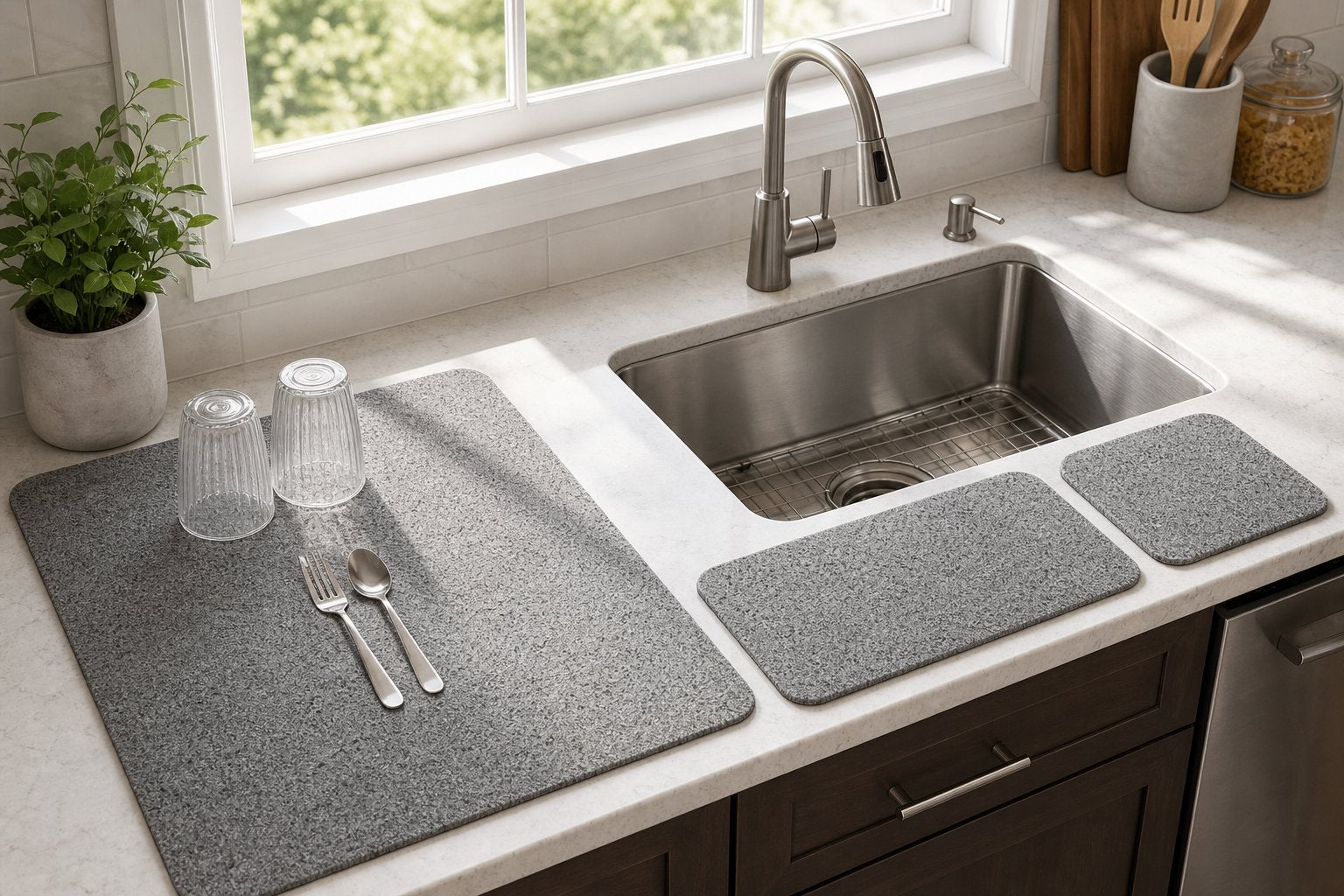
Check out our latest drying mats collection!
A stone dish drying mat only works well when it fits your sink area, dish load, and available counter space. A mat that is too large can crowd your main prep area, while one that is too small may allow water to reach the surrounding countertop. Compact mats around 12 × 16 inches can suit smaller sinks and limited counters, while larger options around 18 × 24 inches may work better for families or double-basin sinks.
Absorption and material quality matter, but size often determines whether a drying mat becomes a practical part of your kitchen. An oversized mat may need to be moved whenever you prepare food. An undersized mat may not provide enough room for your usual dishes.
This guide explains how to measure your sink area, match the mat to your typical dish load, and account for features such as corner sinks, narrow counters, and nearby fixtures. Whether you are replacing a fabric mat or purchasing your first stone drying mat, these steps will help you choose a practical size.
Key Takeaways
- Measure your available counter space and typical dish load before selecting a stone drying mat.
- Choose a size that catches drips without blocking your main food preparation area.
- Large mats provide more drying space, while compact mats are easier to use and store in smaller kitchens.
Assessing Your Sink and Counter Layout
Before buying a stone dish drying mat, measure how much counter space you can comfortably dedicate to drying dishes. Your sink shape, faucet position, nearby appliances, and countertop layout can all affect which mat size will work best.
Measuring Sink Dimensions
Measure the sink from side to side and from front to back. Sink dimensions vary considerably, so using your actual measurements is more reliable than choosing a mat based only on whether you have a single-bowl or double-bowl sink.
Consider where dishes are normally placed after rinsing. The mat should cover the area where water is most likely to drip without extending beyond the edge of the counter.
Measure the distance from the sink edge to the backsplash and from the sink to the nearest appliance, wall, or cabinet. These measurements will show whether a wide mat can fit comfortably or whether you need a narrower option.
Mapping Countertop Space
Identify which side of the sink provides the most usable drying space. Your preferred side may depend on your kitchen workflow, dominant hand, dish rack position, and where you normally prepare food.
Measure the clear area where you plan to place the mat:
- Length: Measure from the sink edge to the nearest appliance, wall, or other obstruction.
- Depth: Measure from the front edge of the counter toward the backsplash.
- Clearance: Confirm that the mat will not interfere with cabinet doors, appliance use, or your main preparation area.
When space allows, leave approximately 2 to 3 inches around the mat. This clearance makes it easier to clean the surrounding counter and helps prevent water from collecting against appliances or walls.
Evaluating Sink Placement and Fixtures
Check how far your faucet reaches and how widely it swivels. Pull-down and pull-out faucets may direct water beyond the immediate sink area, so the mat should cover the most common splash and drip zone.
Observe where water lands when you rinse and transfer dishes. Positioning the mat beneath that area can help protect the surrounding countertop.
Account for soap dispensers, sponge holders, water filters, and other sink accessories. In a compact area, a smaller mat may provide enough drying space without blocking fixtures or making the sink area feel crowded.
Understanding Stone Drying Mat Materials and Technology
Many stone drying mats are made with diatomaceous earth, mineral-based composites, or similar porous materials. Their internal pore structure draws moisture away from the surface and allows it to evaporate. Absorption speed and drying performance vary based on the mat's composition, thickness, surface finish, and surrounding airflow.
Diatomite and Diatomaceous Earth Explained
Diatomite, also known as diatomaceous earth, is a naturally occurring sedimentary material formed from the fossilized remains of microscopic organisms called diatoms.
When diatomaceous earth is processed into a drying mat, its porous structure can absorb surface moisture and distribute it through the material. This helps the exposed surface dry more quickly than many conventional fabric mats.
Not every product uses the same formulation. Some mats are rigid mineral slabs, while others combine mineral materials with flexible binders or backing layers. Review the product description carefully so you understand what you are purchasing.
Material Safety and Product Standards
Choose a mat that provides clear information about its materials, intended use, and care requirements. A product designed for kitchen use should include appropriate instructions and any relevant testing or certification details claimed by the manufacturer.
Do not assume that every mat is intended for direct food contact. Use the surface for drying dishes and kitchen accessories unless the manufacturer specifically confirms that direct food contact is appropriate.
Avoid products with unclear material descriptions, strong chemical odors, damaged surfaces, or care instructions that do not match the way you plan to use the mat.
Stain Resistance and Surface Texture
A quick-drying surface can help reduce the amount of time moisture remains on the mat, but it does not eliminate the need for regular cleaning.
Matte, porous surfaces generally absorb water more readily than heavily sealed surfaces. However, open pores may gradually collect soap residue, mineral deposits, and stains if the mat is not maintained properly.
Coffee, tea, wine, and strongly colored liquids may leave marks. Wipe spills promptly and follow the manufacturer's cleaning instructions. Some rigid mats can be lightly sanded to refresh the surface, but sanding should only be used when recommended for that specific product.
Choosing the Best Size for Your Needs
The right stone drying mat size depends on your usual dishwashing routine, available counter space, and storage needs. Select a mat that accommodates your daily items without interfering with other kitchen tasks.
Small and Compact Options
Compact stone mats commonly measure approximately 12 × 16 inches to 14 × 18 inches. They can work well for individuals, apartments, coffee stations, bar sinks, and kitchens with limited counter space.
Choose a compact mat if you usually dry a few mugs, glasses, utensils, or a water bottle. Smaller mats are also easier to move and store when you need the counter for food preparation.
Best for:
- Studio and apartment kitchens
- Coffee or tea stations
- Bar and prep sinks
- Small daily dish loads
Before purchasing, confirm that the mat is large enough for the base of your dish rack or the items you plan to place directly on it.
Medium and Standard Dimensions
Medium mats commonly range from approximately 16 × 20 inches to 18 × 24 inches. This size can provide a practical balance between drying capacity and countertop clearance.
A medium mat may hold several plates, bowls, glasses, and utensils while leaving enough space between items for airflow. It can suit couples, small families, or anyone who hand-washes a moderate number of dishes.
Measure both the available counter area and the mat's listed dimensions. Product photos may make a mat appear larger or smaller than it is, so measurements are more reliable than visual estimates.
Large and Extra-Large Stone Mats
Large stone drying mats may start around 20 × 24 inches, with some models extending to 24 × 36 inches or more. These sizes can suit families, frequent entertainers, and households that regularly hand-wash cookware.
A larger mat provides room for plates, pots, pans, utensils, and other kitchen items without requiring them to be stacked. The additional surface area may also improve airflow between dishes.
Keep in mind:
- Measure your countertop depth before ordering.
- Confirm that the mat will not block your main preparation area.
- Consider the mat's weight and storage requirements.
- Check whether the mat is one rigid piece or a foldable design.
A large mat can be useful in a busy kitchen, but it should still fit comfortably beside the sink.
Performance Factors: Absorption, Durability, and Everyday Use
When comparing stone drying mats, consider how efficiently they manage moisture, how durable they are, and whether their care requirements fit your routine.
Absorption Speed and Drying Time
Absorption speed varies according to the material composition, pore structure, surface finish, and condition of the mat. A high-quality mat should absorb ordinary drips without allowing water to remain pooled on the surface for an extended period.
Factors that can affect performance include:
- Pore structure: More open pores may improve absorption but can also collect residue over time.
- Thickness: A thicker mat may feel more substantial, but thickness alone does not guarantee better absorption.
- Surface design: Grooves may help distribute water, although deeper patterns may require more detailed cleaning.
- Airflow: Adequate ventilation around the mat supports evaporation.
Review the manufacturer's care guidance and performance information rather than relying only on broad absorption claims. Wipe up unusually large puddles instead of expecting the mat to manage excessive amounts of standing water.
Durability and Maintenance Issues
Rigid diatomaceous earth mats can be brittle, so careful handling is important. Avoid dropping, bending, or placing the mat on an uneven surface.
Common issues may include:
- Cracking after impact or improper storage
- Staining from strongly colored liquids
- Reduced absorption caused by soap residue or mineral buildup
- Surface wear caused by excessive sanding
Clean the mat according to the manufacturer's instructions. Many products can be rinsed or wiped with water and a mild cleaning solution, but care recommendations vary by material and construction.
Do not place the mat in a dishwasher unless the manufacturer specifically states that it is dishwasher-safe. High heat, strong detergents, and prolonged water exposure may damage certain mats or backing materials.
Darker finishes may make minor stains and water marks less noticeable than white or light-colored designs.
Heat Resistance and Multi-Functionality
Do not assume that a stone drying mat can safely be used as a trivet. Heat tolerance varies depending on the material formulation, surface coating, backing, and construction.
Only place hot cookware on the mat when the manufacturer provides a clear temperature rating and confirms that the product is suitable for that purpose.
Depending on its design and care instructions, a stone mat may also be useful as:
- A drip tray beneath a coffee machine
- A drying surface for reusable bottles and cups
- A base for soap dispensers and sink accessories
- A bar mat for glassware and mixing tools
Use the mat only for applications supported by the manufacturer's instructions, especially when heat, direct food contact, or heavy cookware is involved.
Matching Your Kitchen Lifestyle and Aesthetic
A stone dish drying mat may remain visible on your counter throughout the day, so its color, texture, and design should complement both your kitchen and the way you use the space.
Style and Color Considerations
Light colors can make a kitchen feel bright and open, but they may show coffee marks, mineral deposits, and water spots more easily. Gray, charcoal, and slate tones may conceal everyday discoloration more effectively.
Surface patterns can also affect the overall appearance. Marble-inspired mats may complement modern and transitional kitchens, while solid gray or neutral designs can blend into minimalist spaces.
You can match the mat to your countertop for a cohesive look or choose a contrasting color to define the drying area. Consider the finish of nearby faucets, cabinet hardware, and appliances when selecting a color.
Space-Saving and Folding Features
Foldable stone drying mats can help reduce counter clutter in small kitchens. Flexible sections allow the mat to be folded or stored when the counter is needed for meal preparation.
Check the folded dimensions before purchasing. A folding design is only useful if it fits inside your intended drawer, cabinet, or storage area.
If you dry dishes throughout the day and have a dedicated area beside the sink, a rigid mat may provide a more stable permanent setup. Choose between folding and rigid designs based on your available space and storage preferences.
Countertop Organization and Accessories
Some stone drying mat sets include smaller coordinating pieces, such as faucet mats, soap trays, or utensil pads. These accessories can help create a more organized and visually consistent sink area.
A non-slip backing or separate grip pad can help prevent movement, especially when placing heavy dishes on the mat. Check whether the backing is water-resistant and suitable for your countertop material.
Raised feet or ventilated bases may improve airflow beneath the mat. However, they may also add height or require additional cleaning around the supports.
Some rigid mats include a sanding tool for surface maintenance. Use it sparingly and only as directed, since repeated sanding gradually removes material.
Tips for Shopping, Comparing Products, and Finding Support
Stone drying mats are available in many sizes, materials, and designs. Comparing the right specifications can help you select a mat that fits your kitchen and performs as expected.
Comparing Sizes and Product Features
Begin by comparing the product's exact length, depth, and thickness with the measurements you took beside your sink. Common options range from compact mats around 12 × 16 inches to larger designs measuring 24 × 36 inches or more.
Review the material description carefully. Some products are rigid diatomaceous earth slabs, while others are flexible mineral composites. Neither construction is automatically better for every kitchen.
Compare features such as:
- Exact usable surface dimensions
- Rigid or foldable construction
- Non-slip backing
- Surface grooves or drainage patterns
- Cleaning and maintenance instructions
- Heat resistance, when verified by the manufacturer
- Warranty and return terms
Raised edges, curved corners, or accessory sections may reduce the usable drying area. Review diagrams and measurements rather than relying only on the product's overall dimensions.
Order Protections and Buyer Support
Review the retailer's return and replacement policies before ordering. A reasonable return period gives you an opportunity to check the mat's dimensions, condition, stability, and basic absorption performance.
Inspect the mat as soon as it arrives. Look for cracks, chips, uneven surfaces, damaged backing, or dimensions that differ materially from the listing.
Keep your order confirmation, packaging, and photographs until you are satisfied with the product. Clear documentation can make it easier to request a replacement or refund if the mat arrives damaged or does not match its description.
Choose a seller that provides accessible customer support and clear instructions for resolving product issues.
Using Retailer Help Centers and Supplier Options
Retailer help centers can provide information about shipping, returns, product care, and replacement procedures. Review these resources before contacting customer service, especially when ordering a large or heavy mat.
Product pages may also include size guides, material details, safety information, and cleaning instructions. Save or download these instructions for future reference when possible.
For commercial kitchens or custom installations, contact the manufacturer or supplier directly to ask about nonstandard dimensions, bulk orders, and product specifications.
Browsing Categories and Using Shopping Tools
Stone drying mats may appear under categories such as dish racks and drainers, sink accessories, kitchen organization, or kitchen linens. Search terms such as "diatomaceous earth drying mat," "stone dish mat," and "mineral drying mat" can help filter out fabric and silicone products.
Comparison tools and price-history extensions may help you track pricing across retailers. However, product specifications, materials, and dimensions should remain more important than a temporary discount.
Save suitable options to a wishlist and compare their specifications side by side. Reviewing the dimensions while standing in your kitchen can make it easier to visualize how each mat will fit.
Frequently Asked Questions
Choosing the right mat size requires accurate measurements, a realistic estimate of your normal dish load, and enough clearance to keep the sink area functional.
How do I measure my sink and counter area to determine which mat size will fit?
Measure the available length from the sink to the nearest wall, appliance, or obstruction. Then measure the counter depth from the front edge to the backsplash. Account for the faucet's movement, soap dispensers, and other nearby fixtures.
What size mat works best beside the sink without blocking my main prep space?
A mat around 15 × 11 inches to 18 × 12 inches may suit many kitchens with limited preparation space. Choose the smaller option when you regularly need the surrounding counter for cooking.
How much extra room should I leave around the mat?
Leave approximately 2 to 3 inches when space allows. This clearance makes the counter easier to clean and helps prevent moisture from collecting against walls, appliances, or the backsplash.
What size should I choose for frying pans, baking sheets, or cutting boards?
Consider a mat at least 20 inches long for cutting boards and approximately 24 × 16 inches for larger cookware. Measure your largest frequently washed item before choosing a size.
Does a thicker or more absorbent mat require more counter clearance?
Thickness has little effect on the mat's horizontal footprint. However, raised edges, beveled corners, feet, and backing materials can affect placement, so review the full product dimensions before purchasing.
What mat size is best for a small apartment kitchen?
A mat around 15 × 11 inches or 16 × 12 inches can provide useful drying space without occupying most of a compact counter. A foldable design may be helpful when storage and preparation space are limited.
Partager:
How to Clean and Maintain a Stone Drying Mat Without Reducing Its Absorbency
How to Pack a Compartment Snack Box So Sweet and Savory Foods Stay Separate