

Check out our latest golf collection!
A home golf hitting mat can make practice easier, but only if you know what to work on first. Without a clear plan, it is easy to hit ball after ball and still build the same swing mistakes.
Start with alignment, setup, and controlled half swings before moving into full shots. These basics help you understand clean contact, clubface control, and tempo without relying on the mat to hide poor strikes. Since mats can make heavy shots feel better than they really are, your first goal should be honest feedback.
With the right drills and setup, practicing at home can sharpen your ball striking, short game, and putting in a focused way. This guide shows you what to practice first, how to set up your space, and which drills help you build better habits from the start.
Key Takeaways
- Start with alignment and setup drills, then move to half swing work that keeps your focus on clean strikes
- Use feedback tricks like towels behind the ball or foot spray to expose what mats usually hide about your contact
- Structure your routine with short game, putting drills, and swing mechanics, not just endless full shots
Building Your Optimal Home Golf Practice Setup
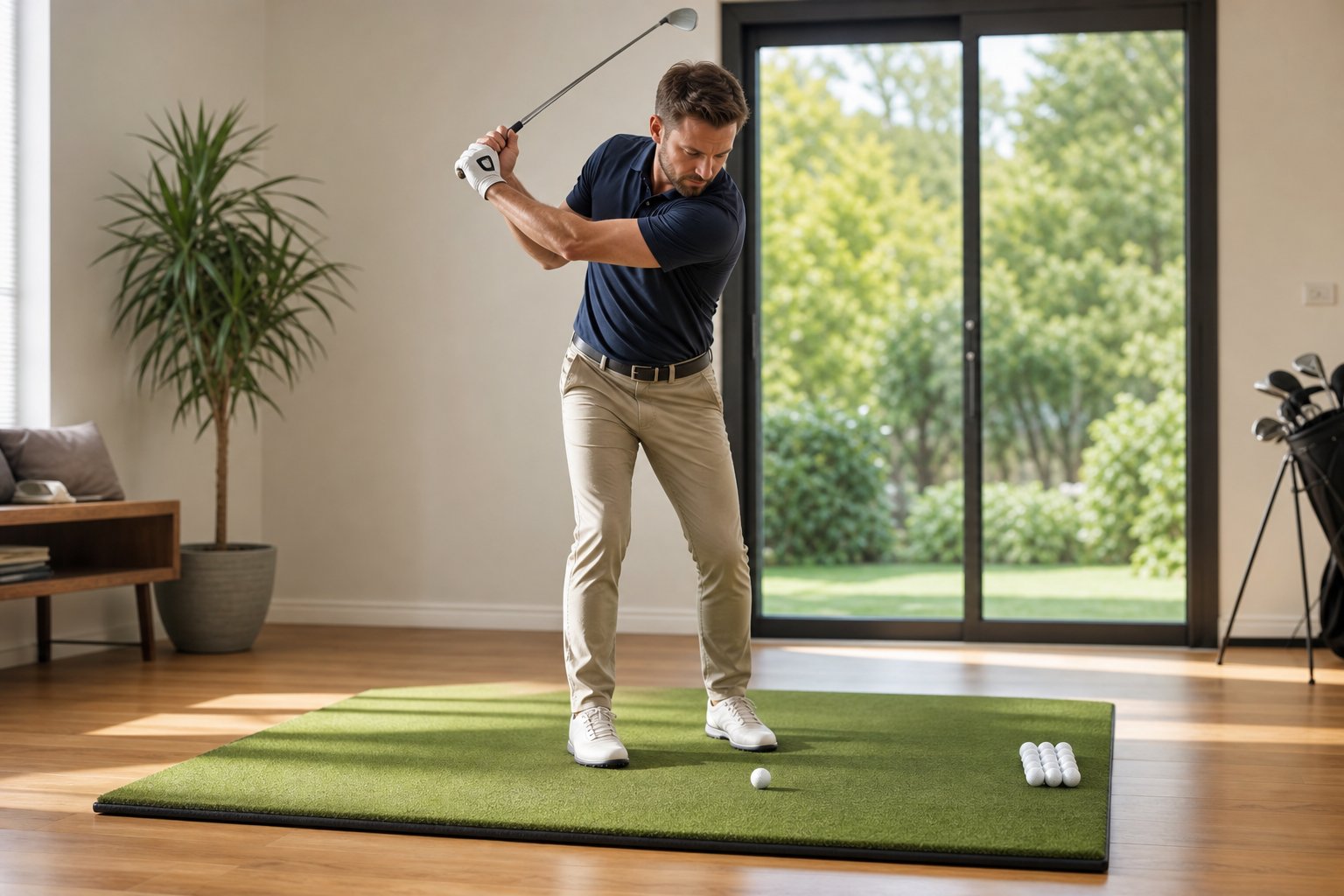
If you want to actually use your home golf setup, you’ve got to get the hitting surface, placement, and a safe way to contain your shots dialed in. Miss any of these and your “practice area” turns into just another thing collecting dust in the garage.
Selecting the Right Golf Mat and Accessories
The mat you pick is really the foundation here. If you’re just starting out, go for something around 4x5 or 5x5 feet that feels pretty close to real turf, but won’t wreck your clubs or your wrists.
Dual turf mats are a smart buy. You get a fairway height patch for irons and a rougher area for specialty shots. Don’t ignore what’s underneath. The backing matters a lot. Heavy rubber, at least 10mm thick, soaks up shock way better than flimsy foam and won’t slide around as easily.
You’ll want a good rubber tee holder, too. Mats with replaceable rubber tee inserts are just better. Fixed plastic tees snap off in no time, but rubber ones flex and last way longer.
For accessories, grab some alignment sticks and impact tape. Alignment sticks are cheap and fix a ton of setup problems. Impact tape shows you exactly where you’re hitting the clubface, which honestly helps more than most fancy gadgets when you’re building a foundation.
Anchoring and Placing Your Hitting Mat
Even a heavy mat will slide around if you don’t anchor it, especially when you start swinging hard. I’ve seen people spend a bunch on a nice mat only to have it bunch up after a few hits because they skipped anchoring.
You’ve got two main options: weighted corners or stake through systems. In a garage or basement, heavy corner weights or strong double sided carpet tape work best. If you’re outside on grass, stake through anchors are the way to go. They dig right in.
Think about where you put your mat, too. You need at least 10 feet behind you for your backswing and 12 to 15 feet in front for follow through and ball flight. If you’re right handed, keep breakables out of the way on your left. Mishits are a thing.
Keep your mat on level ground. If the floor’s sloped, it’ll mess with your balance and groove bad habits. If you’ve got no choice, stick some rubber shims under the low side to even things out.
Setting Up a Golf Practice Net or Hitting Net
Your net has one job: stop the ball. That’s it. Go for something at least 10 feet wide and 7 feet tall for full swings. Smaller nets just mean you’ll be chasing balls all day.
Look for nets made from tough nylon, 600D or higher, with more than one impact layer. Single layer nets wear out fast, especially if you’re hitting drivers. The frame should be solid steel or fiberglass. Plastic ones just don’t last.
Set the net 8 to 12 feet from your mat. Too close and you might blow it out; too far and you’ll need more space than most people have.
If you’re inside, hang a tarp or thick blanket behind and around the net. Balls bounce back sometimes, and repairing drywall isn’t fun. Outdoors, use sandbags or ground stakes to keep the net from blowing away in the wind. Nothing kills a session like chasing your net down the street.
Fundamental Skills to Prioritize on Your Hitting Mat
When you first step on your mat, don’t just start ripping drivers. Strip it back to basics. Grip, alignment, and a repeatable swing path come first. Distance and ball flight can wait.
Mastering Grip and Clubface Alignment
Your grip is everything. It controls the clubface, and the clubface decides where your ball starts. Before you take a full swing, spend time checking your grip in a mirror or on video.
Put your lead hand on so you can see two or three knuckles when you look down. Your trail hand should fit in without overpowering. The trick is to grip firmly enough for control, but not so tight you lose wrist hinge.
Clubface alignment is just as important. Lay a club or stick perpendicular to your target line and square your clubface to it. Tons of golfers set up with a face that’s open or closed and then have to compensate mid swing, which leads to all kinds of mishits.
Check your clubface position at address with every club. A 7 iron should look square; wedges might look a touch open depending on their design.
Perfecting Your Stance and Alignment
A lot of high handicap golfers get their body aimed right but mess up their feet, hips, or shoulders. Your mat is perfect for fixing this since the edges give you a built in reference.
Lay alignment sticks on the ground every time you practice. One goes along your toes, another parallel to it toward your target. This setup shows alignment mistakes right away. Shoulders are usually the sneaky problem. They like to aim right of target for righties, even if your feet are lined up.
Stance width matters, too. For mid irons, keep your feet about shoulder width apart. Too wide and your hips can’t turn; too narrow and you lose stability.
Try hitting from different spots on a dual turf mat to see how small stance changes affect your contact and ball flight.
Building Consistent Swing Path and Plane
Your swing path decides if you hit pulls, pushes, draws, or fades. The mat gives you instant feedback on your path by how the club brushes the surface.
Start with half speed swings, paying attention to your swing plane. The club should move on a tilted circle around your body. Set up your phone and record from the side to see if your hands trace a smooth arc through impact.
Most people want to swing full speed right away, but that just locks in bad habits. Instead, make 20 slow swings working on the right path before you pick up the pace.
Watch how your club enters and leaves the mat. A neutral path leaves a shallow mark pointing at your target. Outside in creates a mark left of target with wear near the heel; inside out does the opposite.
Grab a swing plane trainer or just use a pool noodle at the right angle to help groove the feel of an on plane swing.
Essential At Home Drills for Solid Ball Striking
If you want to get better contact, you need to control where the club bottoms out, get real feedback on every swing, and build awareness with focused reps. These three practice ideas really help fix the most common issues.
Improving Low Point Control
Your low point decides if you hit the ball first or catch the ground first. Most amateurs struggle with fat or thin shots because their club bottoms out too early or too late.
Try the gate drill: set two alignment sticks parallel to your target line about six inches apart, with the ball just before where your club should bottom out. Make swings brushing the mat in the same spot after the ball every time.
The towel drill works, too. Put a towel two inches behind your ball and try to make contact without hitting the towel. This forces you to move your low point forward, just like good ball strikers.
The feet together drill helps you stop swaying. Stand with your feet touching and make half swings. If you move laterally, you’ll lose your balance right away. This teaches you to rotate around your center, which helps your low point.
Using Feedback Tools Like Impact Tape and Bags
Impact tape is brutally honest. Stick it on your clubface and hit 10 balls. You’ll see if you’re hitting the toe, heel, high, or low. Most golfers think they know their pattern, but the tape doesn’t lie.
An impact bag is awesome for learning what good impact feels like. Put it where your ball would be and punch into it with your hands ahead of the clubface and your weight forward. Hold that position for a few seconds.
You’ll feel if your chest is turning, your hands are leading, and your weight’s on your front side. Do 20 reps before hitting balls to lock in that feeling.
Don’t have an impact bag? Stuff a duffel with towels. It works just fine.
Integrating Slow Motion Swings and Mirror Work
Slow motion swings help you feel positions that vanish at full speed. Swing at about 25% speed, focusing on one thing. Maybe keeping your lead arm connected or holding your wrist angles.
Do 10 slow swings for your backswing, 10 for transition, and 10 for impact position. Then do 10 full speed swings, trying to keep the same feels. This really builds awareness.
Mirror work is a game changer. Set up in front of a mirror and check your posture, alignment, and positions at address, the top, and impact. Most people are shocked by what they actually see.
Practice your setup in the mirror without a club first. Check your spine angle, weight, and alignment. Then add the club and watch your positions through the swing. Five minutes of this before you hit balls is worth more than half an hour of just swinging away.
Effective Short Game Practice: Chipping and Pitching Indoors
Working on your short game inside builds the feel and control that save strokes around the green. Set up landing zones and sharpen your wedge work. These habits pay off on the course.
Chipping Drills and Landing Targets
Start your chipping by putting targets at 3, 6, and 9 feet from your mat. Use towels, bins, or even paper plates for landing spots. This trains your eyes to pick exact targets instead of just “somewhere over there.”
Beginner Friendly Target Drill Setup:
- 3 feet: Try bump and run shots with little loft
- 6 feet: Hit standard chips with a sand wedge
- 9 feet: Go for higher loft shots that land soft
Chip with both your pitching wedge and sand wedge to feel the difference. The pitching wedge rolls out more, while the sand wedge flies higher and stops faster. Switching clubs mid session makes you more adaptable for real life situations.
Try chipping one handed with your dominant hand for a few shots. It’ll feel weird at first, but it really helps you get a sense of the clubface throughout the swing and stops your hands from fighting each other at impact.
Dialing In Wedges for Consistency
If you want to get more reliable with your wedges, focus on swing length instead of swing speed. I always tell golfers to picture their backswing in positions: hip high, waist high, and shoulder high. Each spot gives you a pretty consistent distance with each wedge, at least, once you get the hang of it.
Try hitting 10 shots at each swing length and see where most of your balls land. Jot down those distances for your pitching wedge, gap wedge, and sand wedge. Lots of golfers find a hip high swing goes about 15 to 25 yards, waist high gets you 30 to 40, and shoulder high can reach 50 to 60 yards. Obviously, the club matters here.
Key Practice Routine Elements:
- Start with 10 chips at your closest target
- Switch wedges every 5 shots to keep things fresh
- Pay attention to clean contact and where the ball lands
- Notice which swing lengths feel most natural
Drop an alignment stick on the ground, parallel to your target line, when you’re working with wedges. That quick feedback helps you catch setup drift. If you can stay lined up, you’ll make better contact and get more predictable ball flight, especially on those tricky pitch shots near hazards.
Putting Practice You Can Do at Home
A putting mat can actually help you build confidence and consistency on short putts. The trick is creating a spot that makes you want to practice, and using drills that work on alignment and stroke path.
Creating a Reliable Putting Station
Find at least 10 feet of flat, clear space somewhere at home. Hallways, guest rooms, even a corner of the living room can work. The surface under your mat isn’t a huge deal, though carpet does slow the roll a bit compared to hardwood.
Set up your mat so you can hit putts from a few different angles without dragging furniture around. If your mat has alignment lines, make sure you aren’t getting glare from windows or lamps. That can really mess with your eyes. Keep a few balls and your putter handy so you can squeeze in 15 to 20 minutes of practice without digging through closets.
Toss a little basket or cup at the end of the mat to catch balls. You’ll save a ton of time not chasing balls all over the room. If you use alignment sticks, lean them somewhere you can grab them quickly.
Favorite Putting Drills With Mats and Alignment Aids
The gate drill is probably our top pick for home putting. Set up two alignment sticks, tees, or even coins just wider than your putter head, on either side of the ball. Try to stroke the putt through the gate without bumping either side. You’ll know right away if your stroke is wobbly.
For distance control, the speed ladder drill works wonders. Place tees or markers at 3, 5, 7, and 9 feet from the cup. Hit three putts to each spot, only worrying about rolling the ball to stop within a foot past the hole. It’s a great way to build feel for lag putting.
The straight back drill just uses one alignment stick, set parallel to your target line behind the ball. Trace your putter back along the stick. If you tend to pull or push short putts, this one really helps.
Tracking Progress With Tech and Smart Training Aids
These days, tech takes a lot of the guesswork out of practice. Launch monitors and swing analyzers give you instant feedback on club path, face angle, and ball speed. If you actually use that info in a structured practice plan, you’ll see your scores drop.
Using Launch Monitors and Swing Analyzers
A launch monitor can sit a few feet behind your mat and track carry distance, ball speed, spin, and launch angle for every shot. They aren’t cheap, but the feedback is pretty eye opening if you want to track progress indoors.
Start with three basics: club speed, smash factor, which is ball speed divided by club speed, and carry distance. If your smash factor is under 1.30 with irons, you’re losing distance to poor contact. The mat might show you a mark, but the launch monitor tells you exactly how much energy you’re wasting.
Swing analyzers can clip onto your shaft and track tempo, backswing length, and acceleration through impact. They don’t measure ball flight, but they’re great for spotting timing issues. If your backswing to downswing ratio is 4:1 or higher, you might be rushing the transition and losing consistency.
Pair your device with the mat and hit 10 shots, then check the data. Look for patterns, not just the weird one off shots. If eight out of 10 swings show an open face at impact, well, that’s your next thing to work on.
Building a Measurable Practice Plan
Data doesn’t mean anything if you don’t have a plan to improve it. I like to build practice sessions around three specific goals each week: one for contact quality, one for swing path, and one for distance control.
Start every session with five swings at about 70% speed to set a baseline. Record your average club speed and smash factor. Then move into drills that target your weakest metric. If your path is 4 degrees out to in, spend 15 minutes doing gate drills on the mat and check the numbers again. If you can get that down to 2 degrees in two weeks, you’re making real progress.
Keep a simple log on your phone:
| Date | Metric | Baseline | End of Session | Notes |
|---|---|---|---|---|
| 6/24/26 | Club Speed | 82 mph | 84 mph | Focused on hip rotation |
| 6/24/26 | Smash Factor | 1.28 | 1.32 | Cleaner contact drill |
Training aids like alignment sticks and impact tape work well with your tech. Use the sticks to double check your setup. If the swing analyzer says your shoulders are open 6 degrees but you feel square, the sticks will show you what’s really happening.
Go back and review your log every couple of weeks. If a metric won’t budge after a few sessions, switch up the drill or ask a coach for help.
Frequently Asked Questions
Getting started with a hitting mat at home brings up practical questions about drills, setup, clubs, and feedback.
What are the best beginner friendly drills to start with on a home golf hitting mat?
Start with the towel drill. Place a folded towel 6 to 8 inches behind the ball and swing without touching it. Then use alignment sticks to check your stance and target line.
How do you set up a golf hitting mat at home so it feels stable and realistic?
Place the mat on a firm, level surface. Use rubber grip pads indoors or anchors outdoors to keep it from sliding. Make sure the hitting area stays flat before every session.
Which clubs should you practice first on a hitting mat to build solid contact without bad habits?
Start with a 7 iron or 8 iron. These clubs are easier to control and still require clean contact. Add wedges once your low point and ball first contact improve.
How can you tell if your practice mat is helping your swing or just masking fat shots?
Use a towel behind the ball, impact tape, or foot spray. If you hit the towel or miss the center of the clubface often, the mat may be hiding contact issues.
What size golf mat makes the most sense for a garage, backyard, or small space setup?
A 4 foot by 5 foot mat is best for most full swing setups. A 3 foot by 4 foot mat can work for half swings or wedge practice in tighter spaces.
Is a DIY or budget friendly golf hitting mat worth it, and what should you watch out for?
Budget mats can work for light practice, but they may lack cushioning and wear out faster. Avoid mats that feel too slick or bouncy because they can hide poor contact.
Partager:
Can a Putting Mat Help You Build Better Distance Control Indoors?
What Makes a Portable Snack Box Useful for Sports Days, Park Trips, and Car Rides?