

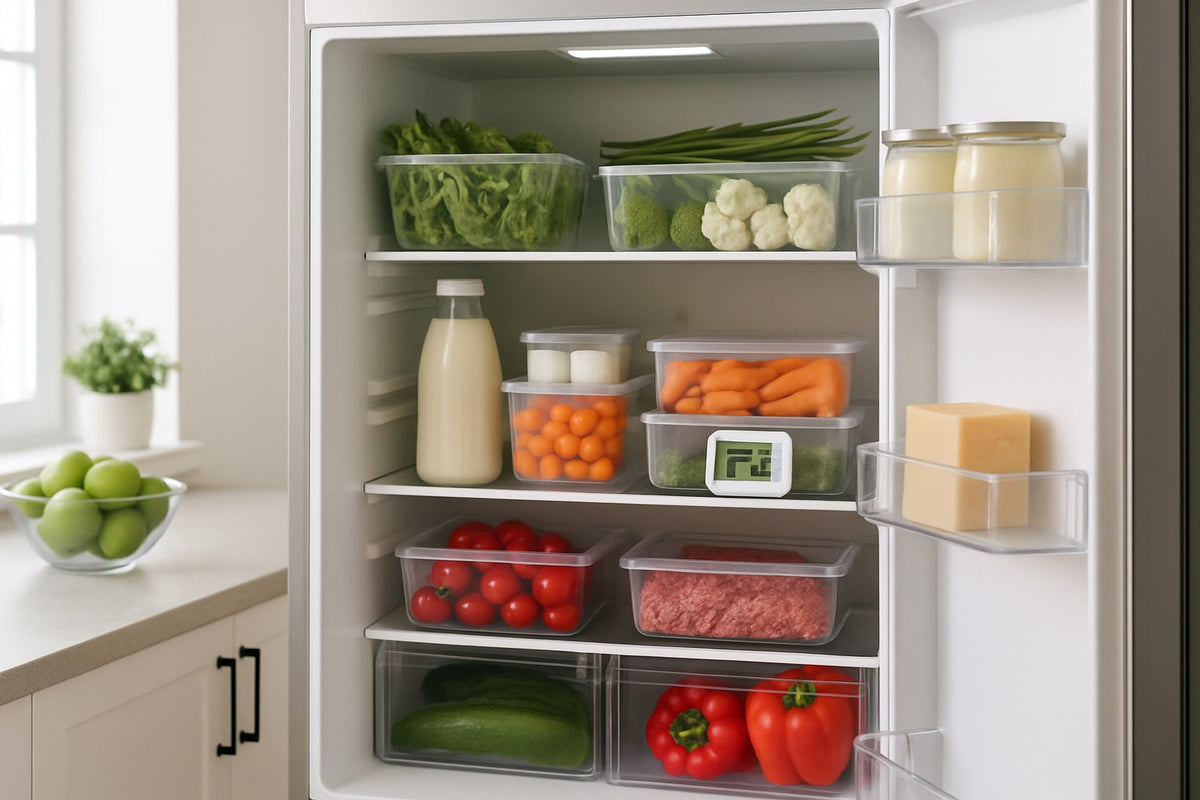
Keeping food safe at home really comes down to one thing: temperature control. Refrigerators should be at or below 40°F (4°C), and freezers at 0°F (-18°C) or colder to stop harmful bacteria and keep food fresh.
These aren’t just nitpicky health rules, they’re grounded in science, and honestly, they can be the difference between a good meal and a rough night.
Who hasn’t stared into the fridge, debating if those leftovers are still okay, or if that frozen “mystery meat” is worth saving?
Improper storage leads to a lot of food waste and is behind a surprising number of foodborne illnesses. The upside? Getting storage temps right isn’t rocket science.
Here, I’ll share how to store different foods safely, where things really belong in your fridge, how long you can actually keep stuff, and a few tricks to make your freezer less of a food graveyard.
Key Takeaways
- Keep refrigerators at 40°F or below, freezers at 0°F or below—this slows bacteria and keeps food safe
- Different foods need different spots and shelf lives; meats and dairy go in the coldest areas
- A food thermometer and smart cooling habits for leftovers help prevent spoilage and illness
Understanding Safe Food Storage Temperatures
Temperature control is basically the backbone of food safety at home. There are pretty strict ranges that either keep bacteria at bay or let them run wild. A few degrees really can make all the difference.
The Temperature Danger Zone Explained
The infamous “danger zone” is between 40°F and 140°F (4°C to 60°C). Bacteria thrive here, multiplying fast on anything edible.
Cold foods should stay below 40°F; hot foods need to be above 140°F. If something sits out in the danger zone for more than two hours, bacteria can reach risky levels. On sweltering days (over 90°F), that safe window drops to just an hour.
Fridges should run at 40°F or lower, freezers at 0°F. It’s not just a suggestion—these temps keep bacteria from turning dinner into a health issue.
How Bacteria Grows at Unsafe Temperatures
Bacteria go wild in the danger zone. One single cell can multiply into millions in just a few hours if the conditions are right.
Between 70°F and 125°F, bacteria double every 20-30 minutes. That’s why leaving groceries in a warm car or forgetting about leftovers on the counter goes south so quickly.
Chilling food slows this way down. At 40°F, bacteria barely grow. At 0°F, they just hit pause—they’re not dead, but they’re not multiplying either.
So, it’s all about keeping food out of that risky temperature range as much as possible.
Key Food Safety Principles for Your Kitchen
Most foodborne illness is pretty avoidable if you stick to a few basics:
Quick temp tips:
- Refrigerate foods at 40°F or below
- Freeze at 0°F or lower
- Use a fridge thermometer—don’t just trust the dial
- For parties or meal prep, check food temps every few hours
- Cool hot leftovers quickly before putting them in the fridge
The fridge dial isn’t always accurate. A cheap thermometer gives you the real story—stick it on the middle shelf for the best read.
Arrange food by risk: raw meats on the bottom (no drips on your salad, please), ready-to-eat stuff up top. It’s a simple way to avoid cross-contamination.
Refrigerator Storage: Best Practices and Temperature Tips
Getting your fridge set up right and keeping it cold is huge for food safety and cutting down on waste. It’s about more than just tossing things in and hoping for the best.
Recommended Refrigerator Temperature Range
Set your fridge to 40°F (4°C) or below. The sweet spot is usually 38°F to 40°F (3°C to 4°C)—cold enough to slow bacteria, not so cold your lettuce turns to ice.
Most fridges use number dials (1-5, 1-9, etc.) instead of actual temperatures, which isn’t super helpful. You can’t really trust those.
Opening the fridge or loading in warm food causes temperature swings. The door and top shelf are usually warmer, while the back of the bottom shelves stays coldest. Don’t cram the fridge full—over 80% capacity and you risk blocking airflow, which creates warm patches where bacteria can flourish.
Don’t put hot food straight in the fridge. Let it cool to around 70°F first (shallow containers or an ice bath help), then get it in the fridge within two hours.
Proper Food Placement in the Fridge
Where you put things matters. Raw meats, poultry, and seafood go on the bottom shelf in leak-proof containers—no one wants meat juice dripping onto tomorrow’s lunch.
Ready-to-eat foods like leftovers, deli meats, and prepared meals should go up top, safe from contamination. The middle is perfect for dairy—think milk, cheese, yogurt.
Eggs last longest in their original carton on a middle or lower shelf. Skip the egg tray in the door; it’s too warm and the temp swings are rough. Fruits and veggies? Crisper drawers are best, since they keep humidity higher. If you can, separate fruits from veggies—fruits release ethylene, which can make veggies spoil faster.
The fridge door is the warmest spot. Use it for condiments, juices, and stuff that can handle a little temperature fluctuation.
Using Refrigerator Thermometers
You just can’t trust the fridge’s built-in dial or display. Get an appliance thermometer—it’s a game changer.
Stick it in the warmest part (usually near the front or door). Check it at least twice a day—morning and night is a good habit.
Digital thermometers are quick, but old-school dial ones work fine and don’t need batteries. Just make sure whatever you use is made for fridge temps.
If you keep reading above 40°F, tweak the settings or call someone to check it out. Some new fridges have alarms if temps go off, which is handy if you’re not always paying attention.
Freezer Storage: Keeping Foods Safe for the Long Haul
Freezers are awesome for stretching your food budget, but only if you use them right. Keep the temp low, avoid freezer burn, and organize things so you don’t lose track of what’s in there.
Optimal Freezer Temperatures
Keep your freezer at 0°F or lower. At this temp, bacteria can’t grow or make you sick. Food technically stays safe forever at 0°F, but the quality drops off after a while.
Use an appliance thermometer—don’t just trust the dial. Check it now and then, especially after a power outage or if the door’s been left open. Try not to let it creep above 5°F.
Even at perfect temps, food has a shelf life for quality. Whole poultry is best for about 12 months, bacon and sausage only 1-2 months. Ground meat? 3-4 months. Cooked meat dishes, 2-3 months. After that, food’s still safe, but the taste and texture suffer.
How to Prevent Freezer Burn
Freezer burn shows up as gray-brown, tough spots—it’s ugly and dries food out, but it’s not dangerous. The trick is to keep air away.
Best ways to pack food:
- Wrap tightly in plastic wrap or foil, then put in freezer bags
- Use containers designed for the freezer
- Squeeze as much air out as possible before sealing
- Double-wrap store packaging for anything you’ll keep a while
Meat and poultry in their store wrap are fine for a few weeks, but for long-term storage, add another layer. If you spot a torn package, just rewrap it. The food’s still good.
Freezer Organization for Efficiency
A little organization goes a long way. Label everything with what it is and the date. Group similar foods together—meats, meals, veggies, baked goods—and put newer stuff in back, older in front. This helps you use things before they lose quality.
Don’t pile packages when you first freeze them. Spread them out so they freeze faster (smaller ice crystals = better texture). Once they’re solid, stack away. A full freezer actually holds its temp better than a half-empty one, since frozen food helps keep everything cold.
Safe Storage Guidelines for Meats, Poultry, and Fish
Raw meats need extra care—keep them below 40°F in the fridge, and know how long each type lasts. Ground meats spoil quicker than whole cuts, poultry needs extra caution, and fish is the most delicate of all.
Storing Raw Beef and Pork: Steaks, Chops, and Roasts
Steaks, chops, and roasts stay fresh in the fridge for 3-5 days at or below 40°F. Put them on the bottom shelf, in sealed containers or on plates, to catch drips.
In the freezer at 0°F, these cuts are best for 6-12 months. Wrap tightly in freezer paper or heavy-duty foil to avoid freezer burn.
Quick tips:
- Fridge at 40°F or lower
- Store on bottom shelf
- Use within 3-5 days, or freeze for longer
- Never leave out at room temp for more than 2 hours (1 hour if it’s hot out)
Pork chops and roasts follow the same rules. Always label with the purchase date so you can use the oldest first.
Hamburger and Ground Meats: Time and Temperature Rules
Ground meats don’t last long—just 1-2 days in the fridge at 40°F or below. Grinding exposes more surface to bacteria, so spoilage happens faster.
If you’re not using ground beef, pork, turkey, etc., within a day or so, freeze it. At 0°F, ground meats keep their best quality for 3-4 months.
| Ground Meat Type | Refrigerator (below 40°F) | Freezer (0°F) |
|---|---|---|
| Ground beef/hamburger | 1-2 days | 3-4 months |
| Ground pork | 1-2 days | 3-4 months |
| Ground turkey | 1-2 days | 3-4 months |
Divide big packs into meal-sized portions before freezing. It thaws quicker and you don’t have to refreeze leftovers.
Poultry and Turkey Safe Storage
Raw chicken and turkey are the most finicky. Use them within 1-2 days in the fridge at 40°F or below—seriously, don’t push it.
Poultry can carry bacteria like Salmonella and Campylobacter more easily than beef or pork. Always stash raw chicken and turkey in leak-proof containers, on the fridge’s bottom shelf, away from anything ready-to-eat.
In the freezer at 0°F, whole turkeys and chickens are good for up to 12 months; chicken parts for about 9 months. Ground turkey follows the same 3-4 month freezer rule as other ground meats.
Always thaw poultry in the fridge, not on the counter. A whole turkey needs about 24 hours of thawing per 4-5 pounds.
Best Practices for Fatty Fish and White Fish
Fish needs the coldest spot in your fridge—colder than meat, honestly. We keep ours at 32-38°F and try to use it within a couple days for best flavor and safety.
Fatty fish like salmon or tuna, with all those healthy oils, don’t last as long in the freezer. They’re great for about 2-3 months at 0°F before the texture starts to slip. White fish—think cod or sole—are leaner and hold up well for about 6 months frozen.
Quick fish storage guide:
- Fatty fish (salmon, tuna): 2-3 months in the freezer
- White fish (cod, sole): up to 6 months frozen
- All fresh fish: 1-2 days in the fridge at 32-38°F
We always wrap fish tight in plastic, then seal it in a bag to keep out freezer burn and weird smells. Fresh fish should smell like the ocean, not funky—if it’s off, we just don’t risk it.
Safe Storage for Eggs, Dairy, Fruits, and Vegetables
Eggs, dairy, and produce all have their own quirks when it comes to storage. Getting the temperature and placement right can mean the difference between crisp lettuce and a sad, wilted mess.
Egg Storage: Do's and Don'ts
Eggs belong on a shelf near the back of the fridge, not in the door. The door warms up every time you open it, and eggs like things steady. Best temp? 40°F or below.
Keep eggs in their original carton, not those cute trays. The carton helps block odors and keeps the eggs from drying out.
Raw eggs stay fresh in the fridge for 3 to 5 weeks after you bring them home. Get them chilled right away and don’t leave them out for more than two hours (or just one hour if it’s sweltering outside).
Hard-boiled eggs don’t last as long—one week max in the fridge.
Keeping Dairy Fresh and Safe
Dairy’s picky about temperature. Milk, cheese, yogurt, and butter all need to be on shelves toward the back, where it’s coldest. The door is just too warm, even if your fridge has a butter cubby.
Aiming for 40°F or colder keeps dairy safe. Milk is usually good for about a week after opening, though the sell-by date helps. Butter lasts 1 to 3 months in the fridge.
Most dairy can be frozen if you need extra time, but some—like cream—can separate after thawing. It’s safe, but the texture’s not always great.
Always pop dairy back in the fridge as soon as you’re done. Don’t let it sit out more than two hours.
How to Store Fruits and Vegetables Properly
Cut fruits and veggies should go in the fridge right away. Once you slice them, get them cold and use them up within a few days. Whole produce is trickier—depends on the type.
Best in the fridge:
- Leafy greens
- Berries
- Grapes
- Cut fruits and veggies
- Carrots, celery
- Broccoli, cauliflower
Better on the counter or pantry:
- Tomatoes (until ripe)
- Bananas
- Potatoes
- Onions
- Winter squash
Keep produce away from raw meat and poultry—use crisper drawers or upper shelves. Never let meat juices drip onto your veggies.
And yeah, the two-hour rule matters here too. Don’t leave cut fruits or veggies out for more than two hours (or just one if it’s blazing hot).
Leftovers, Soups, and Stews: Cooling and Storage Tips
Leftovers can be a lifesaver, but only if they’re handled right. Cooling them quickly and storing them at the proper temp is key.
How to Cool Hot Foods Quickly
To dodge bacteria, we need to cool leftovers fast. The danger zone is 40°F to 140°F—a prime spot for bacteria to go wild.
Big pots of soup or stew? They’ll cool way too slow if you just shove them in the fridge. Split them into shallow containers, no more than 2 inches deep, to speed things up.
For roasts or whole chickens, carve them up before refrigerating. No need to let food cool on the counter first—get it in the fridge hot if needed. An ice bath around your containers can help, too.
Remember the two-hour rule: get leftovers in the fridge within 2 hours of cooking (1 hour if it’s over 90°F).
Safe Temperatures for Storing Cooked Dishes
Keep your fridge at 40°F or below. Honestly, a fridge thermometer is worth it—the built-in dial can be way off.
Wrap leftovers tight or use sealed containers. That keeps bacteria out, stops food from drying out, and blocks weird fridge smells.
When reheating, leftovers need to hit 165°F all the way through. Use a food thermometer—especially in the center of casseroles or thick stews. Soups and gravies should come to a rolling boil.
How Long Can Leftovers Stay Fresh?
Leftovers are good for 3 to 4 days in the fridge—soups, stews, meats, casseroles, all of it.
After that, it’s best to eat or toss them. Even if they look fine, bacteria don’t always give warning signs.
For longer storage, freeze leftovers for 3 to 4 months. They’re technically safe even longer at 0°F, but quality drops off. Label containers with dates so you know what’s what.
To thaw, stick leftovers in the fridge overnight. Once thawed, use within 3 to 4 days—otherwise, pitch them or cook and refreeze.
Food Thermometers: Your Secret Weapon for Safety
A food thermometer is honestly a game-changer. No more guessing if the chicken’s done or the fridge is cold enough. Different types suit different jobs, and a little calibration goes a long way.
Types of Food Thermometers and How to Use Them
Digital instant-read thermometers are fast—2 to 10 seconds for a reading. Stick them at least 1/2 inch into the thickest part, away from bone or fat. For thin stuff like chicken breasts or burgers, poke through the side to get to the center.
Dial thermometers take longer—15-20 seconds for instant-read, 1-2 minutes for oven-safe ones. Oven-safe models can stay in a roast, though the metal stem might mess with accuracy a bit.
Wireless thermometers let you watch temps from your phone and can stay in the food while it cooks. They’re pricier, but great for slow roasting or smoking. Thermocouples are the speed demons—2-5 seconds—but you might not find them at your local store.
When cooking multiple pieces, check each one—sizes and spots matter. Always check the instructions for your thermometer for details on depth and heat limits.
Calibrating and Caring for Your Thermometer
We check our thermometers with ice water or boiling water to make sure they’re accurate. For ice water, fill a glass with ice and water, stick in the probe 2 inches deep (don’t touch the sides), and wait 30 seconds. It should read 32°F.
For boiling water, bring water to a boil, insert the probe, and wait 30 seconds. At sea level, you want 212°F—less if you’re up in the mountains. If it’s off, most thermometers have a little nut you can twist to adjust.
Calibrate before first use, after dropping it, or when switching between hot and cold. Bimetal dial types need frequent checks if you use them a lot.
Wash the probe with hot, soapy water after each use, but don’t dunk the whole thing unless the manual says it’s OK. Store with the cover on to protect the tip.
When to Check Temperatures During Cooking and Storage
Check temps near the end of cooking, not the start. Ground meats need 160°F, poultry 165°F, and steaks or roasts 145°F (let them rest 3 minutes).
For whole poultry, test the innermost thigh, wing, and thickest breast. Casseroles and egg dishes? Check several spots—hot spots can hide. Make sure casseroles hit 165°F and egg dishes at least 160°F.
For storage, use a fridge thermometer to make sure you’re at 40°F or below, freezer at 0°F or under. Put the thermometer in the warmest spot (usually by the door) for a real reading.
Recheck temps when reheating leftovers—they should all get to 165°F. That goes for pizza, ham, whatever you’re warming up.
Frequently Asked Questions
Food safety is a mix of numbers, habits, and a little common sense. Here are some of the questions that come up most often.
What's the ideal fridge temp to keep my greens happy and crisp?
Keep your fridge at 40°F (4°C) or below, but honestly, 35°F to 38°F is the sweet spot for crisp greens without freezing. Most fridges do best around 37°F—cold enough to slow bacteria, just right for crunchy produce.
Don’t trust the built-in display—use a thermometer in the middle of the fridge. Even a couple degrees can make a difference.
Can you spill the beans on the best temp for my freezer to avoid an ice cream meltdown?
Freezers should stay at 0°F (-18°C) or lower. For perfect ice cream texture, somewhere between -10°F and 0°F is ideal.
At 0°F, you’ll slow freezer burn and keep ice cream scoopable instead of brick-hard.
Test your freezer temp by leaving a thermometer between frozen items overnight. If it’s above 0°F, adjust the dial or check the door seal.
If the power zaps out, how long before my frozen stash starts a meltdown?
A full freezer keeps food safe for about 48 hours without power. If it’s only half-full, you’ve got about 24 hours.
Try not to open the freezer unless you absolutely have to. Every peek lets out cold air and shortens safe storage time.
If the power’s out longer, check each item. If it still has ice crystals or feels as cold as your fridge (40°F or lower), it’s safe to refreeze.
Curious cooks inquire: where do veggies and dairy play hide and seek in the fridge layout?
Veggies go in the crisper drawers at the bottom—higher humidity keeps them fresh. Dairy? Stick to the upper or middle shelves, where temps are stable. Never put milk in the door, even if the fridge has a spot for it.
The door gets warm every time you open it. Use it for condiments, juice, or water, but keep milk and eggs on the shelves.
Ever wonder how long those leftovers can chill before they're past their prime?
Leftovers are good for 3 to 4 days in the fridge. After that, bacteria can multiply even if the food looks and smells fine.
Cool leftovers quickly—get them from hot to 70°F within 2 hours, then down to 40°F within another 4 hours.
For longer storage, freeze leftovers within those first 3 to 4 days. Most cooked foods taste best if used within 2 to 3 months in the freezer.
What are the five nifty tricks to keep food storage savvy and my kitchen running smooth?
First off, slap a date on everything you make or open. Seriously, just grab some masking tape and a marker—doesn’t have to be fancy. It’s way easier to remember what’s fresh and what’s, well, questionable.
Next up, the FIFO method (First In, First Out). Push the new stuff to the back and drag the older items up front. It’s easy to forget what’s lurking behind the yogurt, but this little habit keeps things from turning into science experiments.
Third, stash raw meats on the bottom shelf in leak-proof containers. No one wants meat juice dripping down onto their leftovers. It’s a simple fix, but it saves a lot of headaches.
Don’t cram your fridge full—try to keep it at about 70-80% capacity. When you jam it to the brim, cold air can’t do its job, and then you end up with weird warm spots. That’s just asking for trouble.
Finally, set aside one day a week to scan for expiration dates and use up what’s about to go bad. I call it “leftover makeover” day. It’s not glamorous, but hey, it cuts down on waste and keeps your shelves in check.
Share:
Simple Kitchen Storage Mistakes That Lead to Food Spoilage
How to Design a Kitchen Layout That Supports Daily Cooking