

Check out our latest compact vacuum sealer for food collection!
We've all been there, digging through cabinets mid-recipe, searching for that one spice while something sizzles a little too enthusiastically on the stove. The fix isn’t another set of matching storage bins or memorizing shelf layouts.
Grouping ingredients by category and how often you use them creates a kitchen workflow that genuinely cuts prep time and lowers stress. When your oils live near the stove, your baking stuff hangs out together, and breakfast foods have their own zone, you stop wasting time and energy on scavenger hunts.
The line between chaos and efficiency in the kitchen is mostly about how you organize what you cook with, not just how much space you have. Grouping ingredients turns your kitchen into a set of mini-stations, each with everything you need for a specific task. It works whether you're cooking alone on a Tuesday or prepping for the week.
Key Takeaways
- Grouping by cooking task and usage frequency slashes prep time and stops you from running laps around the kitchen
- Dedicated zones for different activities mean you’ve got what you need, right where you need it
- Organizing ingredients well speeds up meal prep and helps you keep better track of what you actually have
Understanding Ingredient Grouping
Organizing ingredients by category does more than tidy up your shelves—it changes how quickly you can get through cooking and how well you keep up with food quality.
The Theory Behind Ingredient Organization
Ingredient organization borrows a lot from professional kitchens. When we group things by function or category, we make cooking decisions faster. Our brains just work better when similar items are together.
This lines up with how we actually think about food. Nobody goes looking for “things that are red” or “stuff starting with T.” We think in terms of baking, proteins, produce, or oils.
Professional kitchens use stations, each with exactly what’s needed for that task. You can do this at home too. Put all your baking supplies—flour, sugar, baking powder, vanilla—on one shelf. Suddenly, you’re not running back and forth between pantry and counter.
Benefits of Grouping Ingredients
Grouping by category saves real time. If your spices are all together and your grains have their own spot, you’re not hunting through cabinets while something simmers.
Some clear upsides:
- Less food waste: It’s easier to see what you have, so you buy less extra and don’t let things expire in the back
- Faster meal ideas: Seeing ingredients grouped together can spark dinner ideas based on what’s actually there
- Better recipe flow: Having pasta, sauces, and related stuff together means you know if you’re missing anything before you start
It’s not just about cooking, either. Shopping gets easier when you can check your “breakfast zone” or “baking shelf” instead of scanning the whole pantry.
Common Mistakes in Ingredient Storage
A lot of us end up grouping by container size instead of function. Tall bottles all together, even if one’s vinegar and another’s olive oil, which just slows you down.
Another slip-up: letting rarely-used stuff take up prime real estate. That fondue set from 2019 doesn’t need to be front and center while your daily rice is stashed out of sight. Put the things you use most where you can grab them.
Temperature and light matter too. Storing olive oil right by the stove? Not great—heat breaks it down. Spices in clear jars above the cooktop? They’ll lose flavor quickly.
Mixing opened and unopened packages just leads to confusion. Try dedicating a spot for opened stuff that needs to be used first, and keep sealed backups elsewhere. No more finding three half-empty bags of flour in random places.
Key Zones for Ingredient Grouping
Organizing ingredients into zones means you put things right where you’ll actually use them, so you’re not wasting steps. Each zone covers a specific task, from chopping to cooking to washing.
Prep Zone Essentials
Most ingredient handling goes down in the prep zone. Set this up near your sink and main counter so you can rinse, chop, and measure without running around.
Group items here by how often you use them. Keep everyday stuff—olive oil, salt, pepper, garlic—within reach. Store baking basics like flour and sugar together in labeled containers so you’re not digging mid-recipe.
Cutting boards, knives, mixing bowls, and measuring tools should all live here too. Use a drawer divider or small organizer to keep them handy but not cluttered. Compost or trash bin nearby? Saves a ton of steps.
A small spice rack or lazy Susan in this area is a lifesaver for grabbing seasonings fast.
Cooking Zone Strategies
The cooking zone centers on your stove and oven. Here, you want oils, your go-to spices, and heatproof utensils close at hand.
Pots, pans, and lids go in lower cabinets right under or next to the stove. Hang spatulas and tongs from a wall rack or stash them in a countertop crock. This way, you’re not moving across the kitchen mid-sauté.
Cooking-specific ingredients—soy sauce, hot sauce, cooking wine, stock bases—should be here, not in the pantry. A small shelf or pull-out drawer beside the stove works well.
Keep oven mitts and trivets in this zone too. When you need them, you really need them.
Cleaning Zone Setup
The cleaning zone is all about your sink and dishwasher. Even though it’s for cleanup, ingredient grouping helps here—especially for stuff you need to wash before using.
Keep a colander or salad spinner by the sink for rinsing produce. Dish soap, scrubbers, and towels should go under the sink or in a caddy. A drying rack right next to the sink keeps things moving from washed to dried to put away.
Trash and recycling bins belong here too, so you can toss packaging and scraps as you go. Food storage containers should be close by, making it easy to pack up leftovers or prepped ingredients right after washing.
Optimizing Kitchen Layout for Ingredient Access
A smart kitchen layout means your ingredients are exactly where you need them, when you need them. How you set up your work zones and storage changes how quickly you can go from reading a recipe to eating.
Work Triangle and Kitchen Flow
The classic kitchen work triangle links your fridge, sink, and stove, each about 4 to 9 feet apart. When these spots are connected well, you walk less and cook more.
But honestly, these days, it’s not just about the triangle. Creating dedicated ingredient zones often works better, especially if you’ve got more than one cook or an open layout. Place your prep zone between the fridge and sink so you can grab and rinse produce with minimal steps.
Put your most-used ingredients along this main path. Oils and spices go near the stove, fresh produce lands on your main counter after leaving the fridge. This way, you’re not zigzagging during dinner rush.
Galley Kitchen and Small Space Hacks
Galley kitchens make you think vertically. Use one side for ingredients, the other for cooking gear. Pantry staples stay closest to your prep area.
Magnetic strips keep spice jars at eye level and off the counter. Stackable containers let you see grains, pasta, and baking stuff without digging. Over-the-door racks can hold snacks, oils, or anything you grab often.
Daily-use ingredients get the best spots. Higher shelves are for once-in-a-while items, and lower cabinets hold bulk or less-used appliances.
Integrating Pull-Out Shelves and Lazy Susans
Pull-out shelves turn deep cabinets into usable space. You can get to that can in the back without unloading everything else. They’re great for base cabinets where jars and bottles tend to disappear.
Lazy Susans are perfect for corner cabinets and weird spaces. A two-level turntable lets you group oils, vinegars, and condiments by cuisine—maybe Asian sauces on one, Mediterranean on another.
When you can see and reach everything, you keep your cooking rhythm. This matters most when recipes move fast and you need to grab ingredients on the fly.
Tools and Systems for Smart Ingredient Storage
Physical storage tools are the backbone of good ingredient grouping. Wall-mounted racks, well-placed prep tools, and smart containers keep essentials close and cut down on wasted motion.
Cutting Board and Prep Tools Placement
Cutting boards should live right in the prep zone. Set them up near the sink and knives for a natural flow.
We keep at least three boards handy: one for produce, one for proteins, and one for bread or cooked stuff. Color-coding helps avoid mix-ups and keeps things moving.
Prep tools like peelers, zesters, and measuring spoons go in shallow drawers or wall containers next to the cutting boards. Avoid deep drawers you have to dig through. Clear bins or dividers make grabbing what you need easier.
Every tool should have a home within arm’s reach of your cutting surface. That way, you’re not leaving your station to julienne carrots or measure out spices.
Magnetic Knife Strips and Wall Storage
Magnetic knife strips on walls or cabinet sides save counter and drawer space and keep knives visible. Mount them 6-8 inches above your prep area so you can reach without risk.
Wall storage isn’t just for knives. Metal S-hooks on rails hold tongs, whisks, ladles—whatever you use a lot. Place them by zone: grilling tools near the stove, mixing stuff near prep.
Wall or cabinet-door spice racks keep seasonings organized. Arrange them alphabetically or by cuisine, with favorites at eye level. Clear containers with labels stop the guessing game.
Using your wall space makes it easier to see and grab what you need, and keeps counters open.
Versatile Cookware and Container Use
Choose cookware and containers that do more than one job. Stainless mixing bowls can handle prep, mixing, serving, and storage. Nesting sets save space and let you scale up or down.
Clear, stackable containers with standard sizes work well for fridge and pantry. Squares and rectangles fit better than rounds. Use the same containers for dry goods, prepped ingredients, and leftovers.
Cast iron skillets and Dutch ovens move from stovetop to oven, so you need fewer pans. Sheet pans can act as prep surfaces, baking trays, or ingredient holders.
Label containers with dry-erase markers or reusable tags for contents and dates. It keeps everything consistent, whether it’s in the pantry or fridge.
Owning fewer, more flexible items cuts clutter and makes grouping more intuitive. Everything follows the same storage logic.
Ingredient Grouping and Meal Prepping Efficiency
When you organize ingredients by category and task, meal prepping stops feeling like a juggling act. Instead, it becomes a smooth routine—prep time drops, portioning gets easier, and you waste less food. Not perfect, but honestly, it makes the kitchen a much more pleasant place to be.
Batch Cooking and Portion Control
Grouping ingredients by recipe or meal type genuinely speeds up batch cooking. If we stash all our pasta stuff—dried noodles, canned tomatoes, garlic, olive oil—in one spot, we grab everything in a single trip instead of rummaging through cabinets.
When ingredients are pre-sorted, prepping proteins, grains, and veggies in bulk suddenly feels doable. It's just easier to lay your hands on what you need for a big batch of chicken or to fill a couple trays with vegetables to roast.
Portion control gets simpler, too. Seeing exactly how much of each thing we have makes it a breeze to divide meals into sensible servings. Labeled containers—say, 4 oz of cooked rice or 3 oz of grilled chicken—take the guesswork out of dinner and make weeknights less stressful.
Smart Grouping for Batch Prep:
- Keep proteins together in one freezer section
- Store grains and legumes in matching containers with measurements marked
- Stash sauce ingredients in their own zone
- Organize veggies by prep method (raw vs. pre-cooked)
Ingredient Prep for Quick Meals
Prepping ingredients by category can totally change the game on busy nights. We like to keep washed, chopped veggies in see-through containers, grouped by how we’ll use them. Stir-fry stuff goes together, salad fixings get their own bin, and soup ingredients stay separate.
Setting up ingredient stations makes assembly a whole lot faster. Maybe one shelf is all about "taco night"—ground beef, cheese, tomatoes, tortillas, all within reach. Another shelf might be smoothie central with frozen fruit, protein powder, and nut butters.
Storage matters here. Chopped onions last five days in an airtight container. Washed lettuce hangs in there for a week if you toss in a paper towel. Pre-cooked grains keep for about four days in the fridge if you store them right.
We probably save 15–20 minutes per meal just by having things ready and grouped. Honestly, that’s the difference between caving in to takeout and actually cooking on a random Tuesday.
Reducing Waste Through Smart Grouping
Smart grouping helps us use food before it goes bad. If we organize by expiration date—older stuff in front—we naturally grab what needs to get used up. No more forgotten veggies morphing into science experiments in the crisper.
Grouping similar things together makes it obvious when we’ve got three half-empty bags of spinach. That’s our cue for a giant salad or smoothie session instead of buying more greens.
We also group versatile ingredients—chicken broth, garlic, onions—since they work in so many recipes. When it’s time to use up odds and ends, we know exactly where to find the basics for soup or stir-fry.
Waste-Reducing Storage Zones:
| Zone | Contents | Purpose |
|---|---|---|
| "Use First" Section | Items expiring within 3 days | Daily visibility check |
| Versatile Ingredients | Broths, aromatics, oils | Quick meal rescue |
| Batch-Friendly Items | Grains, beans, frozen proteins | Long-term meal planning |
Having a "leftovers transformation" station—sauces, spices, grains—turns random bits into real meals instead of waste.
Streamlined Inventory Management and Organization
Grouping ingredients smartly gives us a clearer view of what we have and lets us set up storage that actually helps us prep faster. We’re less likely to double-order or let stuff expire.
Core Ingredients List and Pantry Grouping
Building a core ingredients list means figuring out what we use most often. These are our kitchen’s MVPs—olive oil, garlic, onions, tomatoes if we’re cooking Italian, or soy sauce, ginger, rice vinegar for Asian-inspired dishes.
We put these staples in their own zones in the pantry or dry storage. Grouping by cuisine or dish type makes it easy to spot what’s running low. Baking basics (flour, sugar, leaveners) stay together, separate from herbs, spices, and alliums.
This narrows down what we’re tracking. When everything has a home, it’s easy to check what we need before a shopping trip or during prep. We’re less likely to over-order since we can see what’s there at a glance.
During service, nobody’s wasting time hunting for basics because everything lives where it should.
Inventory Rotation and Storage Optimization
Good rotation keeps ingredients fresh and stops old stuff from hiding in the back until it’s too late. We stick to FIFO (First In, First Out), always putting new deliveries behind the old.
Optimized storage means matching each group to its best conditions:
- Dry goods: Cool, dark shelves with clear sightlines
- Refrigerated stuff: Temperature zones based on how fast it spoils
- Frozen items: Sorted by category in labeled, dated containers
We label everything with received dates and use clear containers when we can, so we don’t have to open everything to check. Shelf risers or tiered racks help us use vertical space and keep things visible.
Weekly spot checks of grouped areas help us catch slow movers before they’re a problem. We can tweak orders or run specials to use up stuff that’s nearing its prime. It’s not perfect, but it beats guessing.
Staff Training and Maintaining Workflow Habits
Grouping only works if everyone gets the system and sticks with it. Training and consistent habits keep our stations running smoothly, even when things get hectic.
Training Staff on Grouping Systems
We don’t just tell new folks where things go—we explain why. During training, we show them the logic: proteins near the grill, aromatics by the prep area, baking stuff in its own spot. Once they get the reasoning, it’s easier for them to restock smartly or adapt on the fly.
We like hands-on training more than just talking. New hires practice grabbing ingredients for real recipes, and we time how fast they can collect what’s needed for a few dishes. This shows where they get tripped up and where our labels might need fixing.
A simple visual guide or map helps too. We laminate diagrams and post them in the kitchen for quick reference. Cross-training everyone on different stations spreads the knowledge, so anyone can jump in without throwing off the flow.
Maintaining Efficient Kitchen Operations
Daily habits keep our grouping systems from falling apart. We assign someone to check and restock each zone at the end of every shift, putting stray items back where they belong. It only takes five minutes but stops chaos from creeping in.
Morning prep is a big deal for keeping things on track. Before opening, we double-check that high-use groups are stocked and set up right. Running out mid-service means someone’s scrambling for substitutes, and that kills the rhythm.
Equipment checks are part of the deal. If a fridge drawer stops working, it’s not just a food safety thing—it messes up the whole group’s location, confusing staff who’ve memorized the layout.
Weekly Resets and Habit Reinforcement
Every Sunday, we do a full station reset—pull everything out, reorganize, fix faded labels. We rotate who does it so everyone stays familiar with the system.
We hold quick weekly check-ins so staff can suggest tweaks. Sometimes what looks smart on paper just doesn’t work in real life, and the people using the system spot those issues first. Making changes based on their feedback keeps everyone invested.
Tracking prep times for standard dishes tells us if groupings are slipping. If times start creeping up, it’s a sign we need to retrain or rethink the setup.
Frequently Asked Questions
Organizing ingredients by category, cooking time, and how often we use them slashes search time and keeps prep moving. A well-thought-out menu and clear kitchen zones help avoid bottlenecks when several dishes are on the go.
What are the top techniques for arranging ingredients to streamline meal prep?
We start by grouping ingredients by their role—proteins, veggies, grains, aromatics each get their own spot. That way, we’re not running back and forth across the kitchen.
Next, we sort by cooking time. Ingredients that need longer go at the front of the prep station, so they hit the heat first while we finish chopping faster-cooking stuff.
Clear containers are a game changer. You can see what you need right away—no more opening jars or digging through drawers.
Can you dish out some secrets on how the pros keep their kitchens organized for swift cooking action?
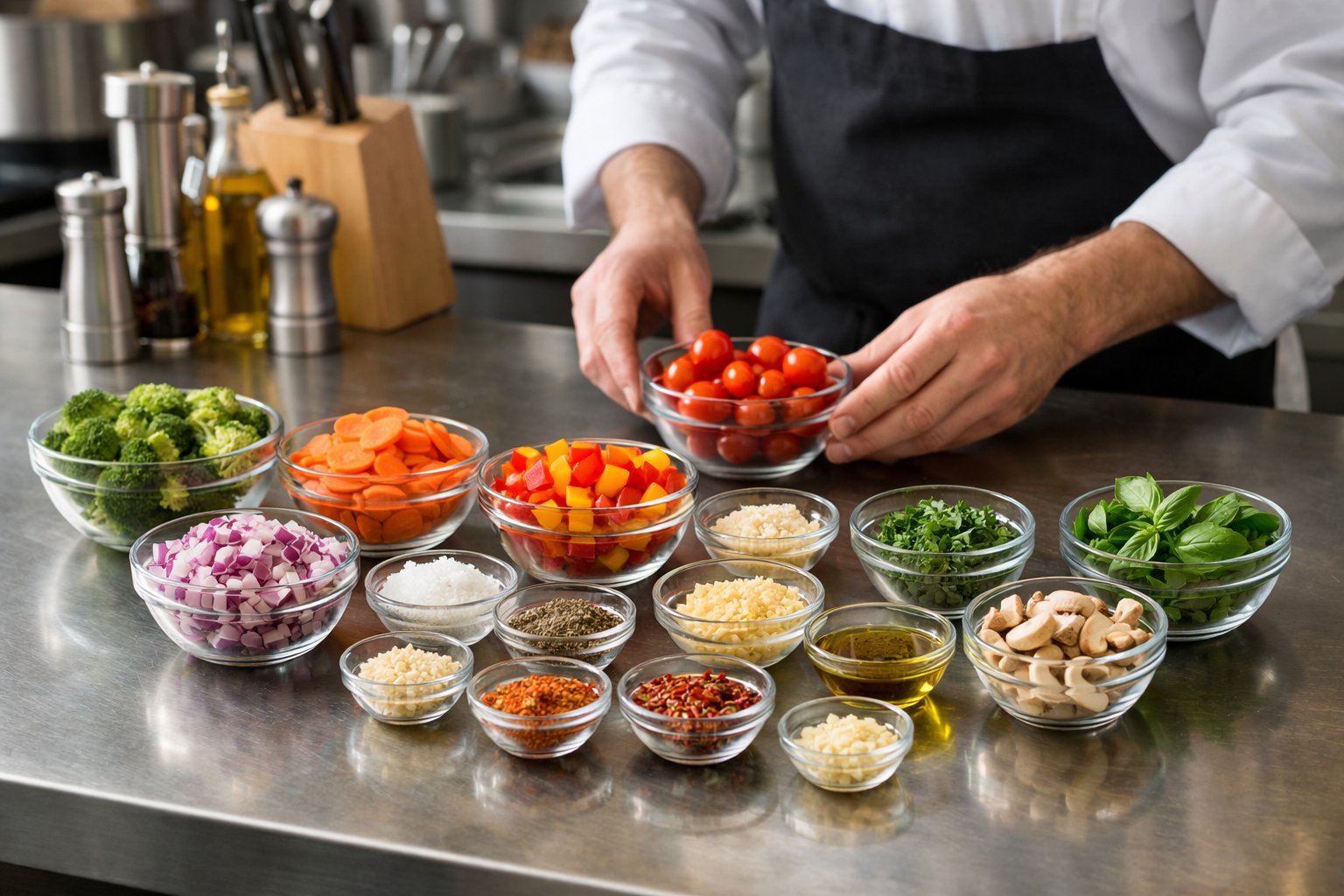
Pros live by mise en place—everything prepped, measured, and placed before cooking. No mid-recipe panic, just steady flow.
They set up zones for different tasks: one for chopping and measuring, another for cooking, and a third for plating and cleanup.
Keeping go-to items like salt, oil, and spices within arm’s reach matters more than any fancy storage system. If it’s used daily, it stays by the stove.
What's the recipe for a kitchen layout that mixes up efficiency and functionality?
The best layouts put the prep area close to both the fridge and the stove. Fewer steps between storage and cooking surfaces make a big difference.
Counter space is sacred—we keep a section clear just for prep, no appliances or clutter allowed.
Storage is based on how often we use things. Everyday ingredients go in the easiest spots, while specialty items live higher up or deeper in drawers.
How does one spice up their kitchen workflow by grouping ingredients like a culinary wizard?
We batch similar ingredients based on when they go into the dish. Stuff for the flavor base—onions, garlic, ginger—shares a container, ready to hit the pan first.
We also group by temperature. Cold ingredients that need to warm up sit together on the counter, while things that must stay chilled stay grouped in the fridge until the last minute.
For complicated recipes, we gather all the components on one tray or in one section so nothing gets missed or added at the wrong time.
In what ways does a thoughtfully crafted menu simmer down the chaos during a kitchen rush hour?
A planned menu lets us prep shared ingredients once for several dishes. If three recipes need diced onions, we chop them all at once instead of pulling out the cutting board again and again.
We stagger dishes that use different equipment—one bakes, one simmers, one chills—so nothing gets in the way.
Knowing what’s up next helps us prep the next dish’s ingredients while the current one cooks. That overlap keeps us moving and cuts out wasted time.
Got any fresh tips on maintaining an ingredient-oriented kitchen without stirring up a mess?
We put things back where they belong right after using or measuring them. Sounds obvious, but it actually keeps piles from forming on the counter and makes the next round of cooking less of a hassle.
Every week, we do a quick check of what’s in stock. Older stuff gets moved to the front, and any new groceries go behind. That way, nothing gets forgotten and wasted in the back of the pantry.
Honestly, small containers and labels make a huge difference. We portion out spices and other go-to ingredients into clearly labeled containers that fit neatly in drawers. It’s way easier to see what you have, and you’re not digging around for that one jar hiding in the shadows.
Share:
Why Overfilled Storage Leads to Daily Kitchen Stress
How Storage Visibility Prevents Overbuying Groceries