

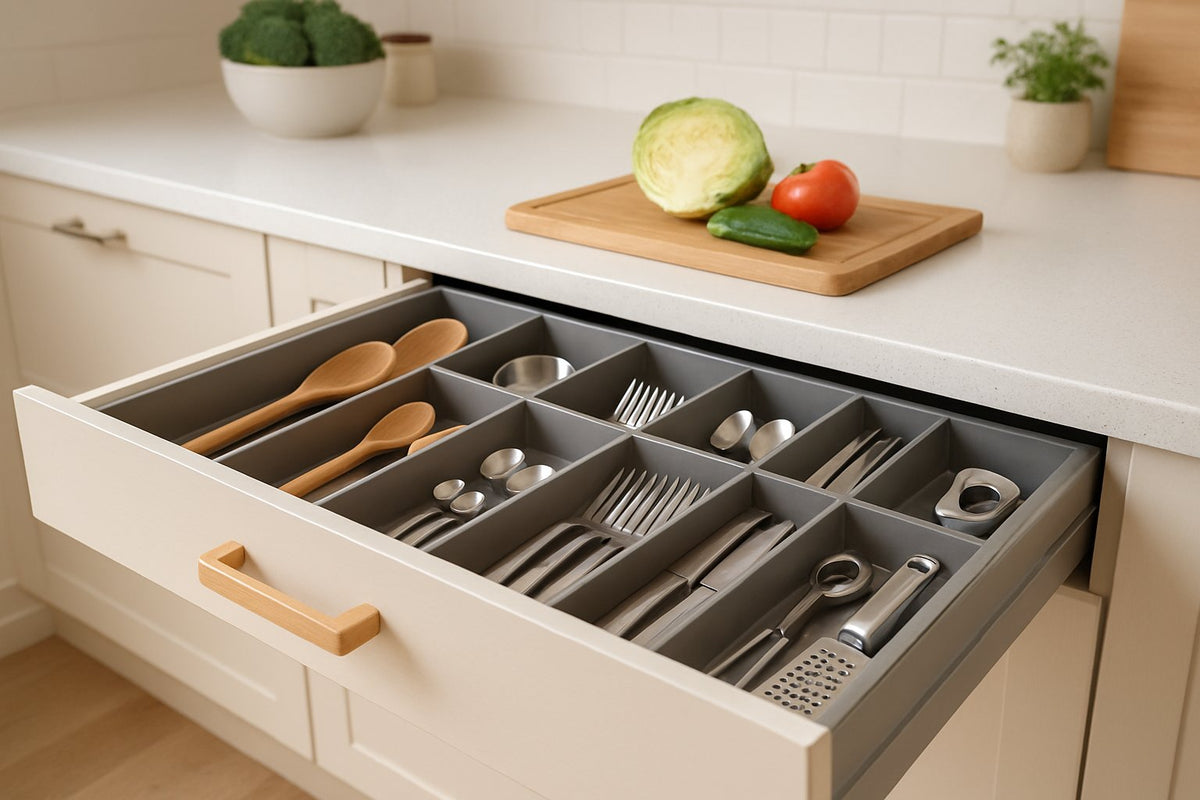
Kitchen drawers somehow become chaotic catch-alls—spatulas tangled with twist ties, mystery utensils you swear multiply overnight. We’ve all been there, rooting through the mess while something sizzles on the stove.
The most effective way to organize kitchen drawers is to group similar items together using dividers or organizers that fit your drawer size, keeping your go-to tools handy and stashing specialty gadgets in their own zones.
You don’t need fancy systems or a full kitchen makeover to get your drawers under control. Adjustable dividers, vertical organizers, and stackable containers can turn even the messiest drawer into something you’ll actually want to open. The trick? Match your organization style to what you store and how you cook.
Let’s get into some practical strategies for real kitchens, whether you’re wrangling silverware or those deep drawers that seem bottomless. Limited space? Sick of hunting for a can opener? There are ways to make drawers work for you instead of against you.
Key Takeaways
- Pull everything out, ditch what you don’t use, and measure before buying organizers
- Use dividers or compartment systems to group like items and make the most of vertical space
- Keep things organized by putting items back where they belong and checking in every few months
Essential Steps Before Organizing Kitchen Drawers
Before you start dropping in dividers and containers, there are a few basic steps that make organization actually stick: emptying out the drawers, sorting what you use, grouping similar things, and giving everything a solid clean.
Decluttering for a Fresh Start
First things first: take everything out. Yup, everything. Only then can you see what’s lurking in those corners.
Sort what you find into three piles: everyday essentials, specialty stuff you use now and then, and things you barely touch. Essentials earn the best spots. Specialty items—think holiday cookie cutters or that fondue fork—can live in less accessible drawers.
Here’s what usually stays up front:
- Cooking utensils: spatulas, wooden spoons, whisks, tongs
- Eating utensils: the forks, knives, and spoons you grab daily
- Prep tools: can opener, peeler, measuring spoons
- Grab-and-go: bottle opener, scissors, pot holders
If you haven’t used that garlic press in two years, maybe it’s time to donate it. There’s no point organizing stuff you never touch.
Grouping Items by Category
After you’ve ditched the extras, group what’s left by how you actually use it. This isn’t just about looking neat—it’s about making things easier when you’re busy.
Think about how you cook. Maybe you want a “cooking zone” for spatulas and tongs, a “prep zone” for knives and peelers, or a baking station. Stuff you use together should live together.
Example categories:
| Category | Items |
|---|---|
| Cooking Zone | Spatulas, ladles, tongs, pot holders |
| Prep Zone | Knives, peelers, cutting boards, measuring tools |
| Baking Station | Whisks, pastry brushes, cookie cutters, piping bags |
| Storage Tools | Bag clips, twist ties, foil, plastic wrap |
Consider workflow too. If you always reach for certain tools at the stove, keep them close by. This isn’t just about organizing—it’s about making your kitchen work for you.
Cleaning and Prepping Drawers
With drawers empty, give them a real clean. Wipe out crumbs, use a cleaner, and let them dry before putting anything back.
This is a good time to add drawer liners. Liners keep things from sliding around and make cleaning easier next time. Adhesive liners stay put, while non-slip mats can be pulled out and washed.
Check the drawer slides while you’re at it. If something sticks or wobbles, fix it now—it’ll save you grief later.
Choosing the Right Drawer Organization System
What you store, how much space you have, and how often you shuffle things around all affect which organizer works best. Let’s look at the main types and what makes them tick.
Types of Drawer Dividers for Kitchen Drawers
There are a few main styles. Fixed dividers are great for utensils and cutlery if you know exactly what goes where—usually those plastic or bamboo trays with set compartments.
Adjustable dividers offer more wiggle room. Spring-loaded or pegged, they let you make custom sections for odd-shaped tools or if your collection changes.
Modular systems are the most flexible. Separate bins or boxes you can move around, stack, or swap out anytime.
Expandable dividers are kind of a hybrid. They stretch to fit your drawer and often have movable sections. Handy if you’re renting or might move someday.
Customizable Solutions: Expandable Trays and Inserts
Expandable trays stretch from about 12 to 18 inches, so you can get a snug fit—no wasted space at the sides. Just pull the sides out until they’re tight.
Modular inserts let you build your own setup. Start with a base tray, then add bins for spices, clips for bag ties, or tall sections for shears. If your needs change, just swap out pieces.
Combination sets come with bins of different sizes that nest together. Use bigger ones for measuring cups, smaller for gadgets. Rearranging is easy—no commitment to one layout.
Some systems have both horizontal and vertical dividers, which works well in deep drawers. You can keep everyday stuff on top and stash backup or seasonal tools below.
Selecting Materials: Bamboo, Acrylic, and More
Bamboo dividers are sturdy, resist moisture, and look sharp in modern kitchens. They’re also eco-friendly if that’s your thing.
Acrylic or clear plastic makes it easy to see what’s inside. Lightweight and usually dishwasher-safe, though cheap plastic can crack or warp—especially near heat.
Metal dividers (think stainless steel or aluminum) are tough and last ages. They’re great for heavy-duty use, but can be noisy when you grab metal utensils.
Wood dividers—not just bamboo, but maple, oak, pine—feel solid and classic. They might need a little upkeep to stay smooth, and are best away from sinks to avoid water damage.
Bamboo and decent plastic usually hit the sweet spot for price and durability.
Organization Techniques for Every Drawer Type
Different drawers call for different tricks. Let’s hit the big ones: utensils, deep cookware drawers, spices, and the never-ending Tupperware lid mess.
Utensil and Cutlery Drawer Solutions
A cutlery tray is the backbone of any utensil drawer. Go for one with at least five slots—forks, knives, spoons, serving utensils, and small tools each get their own spot.
Typical setup:
- Front: Daily forks, knives, spoons
- Back: Serving spoons, tongs, specialty stuff
- Sides: Steak knives, butter knives, little gadgets
Expandable trays are great if your drawer size changes or you need space for guests. They usually stretch from 12 to 18 inches.
If your drawer is deep, try stackable organizers. The top holds what you use most, the bottom stashes backups or seasonal tools. Bamboo ones stay put better than plastic.
For shallow drawers, just stick to the essentials. Most of us only really need 8-12 of each utensil for daily use.
Organizing Deep Drawers for Cookware and Bakeware
Deep drawers are perfect for pots, pans, and baking sheets—if you stand them up. Tension rods or adjustable dividers keep things upright and scratch-free.
Why vertical storage rocks:
- Uses 40-50% less space than stacking
- No more lifting five pans to get one
- Non-stick surfaces stay scratch-free
- You can grab what you need faster
For pot lids, tension rods at the back hold them up. It works for lids from 8 to 12 inches, and bigger ones can lean on the side.
Baking sheets and cutting boards fit nicely in pegboard-style systems with adjustable pegs.
Stash pot holders and trivets in a bin at the front so they don’t get lost under heavy stuff.
Spice Drawer and Spice Rack Integration
A spice drawer clears up cabinet clutter and puts everything in view. Transfer spices to matching jars and label the tops for quick scanning.
Tiered inserts or angled risers make it easy to see everything at once. Back rows sit higher, so you’re not shuffling bottles to find what you need.
Label ideas:
- Top labels for drawers
- Side labels for cabinets
- Color dots for cuisine types
- Write expiration dates with a marker
Arrange spices alphabetically or by how often you use them. Everyday stuff—salt, pepper, garlic powder—goes up front. Rarer spices hang in the back.
If you’ve got a lot of spices, pull-out drawer organizers are a lifesaver. They let you reach the back bottles without knocking over the front ones.
Managing Tupperware and Food Storage Lids
The lid-and-base separation is the bane of container storage. Nest bases together, and keep matching lids in a bin or section nearby.
Three methods that actually work:
- Vertical lid storage: Tension rods or file organizers stand lids up
- Drawer dividers: Make spots for small, medium, and large lids
- Lid racks: Use racks made for plastic lids by size
Only keep containers you actually use. If you haven’t touched one in three months, it’s just taking up space. Most kitchens do fine with 3-4 containers per size.
For lids, a shallow bin with dividers keeps them from avalanching. Flat lids in one section, domed in another.
Square and rectangular containers nest better than round ones. Switching to square saved me about 25% more space—and they fit better in the fridge, too.
Maximizing Space and Accessibility
Good drawer organization turns wasted space into storage you’ll actually use. Vertical dividers, hidden compartments, and smart zoning put what you need right where you want it.
Utilizing Vertical Organizers
Vertical organizers make deep drawers usable. Pegboard systems let you move pegs around to fit whatever you’re storing—utensils, cutting boards, baking sheets—all standing up instead of stacked.
Adjustable dividers are a game-changer for pots, pans, and lids. Stand each piece on its edge, and you’ll never have to dig again. It saves time and keeps things from getting scratched.
Stackable risers add a second level inside deep drawers. Big stuff goes on the bottom, everyday tools on top. You basically double your space without a bigger drawer.
For utensils, angled organizers let you see everything at a glance. No more digging for that one spatula buried at the back.
Hidden Storage Solutions Inside Drawers
Hidden storage makes the most of every inch inside kitchen drawers. False bottoms create secret compartments—great for stashing specialty tools we only grab now and then but don't want cluttering up our main space. Just lift out the top tray, and you'll find things like cookie cutters, meat thermometers, or backup measuring spoons underneath.
Toe-kick drawers make use of that odd 4-inch gap under base cabinets, which usually just collects dust. Slide one out and you've got a shallow spot for baking sheets, cutting boards, or placemats.
Pull-out drawer inserts with tiered layers act like stadium seats for spice jars and little containers. Each row sits a bit higher than the one in front, so you can actually read all the labels without shuffling things around. Some setups have bins that pop out, making it easier to grab stuff hiding in the back.
Corner drawer organizers tackle those weird wedge-shaped spaces in corner cabinets. Pie-shaped inserts or spinning lazy susans mean things don't disappear into the abyss you can't reach.
Zoning Drawers for Daily Efficiency
Zoning means giving each drawer a job based on how we move around the kitchen. Prep tools hang out near the cutting board, cooking utensils live by the stove, and serving pieces stay close to where we dish up food. This setup cuts down on pointless wandering when we're in the middle of making dinner.
Common zoning categories:
- Prep zone: Measuring cups, mixing spoons, peelers, graters
- Cooking zone: Spatulas, tongs, ladles, wooden spoons
- Baking zone: Rolling pins, pastry brushes, cookie cutters, piping bags
- Serving zone: Serving spoons, cake servers, wine openers
Inside each drawer, we corral similar items with bins or dividers. All the whisks go together, spatulas in their own spot, and so on. Micro-zoning like this keeps things from turning into a jumbled mess after washing up.
We stash everyday essentials in the easiest-to-reach drawers—right around waist height. The stuff we barely use gets relegated to the bottom or way up top. If we use something all the time, it deserves the best real estate.
Maintaining an Organized Kitchen Drawer System
Getting drawers organized is one thing—keeping them that way is a whole other challenge. It really comes down to habits and tweaking the setup as life changes.
Routine Upkeep and Quick Resets
Drawer maintenance should slide into our regular kitchen routine, not just wait for chaos to take over. The simplest trick? Put things back where they belong right after use. It barely takes a second, but it stops clutter from creeping in.
A quick weekly reset helps too. Spend five minutes per drawer—pull out anything that wandered in, straighten up dividers, wipe down crumbs. Small messes don't get a chance to snowball.
Once a month or so, it's worth digging a little deeper. Check for broken organizers, things that migrated from other drawers, or tools we never actually use. Tossing just a couple of unnecessary items each month keeps things lean and useful.
Weekly maintenance checklist:
- Put stray items back where they belong
- Nudge dividers back into place
- Clear out crumbs and junk
- Toss or fix broken tools
Adapting Your Organization for Changing Needs
Our cooking habits and gadgets shift, so our drawer systems should too. If we keep hunting for the same thing or avoiding a certain drawer, that's a sign the setup needs a rethink.
Life changes—new appliances, a different diet, more people in the house—mean different stuff needs to be handy. Don't be afraid to swap drawers around or rearrange dividers to match what's actually happening in the kitchen.
Seasons matter too. Maybe in December, holiday baking tools move up front, then in summer, grilling gear takes their place. Rotating things keeps the stuff we use most within reach, without needing more space.
Honestly, the best system is the one that works for us right now—not whatever seemed perfect last year.
Incorporating Kitchen Design and Aesthetics
Organized drawers shouldn't fight with your kitchen's look. It's worth matching drawer systems to cabinet finishes and color schemes so everything feels put together but not showy.
Blending Organization with Kitchen Style
We try to pick drawer organizers that vibe with the rest of the kitchen. Bamboo inserts just look right with warm wood cabinets, and those clear acrylic dividers fit in with sleek, modern spaces.
Color matters more than you'd think. White or light organizers brighten up dark drawers, while darker woods add some coziness to modern kitchens. If you've got glass-front cabinets, hardware-free organizers keep things from looking cluttered.
The goal? Pick organizers that echo your cabinet's finish. White-painted cabinets? Stick with white dividers. Natural wood? Go for matching or complementary wood organizers—they look like they belong, not like an afterthought.
Open Shelving and Drawer Coordination
Open shelving changes the drawer game a bit, since what's on display sets the tone. We try to match the vibe—if open shelves have glass jars or ceramic containers, we use similar bins in the drawers for a sense of flow.
If you’ve got metal baskets on display, metal drawer dividers make sense. Woven baskets? Bamboo or rattan inserts. The handoff between open and closed storage should feel intentional.
We keep the daily-use stuff on open shelves, and stash backup supplies in drawers using the same style containers. That way, the kitchen feels pulled together, not random.
Frequently Asked Questions
Organizing kitchen drawers brings up plenty of practical questions. Here’s what we’ve figured out along the way.
What are some clever ways to maximize space in small kitchen drawers?
Vertical storage is a game changer in tight spots. Dividers let us stand up cutting boards, baking sheets, and lids instead of stacking them. That way, you can see and grab what you need without digging through a pile.
Adjustable dividers help us customize each drawer. They stop small tools from sliding around and make the most of every inch. Rolling dish towels and napkins instead of folding them flat also saves space and makes everything easier to spot.
Nesting items together frees up more room—measuring cups and spoons just fit inside each other, and small boxes help wrangle loose odds and ends like bag clips and twist ties.
Can you give tips for organizing deep kitchen drawers so everything is easy to reach?
Layered organizers can turn those deep, cavernous drawers into something actually usable. Try tiered inserts or stackable containers—just pop the stuff you reach for all the time on top, and tuck the specialty gadgets underneath.
Stash the heaviest, least-used things at the bottom. Mixing bowls, serving platters, those random appliances you swore you'd use more—let them hang out down there. You probably don't mind moving a couple things when you really need them.
It helps to group by task, too. Maybe one section for baking gear, another for cooking utensils. That way, you're not rooting around through a mess of unrelated stuff every time you need a spatula.
Share:
Creating a Clean Kitchen Aesthetic with Matching Storage Containers
How to Store Fruits and Vegetables to Keep Them Crisp