

Check out our latest golf collection!
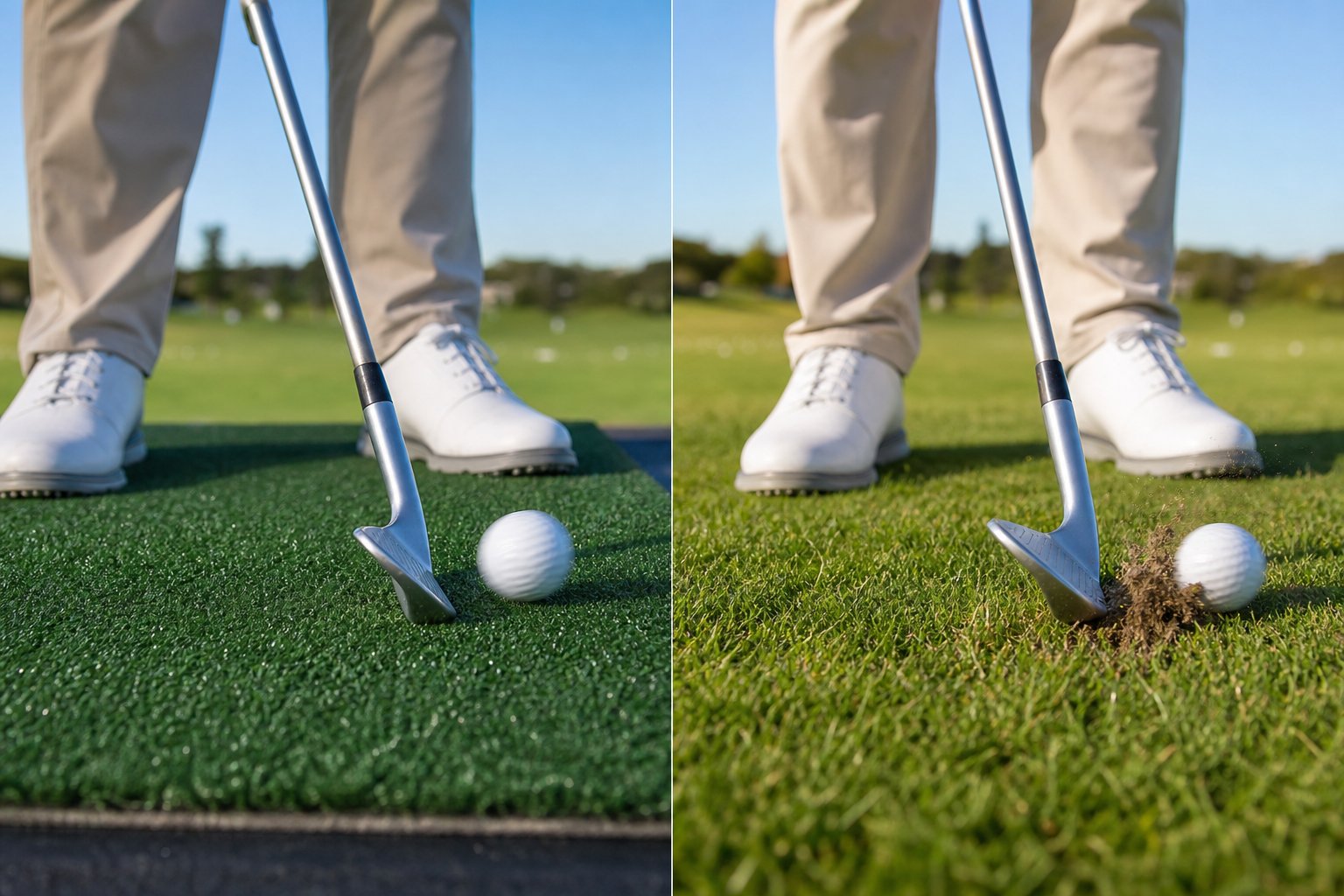
Your chipping surface can make a good shot feel real, or make a bad shot look better than it is. The main difference between chipping on turf mats and grass shows up at impact: mats do not let your club interact with the ground the way grass does, which can hide fat shots and change how contact feels. That affects feedback, spin, launch, and distance control.
You do not need to avoid mat practice. You just need to know what it teaches, what it hides, and when grass practice matters most. In this guide, you will learn how mats and grass change impact, launch, spin, feedback, and your short game practice plan.
Key Takeaways
- Turf mats bounce the club through impact instead of letting it dig, so fat contact gets hidden and feedback isn’t as real
- Grass gives you true ground interaction and spin, which translates directly to on-course chipping
- Good practice means knowing what each surface can’t do and adjusting your setup to build a reliable short game
How Hitting Surfaces Affect Chipping Impact
What you chip from changes how your club meets the ground, how the ball reacts, and if you get honest feedback about your swing.
Differences in Ball Striking
Chipping off natural grass gives you real resistance. You can feel when you strike it clean or heavy. If you hit it a bit fat, the club digs and the shot comes out totally different.
On a mat, you don’t get that. The firm, bouncy surface lets the club skip into the ball, even if you hit behind it. You might think you made solid contact, but on grass, that swing would chunk.
We’ve noticed that ball striking on mats looks cleaner than it actually is. The club just slides across the surface, not digging into soil or roots. This can give you a false sense of security with your technique, since you’re not getting real info about your angle of attack or where the club bottoms out.
Interaction with the Hitting Surface
Grass compresses and gives way when your club comes in, adding friction and resistance. You have to work through blades, roots, and dirt, which actually teaches you to keep accelerating through impact.
Mats act differently. Most have a rubber base that bounces the club instead of resisting it. Your club can just glide, and you get away with more mistakes.
We also feel the difference in footwork. Mats don’t grip your shoes like grass does, so sometimes your feet slide, especially if the mat’s a bit wet. Grass handles that much better.
Club-Soil vs Club-Mat Contact
On grass, you want the club’s leading edge to hit the ground after the ball. You’ll feel it brush or nip the turf, maybe take a small divot or just compress the grass. That feeling tells you you’re on the right track.
On mats, you lose most of that feedback. The club hits a fake surface, and the sensory info just isn’t the same. The sound changes too. It is more of a dull thump than the crisp “whip” you get from grass.
The rubber underneath most mats can also jar your wrists and elbows, especially with wedges. That kind of shock doesn’t happen on grass, which just absorbs the energy.
Effect on Divots
Chipping from grass, you expect some turf interaction. A good chip leaves a little divot or brush mark, showing your club’s path and depth. These patterns give you clues about your swing.
Mats don’t give you any of that. Every shot leaves the surface unchanged. You can’t check your low point or confirm ball-first contact.
And since mats never change, you never get to practice from different lies. Grass always gives you a new look, which is way more like what you’ll face on the course.
Chipping Technique and Swing Mechanics on Turf Mats
Turf mats change how you chip because the surface is forgiving and the club interacts differently. The bounce under synthetic mats changes your feedback and can hide swing flaws that grass would call out right away.
Forgiveness and Masking of Fat Shots
The rubber or foam under most mats makes them forgiving. If you hit behind the ball, the club usually bounces through and still makes decent contact. That same swing on grass would be a disaster.
We’ve noticed it’s harder to tell when you’re hitting behind the ball on a mat. On grass, a fat shot feels heavy, goes nowhere, and sometimes doesn’t even reach the green. On mats, you might get 70-80% of your distance, and the ball flies okay.
The sound is a giveaway. Ball-first contact gives a “click then thump,” while a fat shot is more “thump then click.” Listening for that helps spot issues, even on mats.
Adjustments in Swing Path
When you hit off mats, you don’t need to be as precise with your angle of attack. The surface is so forgiving, you can get away with a steeper swing that would dig into grass and ruin the shot.
A lot of golfers who mostly practice on mats develop a sweeping motion. It works on synthetic turf but falls apart on real grass, where you need to hit down just a bit. So, even on mats, keep that slight downward strike to build skills that transfer.
Slippery mats also mess with your stance. Sometimes your feet slide, especially on old or wet mats, which throws off your weight shift and how you deliver the club.
Developing Good Habits
On mats, focus on your swing fundamentals, not just where the ball goes. Since feedback is off, don’t trust every result you see. Work on your setup, keep your weight forward, and lead with your hands through impact.
Video helps a lot with mat practice. Since mats hide mistakes, watching your swing is the best way to check if your path and wrist angles are right.
Shorter, focused practice sessions work better on mats. You can hit balls quickly without hunting for fresh grass. This helps with repetition and muscle memory, as long as you’re working on the right moves.
Risk of Injury
The hard base under mats sends more shock up your hands, wrists, and elbows than grass does. You’ll feel it more if you do long sessions or practice on mats several times a week.
It’s especially obvious when you hit fat shots. Even with the mat’s forgiveness, the jarring sensation goes right up the shaft. Over time, this can cause discomfort or flare up old joint issues.
Take breaks, limit how many balls you hit, and pay attention to any pain. If something hurts, stop and adjust.
Chipping Technique and Swing Mechanics on Natural Grass
Natural grass gives you instant, honest feedback about your impact. The turf shows you where your club hit and whether you made clean contact.
Feedback from Divots
Every chip on grass leaves a mark. The divot tells you exactly where the club hit and how steep your swing was.
A good chip leaves a shallow divot starting after the ball. If you see deep gouges or divots before the ball, you’re hitting fat. You just can’t get this info from mats.
The sound and feel of clean contact on grass is easy to recognize. You hear a crisp click as the clubface compresses the ball. Fat shots sound dull and feel heavy.
Grass also shows your swing path. Divots angled left mean an out-to-in path. Right-leaning divots mean in-to-out. This visual feedback helps you adjust as you practice.
Developing Consistent Impact
Grass demands precision because it won’t bail you out. You’ve got to keep your hands ahead through impact for ball-first contact.
The turf’s resistance teaches you to transfer your weight forward. Hanging back leads to chunky chips. Grass practice forces you to shift forward and keep that shaft lean.
We see that golfers who practice on grass control distance better. The turf affects spin and launch in ways that match real course conditions. When you chip on grass, the ball reacts after landing just like it will out on the course.
Adapting to Varied Lies
Grass gives you the uneven lies you’ll face during a round. Sometimes the ball sits down in rough, sometimes it’s on a tight lie, or maybe it’s in a little depression.
These conditions force you to adjust your setup and swing. A ball sitting down needs a steeper approach and maybe more loft. Tight lies require perfect contact.
Practicing on grass lets you experiment with ball and hand positions for different shots. You’ll learn when to move the ball back for a low chip and when to open the face for loft and spin.
Ball Flight, Spin, and Distance: Mats vs Grass
Chipping from mats versus grass changes launch angle, spin, and distance more than you’d expect. The mat’s firm surface and lack of friction alter the club’s impact with the ball, so your ball flight just isn’t the same as it will be on the course.
Changes in Launch Angle
Chipping off mats bumps your launch angle up by about 1 to 2 degrees. The bouncy rubber base makes the club skip or bounce, adding loft even if your swing stays the same.
On grass, the club interacts naturally, compressing the turf and giving you a more neutral or even slightly lower launch, depending on how firm the ground is. Firm grass gives the truest feedback, while soft grass lets the club dig a bit, which can lower your launch.
We’ve seen beginners get a steeper angle of attack on mats to fight the bounce. When they move back to grass, that steep swing leads to chunks or thin shots because the ground won’t forgive like a mat does.
Differences in Spin Rate
Spin drops by about 1,000 rpm when you chip from mats. That’s a big drop, and it changes how the ball reacts after landing. Mats are smoother and reduce friction, so the clubface can’t grip the ball the way grass blades do.
A couple things cause this. Mats don’t let the clubface pinch the ball against uneven ground like grass does. Plus, you might subconsciously change your swing, knowing you’re hitting a hard surface, which leads to a cleaner but less spinny strike.
Grass creates friction through the blades. The ball climbs up the face differently, generating more backspin because there’s more grip.
For practice, this means shots that check up fast on grass will roll out more from mats. We suggest aiming for landing spots a little farther from the pin when you’re on mats, just to mimic real rollout.
Distance Control and Mat vs Grass Distance
Mat versus grass distance often throws golfers off, especially when a higher launch and lower spin combo sends the ball flying farther than you’d expect. You might chip a ball 12 metres on the mat, but then watch it only carry 10 metres off grass with what feels like the same swing.
Less spin means less air drag, so the ball stays up a bit longer before dropping. And once it lands? That same lack of spin lets it roll out more than you’d ever see with a wedge shot spinning properly on grass.
Distance control really takes a hit in the scoring zone. Golfers who stick to mats for practice often struggle with touch around the greens on the course. They’ve gotten used to the ball carrying and rolling farther than it does on real turf.
Mats are pretty forgiving, too. They hide fat shots that would lose a ton of distance on grass. You might walk away thinking you hit a solid chip, when in reality the club smacked the mat first, bounced into the ball, and somehow produced an okay shot.
Effect on Ball Speed
Ball speed stays about the same between mats and grass if you hit the centre. But mishits? That's where things change. The mat’s rubber base lets the club glide through impact, even on fat shots, so ball speed doesn’t drop off like it does on grass.
This can mess with your practice. If a slightly heavy chip still comes off the mat with decent speed, you don’t get that immediate feedback you need to fix your strike.
Grass tells the truth. Hit it fat by even a quarter-inch and you’ll lose both speed and distance. That honest feedback helps you find the right bottom of your swing. Mats just don’t offer that. They let the club bounce through, preserving more ball speed even when your contact isn’t great.
A launch monitor helps a lot when you’re chipping on mats. It shows you the real story, even when your eyes or feel might miss a drop in contact quality.
Consistency and Realism in Short Game Practice
Chipping mats give you the same surface every time, while grass brings all the unpredictable conditions you’ll actually see on the course. The surface you use in practice shapes how well your skills transfer to real play.
Year-Round Accessibility
Chipping mats keep your short game sharp no matter the weather, season, or how much daylight you’ve got. Especially in winter or rain, when grass practice areas turn to mud or close altogether, a mat becomes a lifesaver. Honestly, most golfers don’t realize how much the convenience matters until they try it.
A good mat in your garage or basement lets you sneak in 15 minutes of practice before work or during lunch. More practice beats perfect conditions for most folks. With grass, you need to drive to a facility and hope the short game area’s open.
But here’s the thing: grass changes with moisture, firmness, and how long it’s been since the last mow. You have to adapt, and that’s what builds real course skills. Mats erase those challenges, so they’re great for basic mechanics but not for developing touch or adaptability.
Feedback and Realistic Conditions
Grass shows your swing flaws right away. Hit behind the ball and the club digs in, leaving your shot short. Mats let the club bounce through fat contact, so you get a result that looks decent, but it would not happen on the course.
The biggest difference? How the club interacts with the ground after contact. Grass gives you honest feedback about your angle of attack and where the club bottomed out. For chipping, that’s huge. Crisp contact is what separates good shots from chunks or blades.
Mats can also cut spin by up to 1,000 rpm compared to grass, which changes how your shots behave on the green. If you mostly practice on mats, expect your chips to check up more when you finally play on grass.
Impact on Practice Setups
The best practice routine uses both surfaces when you can. Mats are perfect for working on mechanics and getting lots of reps without worrying about ground conditions. Save grass sessions for fine-tuning distance control, spin, and shot variety.
Mix it up like this:
- Use mats for mechanics and consistency drills
- Practice on grass for pre-round warmups and feel
- Rotate between both to stay adaptable
You’ll get more out of your range time if you know what each surface teaches. Mats build confidence and let you practice a ton without wearing yourself out. Grass tells you the truth about your contact and gets you ready for the random lies you’ll face on the course.
Choosing Between Mats and Grass for Home and Range Practice
Mats shine when you’re building confidence or making swing changes. Grass gives you the feedback you need before a round. Mixing both into your practice keeps your contact consistent but doesn’t let you lose touch with real course conditions.
When to Use Driving Range Mats
Hit off mats when you’re working on swing mechanics or changing tempo. The forgiving surface lets you focus on your movement without worrying about chunking shots. That mental boost matters more than most people think.
Mats are also handy for quick practice. No need to hunt for a good lie or move around as the turf gets chewed up. You can zip through a session, which is perfect if you’ve only got 20 minutes.
Mats are great for:
- Learning new chipping techniques
- Rebuilding confidence after a rough round
- Practicing in wet or bad weather
- High-rep drills
The main downside is feedback. Mats hide fat shots because the club bounces off the base instead of digging in. You’ll hear a thump before the click, but the ball might still fly okay. If you’re not careful, this can reinforce bad habits.
Best Times to Practise Chipping on Grass
Get on grass at least a few days before you play. The way your wedge interacts with real turf just can’t be faked by a mat. You need that honest feedback to fine-tune your short game.
Grass practice is key for distance control and spin. Mats can drop spin by up to 1,000 rpm and bump launch up by a degree or two. That totally changes how your chips behave when they land.
Grass conditions also change every time you go out. Sometimes the ball sits up, sometimes it’s buried. Firm ground isn’t the same as soft ground. These differences force you to adjust, and that’s what makes you a better player.
Focus on grass when:
- Fine-tuning trajectory and spin
- Prepping for tournaments
- Working on bump-and-run shots
- Diagnosing contact issues
Maintaining Your Hitting Surface
If you’ve bought a good hitting mat for home, rotate your hitting spots to make it last. Mark a few different areas with tape so you’re not hammering the same 15-centimetre patch every time.
Check the rubber base on your mat every month. If it gets compressed or starts separating, the club will bounce differently, and you’ll get weird feedback. Mats with drainage stop that slippery feeling underfoot, too.
At the range, spread out your divots. Don’t chip from the same spot over and over. It trashes the turf and gives you worse lies as you go. Take a few steps between shots.
If you have a grass chipping area at home, mow it to fairway height instead of leaving it long. That matches what you’ll see on most approach shots during a round.
Frequently Asked Questions
Chipping from a mat or grass changes feedback, contact, spin, and distance control. Here are the key differences to know.
How does the club interact with a turf mat versus real grass when you hit a chip shot?
A mat lets the club bounce or glide through impact, while grass gives more resistance. Grass makes heavy contact easier to feel because the club can dig into the turf.
Will a turf mat hide chunked chips and make my short game look better than it really is?
Yes. Mats can hide fat shots because the club may skid into the ball after hitting behind it. On grass, the same strike usually loses speed and distance.
What type of chipping mat feels closest to real turf for practising impact and contact?
Choose a mat with short, dense fibres and a firm base. It should give enough resistance to feel mishits without creating too much bounce.
How do different mat fibres and pile heights change bounce and leading-edge behaviour on chips?
Longer fibres add cushion and forgiveness. Shorter, stiffer fibres give more realistic resistance and make it easier to notice poor contact.
Should I change my setup or ball position when practising chipping off a mat compared to grass?
No. Keep your setup close to your on-course technique. Use the mat to practise ball-first contact, not a swing that only works on synthetic turf.
What practice drills help you transfer clean contact from a mat to real-course lies?
Place a towel a few centimetres behind the ball and avoid hitting it. Also listen for ball-first contact, with the click before the club reaches the mat.
Share:
Chipping Net vs Putting Mat: Which Helps Beginners Improve Faster?
How to Practice Golf Chipping Accuracy at Home Without a Full Yard